Most people walk through Singalila National Park with their eyes fixed on the horizon. The sweeping Himalayan views, with the Sleeping Buddha range on one side and Everest on the other, make it one of India’s most celebrated trekking routes, drawing thousands of visitors to these mountains every year. We found ourselves looking in the opposite direction. Instead of distant peaks, our attention lingered on bamboo thickets, damp forest trails and the quiet signs of life hidden beneath our feet.
Our visit to Singalila was not just another trek. It was a preliminary reconnaissance (recce) survey that would guide the future red panda ecological survey. Before any field research could begin, it is important to understand the landscape itself. The recce became a lesson in slowing down, observing closely, and experiencing a familiar landscape in a completely different way.
Why walk before research?
The first morning began in Rimbik, where we fuelled ourselves with a warm bowl of taipo and soup before setting off on the 4 kilometre trek to Gurdum. Backpacks were checked one last time: camera traps, GPS, notebooks, water bottles, and enough warm layers for the unpredictable mountain weather. With everything in place, we took our first steps onto the trail, unaware of how quickly the forest would begin to reshape the way we looked at the landscape. Unlike the regular survey, our recce was not about recording data, it was to become familiar with the landscape, identifying potential survey routes and learning how the forest changes with every turn. It didn’t take us long to realise that this wasn’t going to be a walk measured in kilometres but in the moment of observation. Our journey would take us from Rimbik - Gurdum - Sandakphu - Molley - Ramam - Rimbik, over a week of walking through forests, ridges, and mountain settlements. Accompanied by forest guards, we let the landscape set the rhythm of our days. Every few minutes, something drew our attention- a dense patch of bamboo, a sudden change in vegetation, narrow animal trails disappearing into the thick forest understory, and the magical song of different birds. What might have seemed like an ordinary trail to most trekkers slowly unfolded into a landscape full of clues. Our pace was dictated by the forest; steep ascents demanded frequent pauses. The objective was not to reach the next viewpoint as quickly as possible, but to understand how the landscape unfolded beneath our feet. Each bend in the trail helped us build a mental map of the area. The recce allowed us to assess the access routes, recognise different habitat types, anticipate field challenges, and prepare for the work ahead.
What might have seemed like an ordinary trail to most trekkers slowly unfolded into a landscape full of clues.
Reading the forest
Walking through Singalila with forest guards changed the way we looked at the landscape. What first appeared to us as a continuous stretch of forest slowly unfolded into a mosaic of habitats, each with its own story. Years of patrolling these trails had trained the forest guards to notice details that we would have easily overlooked. With camera traps packed into our backpacks, we followed their guidance to locations that showed signs of suitable habitat.
Whenever we came across habitat that appeared suitable for red pandas, we left from the trekking trail into the forest. One of the clues we looked for was red panda pellets or droppings. While the red panda itself remained hidden, the fresh pellets hinted that the area had recently been used. Around these feeding sites, we searched for suitable trees to install and test our camera traps, hoping to capture future activity. Every indirect sign became another piece of the puzzle, helping us understand how the species moved through the landscape.
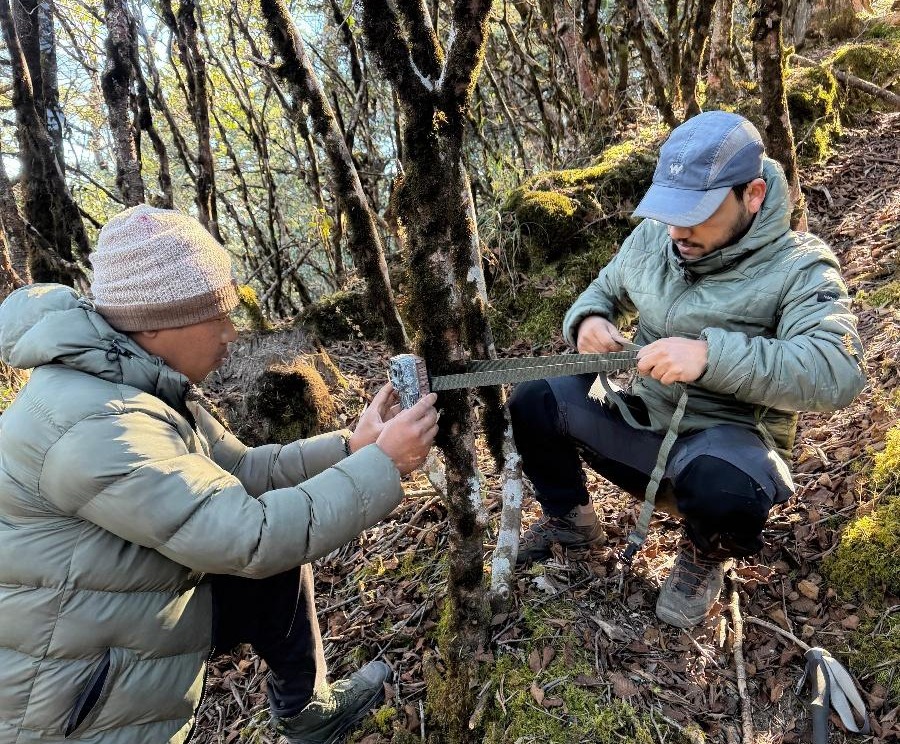
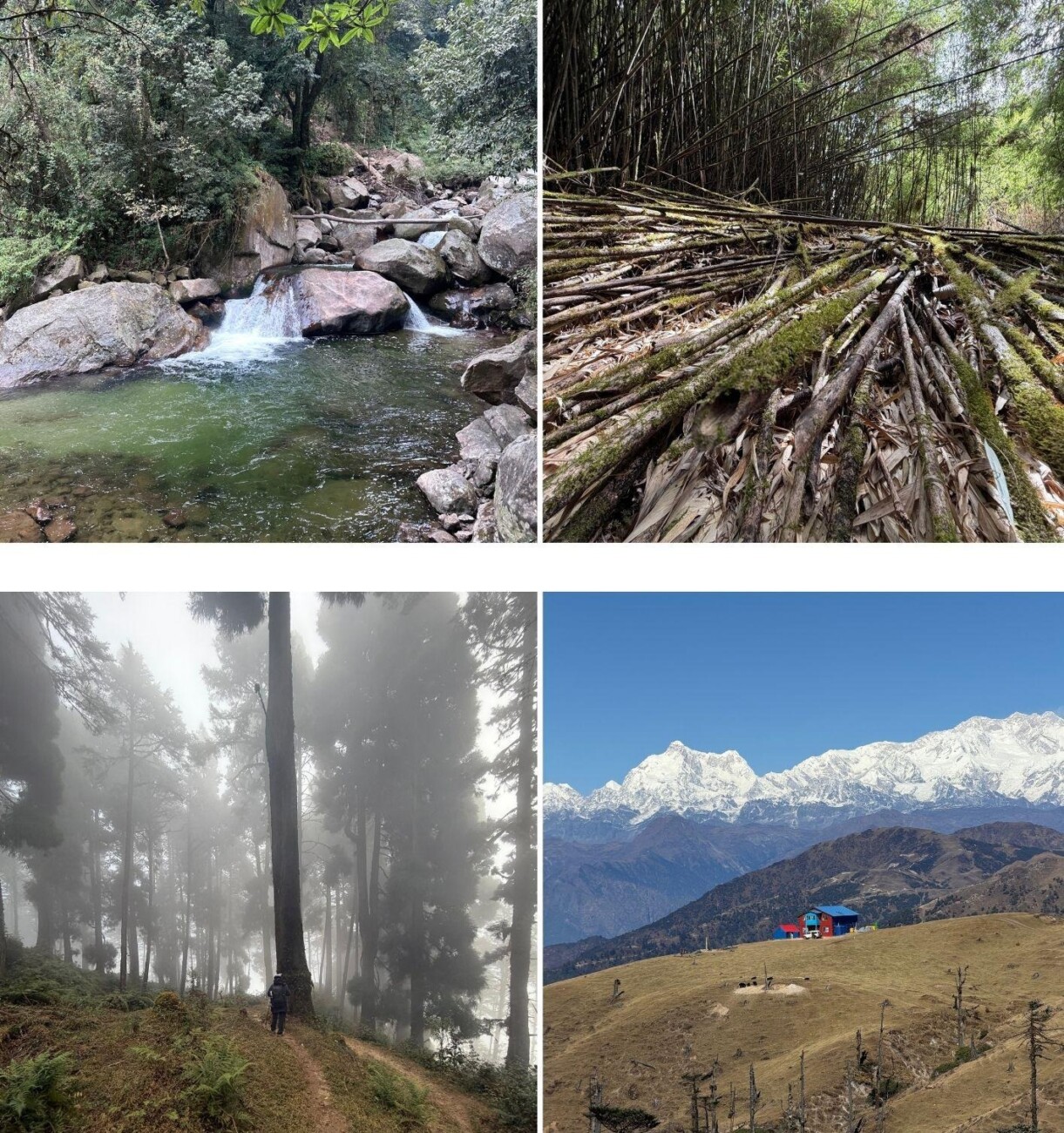
With every few kilometres, the forest seemed to reinvent itself. Dense bamboo tunnels gave way to damp marshes where our boots sank slightly into the ground before opening into grassy meadows. The temperature shifted with elevation, the light filtering differently through each patch of forest. It reminded us that Singalila is not one continuous forest, but a collection of habitats stitched together across the mountains. These detours often made our days much longer than expected, but they also became some of the most rewarding parts of the journey.
It reminded us that Singalila is not one continuous forest, but a collection of habitats stitched together across the mountains.
As we continued walking, the landscape transformed around us. Near Gurdum, we stumbled upon a small waterfall tucked away beside the trail, its sound breaking the stillness of the forest. By the time we reached Sandakphu, we took a well-earned break overlooking the Sleeping Buddha range. With cold winds numbing our fingers and clouds drifting past, we discussed the day's observations, possible survey sites, and how dramatically the landscape had changed within just a few kilometres. Even while resting, the conversation kept returning to the forest.
Walking with those who know the forest
Our first halt was at Gurdum, where conversation with local people quickly moved beyond greeting. Over cups of tea, they spoke about the wildlife they occasionally encountered-Red Pandas, Asiatic Black Bears, and Golden Jackals and what it meant to live alongside the forest. The conversations soon drifted from wildlife to everyday life. With only one vehicle making a couple of trips each day, children relied on it to travel to school, while trips to Manebhanjan or Darjeeling were necessary for most essential supplies. No formal interviews, just stories exchanged over tea that added another layer to understanding the forest.
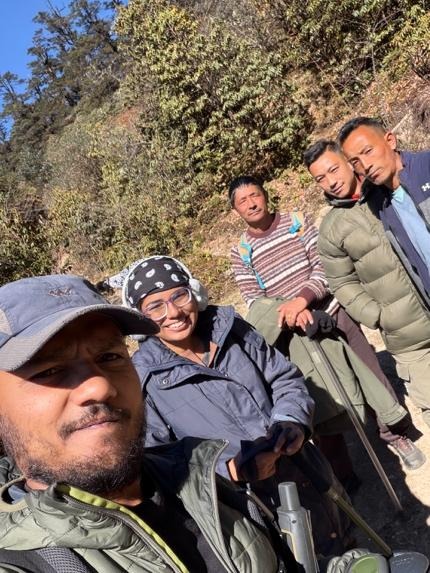
As we continued our journey, we met forest guards stationed at different camps. Their knowledge came from years of walking these trails every day. They pointed out subtle signs, suggested areas where red pandas had been seen in the past, and helped us understand how the landscape changed with elevation and season. Along the way, they also introduced us to the forest itself. Trees that looked ordinary to us carried familiar local names and uses. We learnt about Timur, valued for its medicinal properties, and Angeri, traditionally used to relieve itching. These weren't facts from a field guide but knowledge passed down through years of walking these forests. Listening to the guards reminded us that every landscape can be understood in different ways-through scientific surveys, but also through the everyday experiences of those who call these mountains home.
One afternoon, while walking from Thakum towards Moley, our forest guard suggested we leave the main trail and follow him into a dense bamboo valley. We carefully made our way through the vegetation, scanning the trees as he quietly searched ahead.
Then he stopped.
High up on a tree branch, we found our first red panda pellet. They were two to three inches long, with 20-30 pellets in one place.
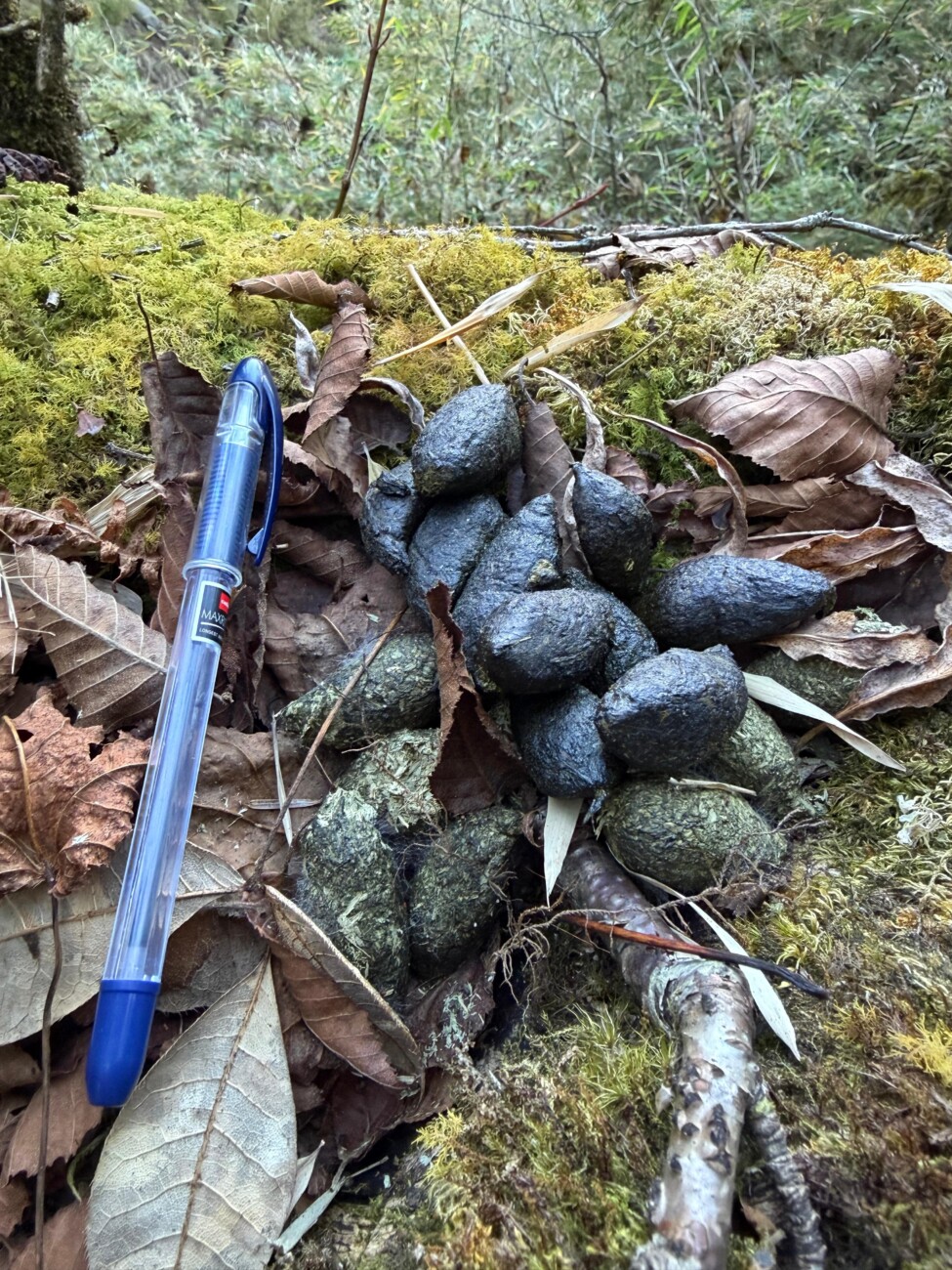
It wasn't the animal we had hoped to see, but it was enough to tell us we were in the right place. After days of walking, that small sign brought an excitement that is difficult to describe. There were smiles, happy tears, and a shared sense of relief. We scrambled through shoulder-high bamboo, trying not to lose sight of each other while following the forest guard. Finding our first sign of a Red Panda changed the rest of our walk. From that point onward, every bamboo patch, every conversation, and every bend in the trail felt different.
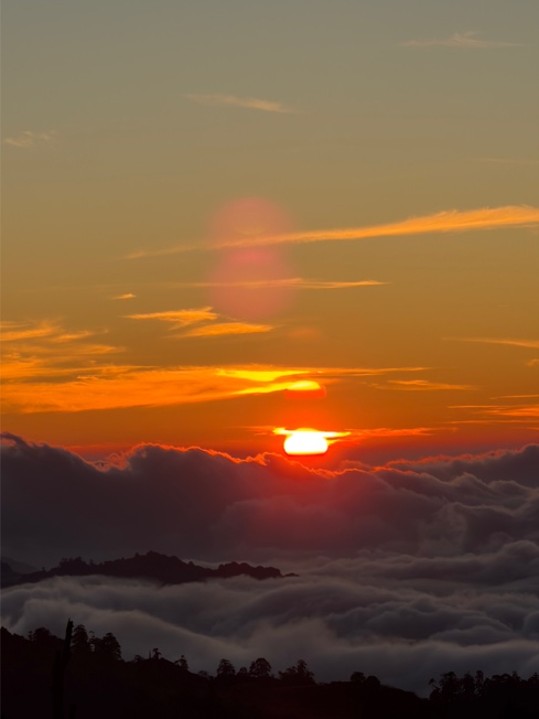
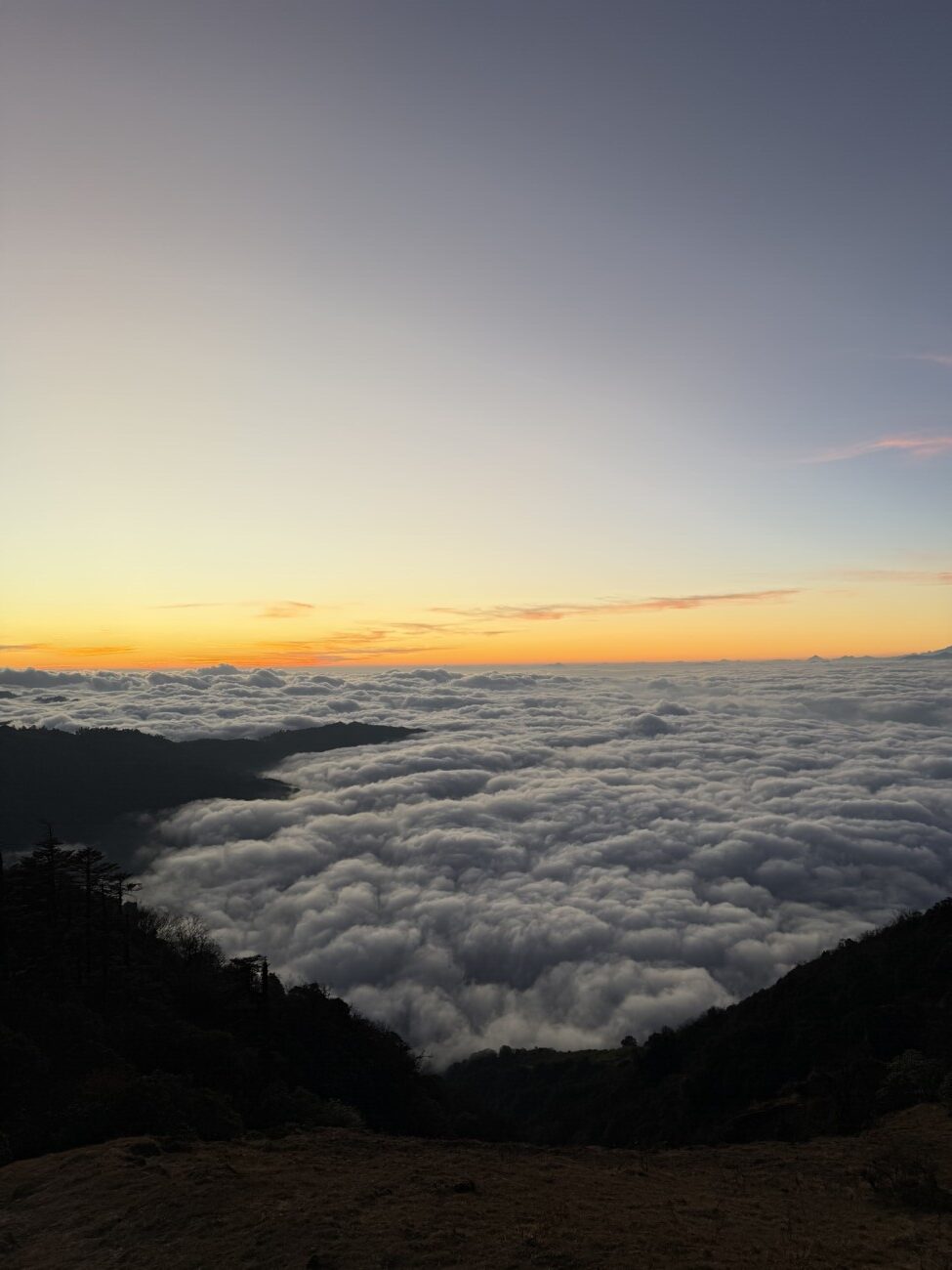
That evening, as the sun dipped behind the mountains, we walked towards Molley beneath an orange sky, with clouds rolling through the valleys below. Later, under a sky full of stars, conversations turned once again to the forest. Local trekking staff shared stories of past Red Panda sightings, changing weather patterns, and how they had seen parts of the forest change over the years. Those conversations reminded us that understanding a landscape doesn't come only from scientific surveys. It also comes from listening to the people who have lived and worked within it for years.
Beyond the view
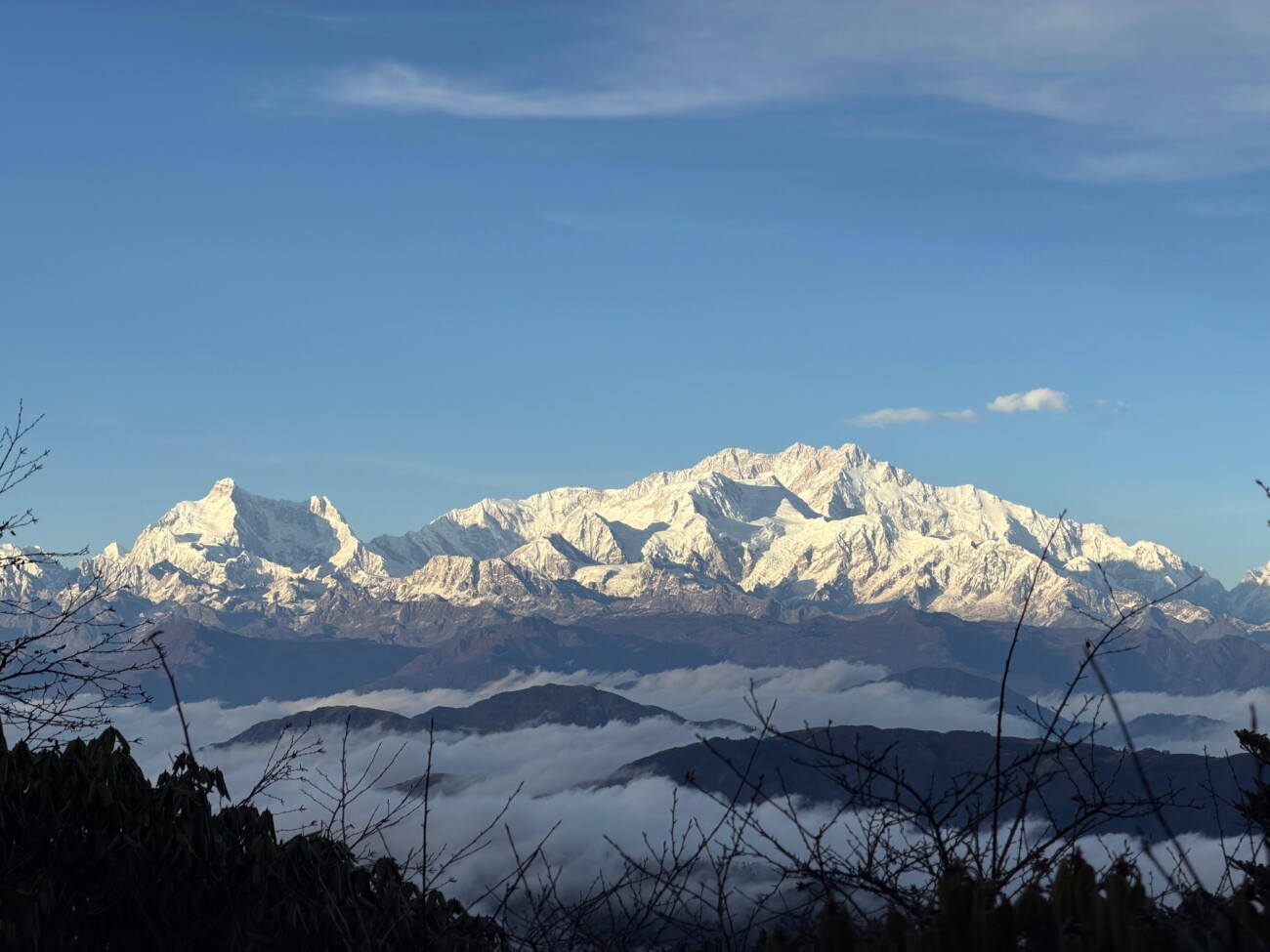
We rested at Moley, discussed possible survey locations, and reflected on how dramatically the landscape had changed. The Sleeping Buddha stretched across the horizon, and on a clear day, Mount Everest stood proudly in the distance. It was a breathtaking view, but after days of walking through the forest, we found ourselves appreciating something beyond the mountains. Standing on the ridge, it was easy to understand why people remember Singalila for its mountains. For visitors, these paths offer unforgettable mountain views. It is easy to remember Singalila for its spectacular peaks, but the journey reminded us that the forests below are just as remarkable. Every bamboo patch, stream, and meadow supports species that many visitors may never notice, yet they are as much a part of Singalila's identity as the mountains themselves. For researchers, forest guards, and local communities, they are also routes through habitats that support an extraordinary diversity of life. Walking the same trail with a different purpose reminded us that conservation and tourism are not separate stories- they share the same landscape and indeed the same purpose.
For visitors, these paths offer unforgettable mountain views. It is easy to remember Singalila for its spectacular peaks, but the journey reminded us that the forests below are just as remarkable.
Reflection
Perhaps this is what it truly means to walk beyond the trails-not simply to leave the path, but to see the landscape as more than a destination. Our recce may have been the first step towards a red panda survey, but it also gave us the opportunity to appreciate the quiet details that often go unnoticed. Sometimes, understanding a forest begins not with finding wildlife, but with learning how to observe the traces they leave behind.
Note from the Artist, Shreya Khadilkar
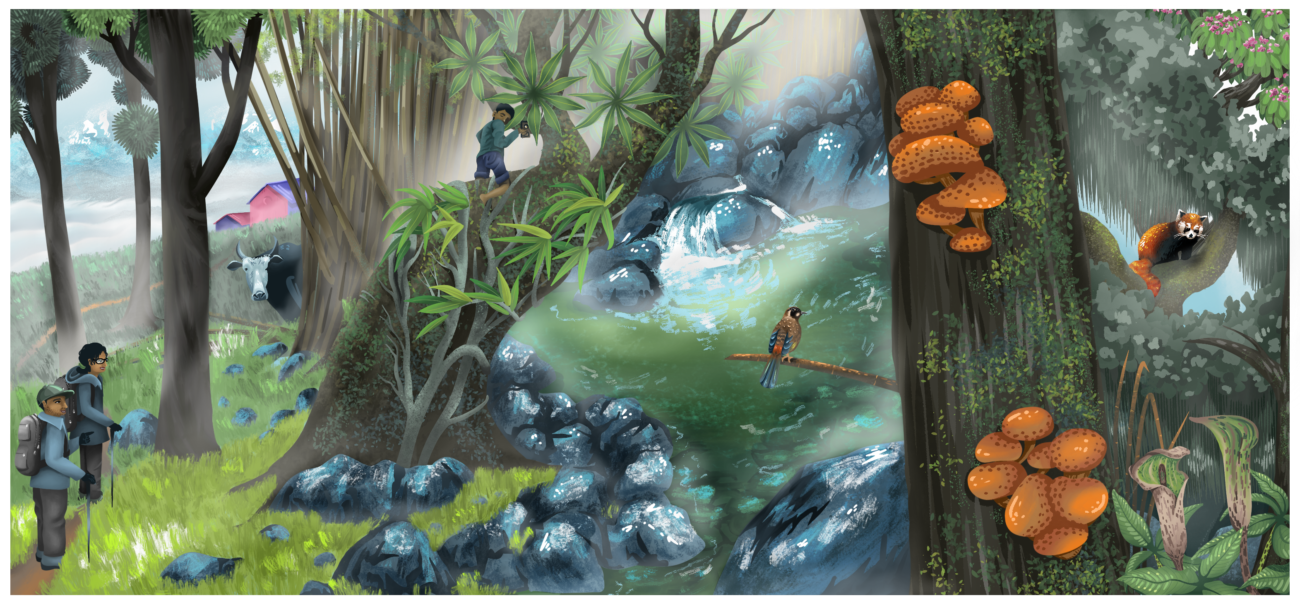
Representing a magical place like Singalila, Darjeeling Himalayas, on a digital screen is a brain-eye-wrist-racking task. Every scene has one specific unifying colour, the undertone. For this landscape, it was a light steel blue, from the fog that seeps into every nook and cranny. Every other colour was mixed into this blue, and the resulting shades form the finished work. The blue itself disappears, but only after it lends its misty, blurry personality to the image.
The composition itself unfolds the process of discovering the elusive red panda. Researchers are about to embark on a trail. But unlike others, their road will wind far beyond streams and lakes, hills and houses, rocks and ravines. They are seeking an enigmatic creature, probably tucked away in a blanket of mist, on stocky bamboo, even at this very moment. I hope the illustration pulls the reader OUT of the screen. This illustration is meant to reflect the landscape for those who haven’t visited yet, so they can yearn for it.
Priya Jadhav: Priya Jadhav is an independent wildlife researcher with a background in biodiversity, wildlife conservation, and management. Her work focuses on the relationship between people and wildlife, with an interest in human–wildlife interactions and community perspectives in conservation. Her field experience spans wildlife research and community-based conservation across landscapes in India, including the Himalayas and Central India.
Aamer Sohel Khan: Aamer is a Wildlife Biologist and HDR Fellow at Adelaide University. He initiated Project Red Panda in the Darjeeling Himalayas and currently focuses on populations in Singalila and Neora Valley. His vision is to propose these national parks as the Red Panda Reserve. To support this, he is conducting long-term research on red panda behavioural ecology and physiology. He and his team are also exploring the red panda’s role in local communities through the documentation of cultural practices and folklore. He believes that involving local communities in conservation practices is essential to achieving a sustainable, long-term solution to ecological crises.



Such a beautiful perspective.A reminder to slow down and notice the stories hidden in the forest, beyond the breathtaking views. And This illustration has me yearning to walk this trail now!
Thankyou 😄