Amala had never set foot beyond the boundaries of Jhyam Busty(village). Once she was taken to Namchi hospital to have her appendix removed, but she was unconscious with pain and fear, so that did not count. Today, she felt out of place among the marbled floors and electrical appliances of a place far away from home. Everything happened so suddenly that she was beyond understanding the events that landed her in Gangtok.
Everything happened so suddenly that she was beyond understanding the events that landed her in Gangtok.
Three weeks ago her father got a phone call from his friend from Gangtok; they were looking for a bride for their only son. Her father was elated; the same friend that he had grown up with now wanted his Amala as his daughter-in-law. His friend had left behind Jhyam Busty to work for the government; apparently, he now enjoyed quite a senior position in some Government office. “His Amala must be blessed”, he thought. All those rejections were just leading towards something good; patience did bear good results.
Everything was prepared within the span of a week. Being the only daughter, Saila Bajey (Grandfather) left no stone unturned for the wedding of his darling daughter. The fields were cleared, tents were put up, and people began flitting in and out of their three-room government-funded model house. The courtyard was filled with sacks and crates brought in from Jorethang. The goat shed was cramped with the addition of two new goats ready to be butchered for the wedding, and the stench of poultry emanated from the backyard. Everything appeared ready for what seemed like the wedding of the century in Jhyam busty.
Everything appeared ready for what seemed like the wedding of the century in Jhyam busty.
The day finally arrived. The villagers had gathered early in the morning to witness the wedding. Amala decked in a crimson sari and covered with an equally red netted scarf, waited in anticipation. She had not seen her groom-to-be, but just the fact that he was from Gangtok made him handsome in her eyes. He was the man of her dreams; it was surreal that she would be leaving the confines of her home, her village, in a few hours to enter a completely different world. She was nervous but happy. Her father had been boasting of his good fortune to anyone who dared broach the question regarding Amala’s hasty nuptials. The perpetual smile etched on his face showed just how much this alliance would mean to his family. Neighbours who earlier refused to give them a second of their time now visited their house in flocks, even the Panchayat Sarpanch had been generous enough to extend help in the form of a sack of rice, “Your daughter, my daughter, same thing”, he had beamed at Saila Bajey.
She had not seen her groom-to-be, but just the fact that he was from Gangtok made him handsome in her eyes. He was the man of her dreams; it was surreal that she would be leaving the confines of her home, her village, in a few hours to enter a completely different world. She was nervous but happy.
The wedding frenzy began at the crack of dawn on that fateful day. At around 11 o’clock, the village kids began running towards the house screaming, “Ayo hai, Ayo hai” (They are here, they are here). No sooner had they reached the house than a car came in sight; it was an I10 decked in floral arrangements, followed by a rally of vehicles. The villagers watched in amazement; the only vehicles they had closely seen were Baley’s scooter and Rajmaan’s Commander. For them, this was grand, royal almost. They whispered and sneered, some were green with envy, and others were just too surprised to react. Finally, the procession halted just above the house and people began to scramble out. More surprises for the villagers were in store as they saw people clothed in brightly colored attires that sparkled in the noonday sun, sunglasses perched on their faces like it was a part of their anatomy. Saila Bajey scrambled down the newly built staircase, hands folded with respect, happiness glinting in his eyes. Spotting a familiar face, he went ahead and bowed with hands joined in respect and humility.
At around 11 o’clock, the village kids began running towards the house screaming, “Ayo hai, Ayo hai” (They are here, they are here). No sooner had they reached the house than a car came in sight; it was an I10 decked in floral arrangements, followed by a rally of vehicles. The villagers watched in amazement; the only vehicles they had closely seen were Baley’s scooter and Rajmaan’s Commander. For them, this was grand, royal almost.
“My long-lost friend”, cried the other man, enveloping Saila Bajey in a hug. This was signal enough for the rest of the family to join Saila Bajey in welcoming the guests. The janti (groom’s party) was led towards the house, refreshments were served, and in a short while, the town folk were marvelling at the rustic festivities that they had almost forgotten existed. The rest of the day went by without any glitches save for the drunken skirmishes that accompany every wedding ceremony.
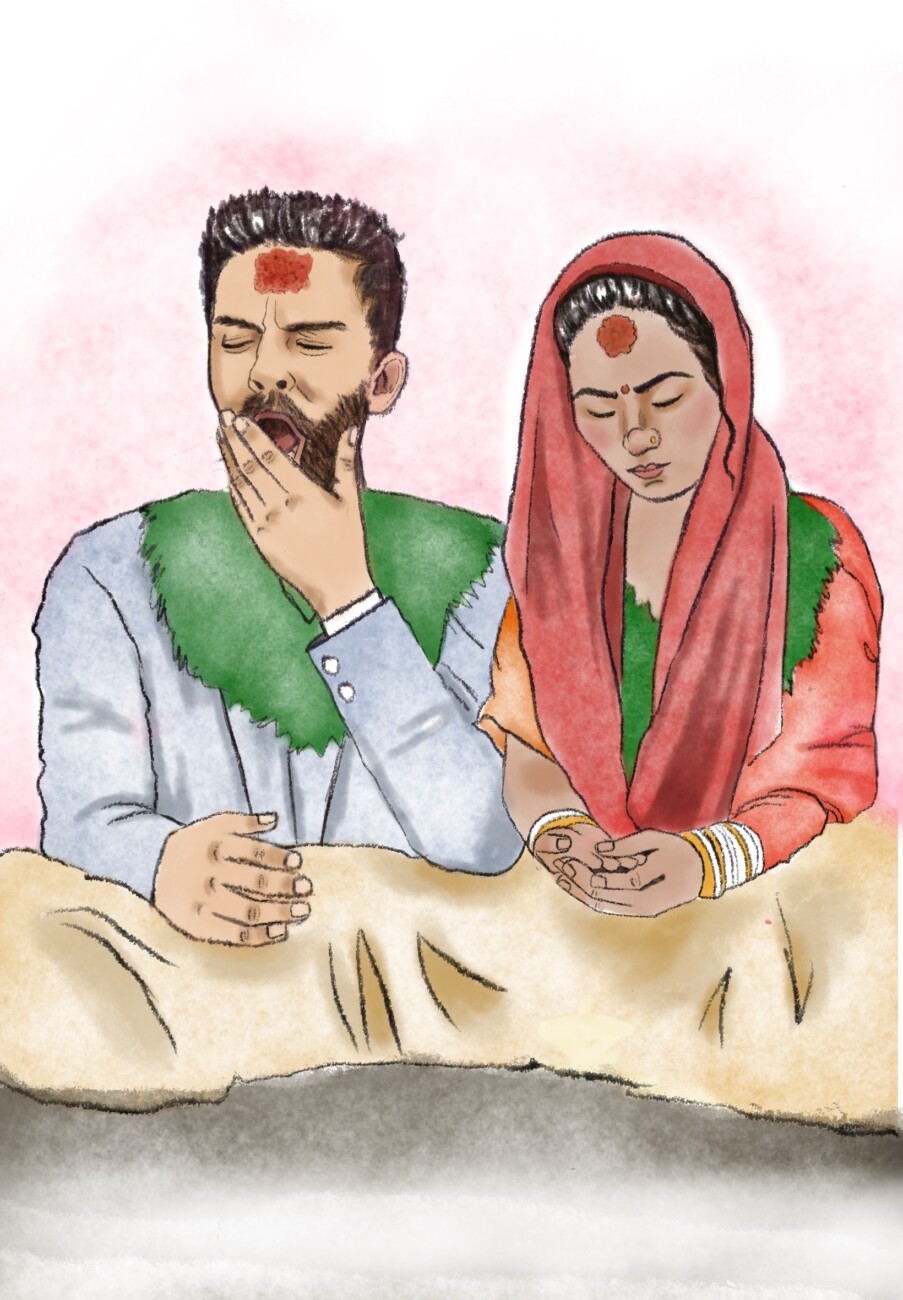
Amala stole glances at her husband, blushing every time he tried to make conversation. He was a heavy-built, muscular man with brown eyes that actually reminded her of a villain in a Nepali movie that she had watched long ago during her only visit to Jorethang Mela. She tried not to make anything of it; at least he resembled someone in a movie. By evening, the bride and groom were exhausted. Rice plastered on their forehead hid their frowns, but their eyes could not lie; they were also yawning at regular intervals and looked ready to collapse. Amidst all the madness, no one had remembered to feed the pair. Finally, after the last well-wisher had done his share of congratulating the couple, they were taken into the house from their makeshift mandap (makeshift stage for wedding ceremonies) and fed with the remains of the day’s feast.
As night fell, happiness mingled with liquor brought out the ‘Mithun’ in everyone, chairs were removed, and a dance floor came up in minutes. City folks danced to the tunes of new-age Nepali music that had become a rage in recent times while the villagers looked on, transfixed, eyes gleaming with some unidentifiable emotion. The celebration continued until the wee hours of the morning. Had it not been for sheer exhaustion, lord knows if it would’ve stopped at all. The wedding party was to leave early in the morning; they weren’t staying back. They had to be back at Gangtok; apparently, everyone had a ‘tight schedule’ that could not be compromised.
Tears were shed, promises of “will visit again” were spoken. The newlywed couple was sent back with sacks full of homegrown ginger, cardamom and all kinds of vegetables straight from the in-laws’ backyard. The accompanying janti looked quite pleased with their share of organic produce, courtesy of the bride’s family.
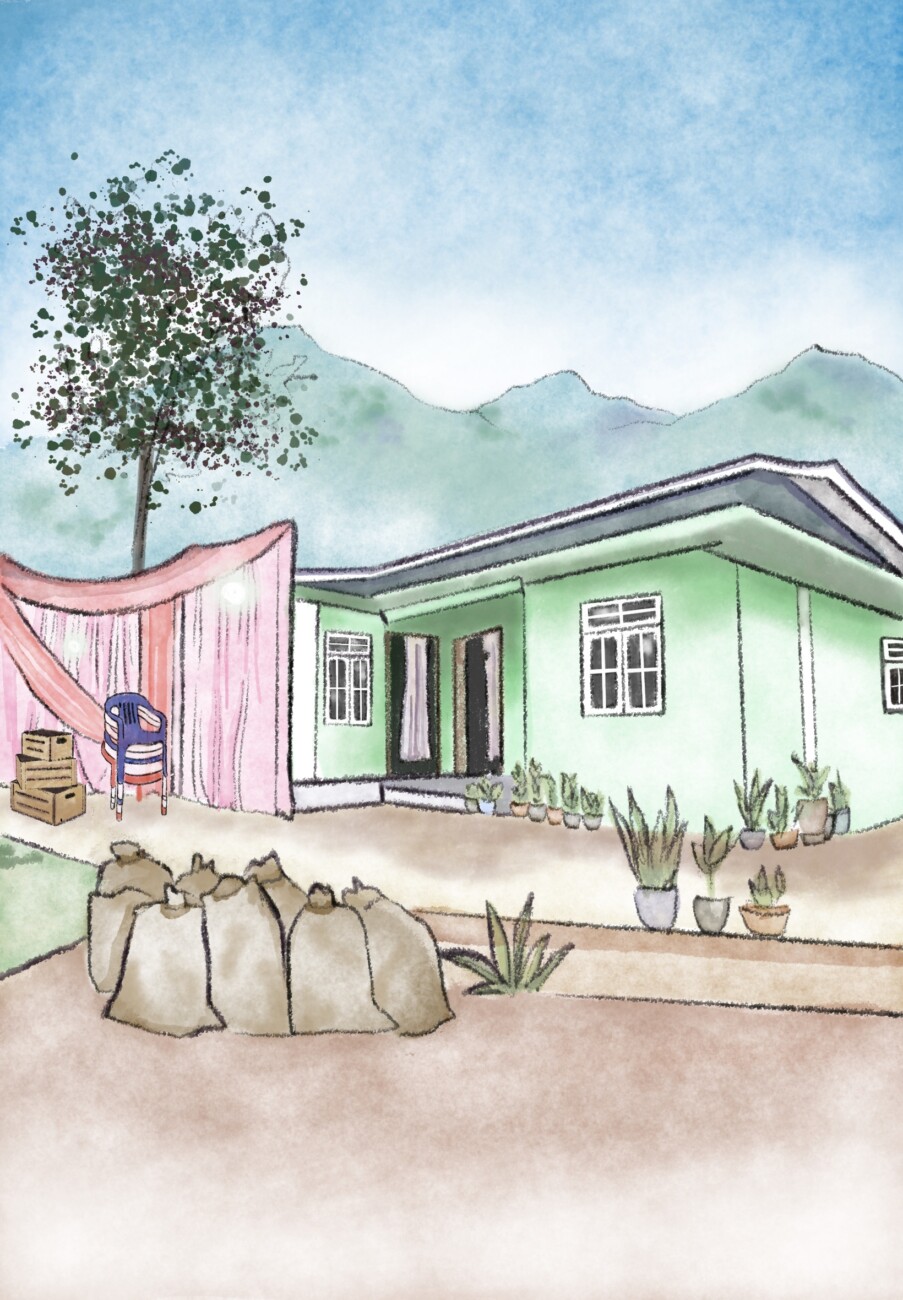
Tears were shed, promises of “will visit again” were spoken. The newlywed couple was sent back with sacks full of homegrown ginger, cardamom and all kinds of vegetables straight from the in-laws’ backyard. The accompanying janti looked quite pleased with their share of organic produce, courtesy of the bride’s family.
They left, raising a storm of dust along the newly dug road. Amala, too tired to keep her eyes open, eventually fell asleep and woke up just when their vehicle was climbing uphill from Ranipool. She looked on with bewilderment: concrete jungle and unending train of vehicles plying up and down were the first things she noticed. Her husband had not spoken a single word to her. Too shy to start up a conversation, she buried the hundreds of questions that had begun to crowd her mind, telling herself that she had enough time for that as she was to spend her life with him.
She looked on with bewilderment: concrete jungle and unending train of vehicles plying up and down were the first things she noticed. Her husband had not spoken a single word to her. Too shy to start up a conversation, she buried the hundreds of questions that had begun to crowd her mind, telling herself that she had enough time for that as she was to spend her life with him.
The vehicle slowed down and came to a stop at Tadong, just a few meters from the College. All the other vehicles accompanying them had gone their separate ways. Her husband spoke his very first words to her, “Time to get down”. Still clad in her wedding attire, she got down with wobbly feet and stood beside him as he gave orders to his driver to get their things home. He started walking and Amala followed him down a steep staircase. He stopped in front of a tall building and said, “This is where I live”. Unlike the few movies that she had watched, no welcoming rituals were performed for their homecoming. “Things must be done differently, life is not a movie after all”, Amala thought as she entered the house.
“Where is your father?” Amala spoke, her first ever words to her husband.
“I do not live with my parents”, he replied without looking at her.
She nodded at his reply. The house was a three-roomed apartment with a kitchen extended into a living room and a balcony. Apparently, the husband did quite well for himself. Amala was quite in awe about the whole scene unfolding before her. “This will be your room”, the husband broke Amala’s daydream and pointed towards what appeared to be a room next to the kitchen. Something seemed amiss, but Amala did not have the energy to figure it out. Meanwhile, the driver had brought in their luggage and the husband was instructing him to put everything in place. Amala did not have a fancy trousseau; she had two bags of clothes and sacks of vegetables and spices to last a few months. Speaking of which, the sacks now looked ill-placed and neglected in the shiny tiled kitchen with its fancy appliances and marble countertops.
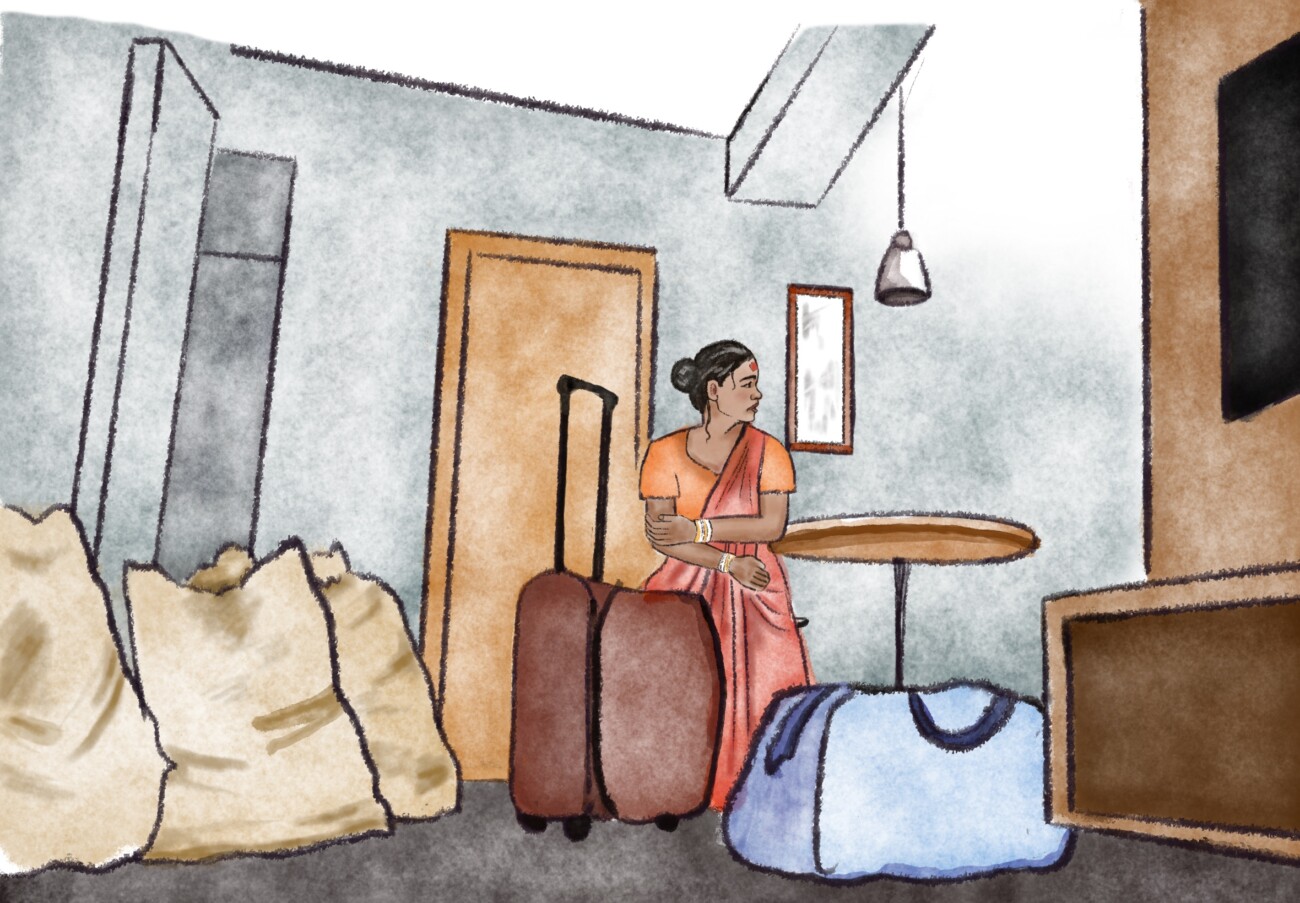
She went into her room and saw that her bags were already there. It was a modest-looking room with minimum furnishings: a bed, a bedside table, a vanity mirror and a cupboard. More than a bedroom, it looked like a guest room. But Amala had no idea; she had no experience to compare it with. Just as she was wondering what was next, her husband appeared in the doorway.“Freshen up if you want, I will be out for a few hours, cook anything you want, but don’t wait up for me”, and he disappeared before she could even reply. Amala thought it was odd that he had not entered his own room. He was being a gentleman, of course, that could be the reason, or he was too shy to interact. “These things take time”, she silently scolded herself for being too quick to question his motives. She decided to take a bath.
She came out of the bathroom with hesitating steps and walked towards the living room. The house felt empty. It was almost five o’clock in the evening, and the pale sunlight filtered through the curtains, casting long shadows. Amala felt a sense of loneliness creeping up from within, threatening to spill out in tears. She would not ruin it; this was the beginning of a good life and she could not give in to crying, no matter how much she missed the warmth and the familiarity of Jhyam. She walked towards the kitchen and found herself staring at appliances that looked too fancy to be touched. She opened the fridge only to be greeted by more packaged stuff that she did not recognise. Overwhelmed but also too tired to cook, she decided to eat the only thing she could recognize - bread that she spotted in one corner and some fruits for dinner. Unknowingly, she was adapting to urban life after all!
The house felt empty. It was almost five o’clock in the evening, and the pale sunlight filtered through the curtains, casting long shadows. Amala felt a sense of loneliness creeping up from within, threatening to spill out in tears. She would not ruin it; this was the beginning of a good life and she could not give in to crying, no matter how much she missed the warmth and the familiarity of Jhyam.
After finishing her dinner, she decided to explore the rest of the house. She found there were two other rooms apart from the one where she was housed. One of the rooms looked exactly like hers, but the other room was bigger in size and looked quite lived in. It had a bigger bed and was well furnished, unlike the other two rooms; this had personal belongings with photo frames and a painting adorning an entire wall. Her naivety failed to elicit the kind of suspicion that would otherwise have rattled a person with more worldly knowledge. But Amala came from a world where master bedrooms and living rooms were alien concepts. These things were beyond her comprehension; ignorance was bliss. The house tour did not take much time; she wandered back to the hall and decided to wait for her husband.
Her naivety failed to elicit the kind of suspicion that would otherwise have rattled a person with more worldly knowledge. But Amala came from a world where master bedrooms and living rooms were alien concepts. These things were beyond her comprehension; ignorance was bliss.
The rhythmic ticking of the wall clock lulled her to sleep; Amala woke up to faint light streaming from the windows. According to the clock, it was six in the morning; she had fallen asleep waiting for him. Waking up to a completely different view, it took her a couple of seconds to realise that she was in Gangtok and not Jhyam. Just as the reality was sinking in, she heard the door to the master bedroom open, expecting to see her husband, she looked towards the door, wary of how he might react. Her eyes were greeted by a different pair of eyes, unlike the brown of her husband’s; his were black. He gave a warm smile and walked towards the kitchen, opened the refrigerator and grabbed a water bottle. His actions oozed a questionable familiarity.
“You must be Amala”, he said, but more to himself and sauntered back to the room.
“Don’t forget to close the door”, the husband’s voice could be heard from within the room.
Amala looked at what had transpired before her, confusion clouding her thoughts. “He must be his best friend”, she thought as she began tying her hair up to prepare some tea for her husband and his best friend.
Arpana Guring is from Mangalbarey, West Sikkim. She currently works as an Assistant Professor in the Department of English at Narbahadur Bhandari Government College, Tadong, Gangtok.
She thinks a lot about writing, but only occasionally writes short stories and a little poetry when the muse comes alive. Life and lived experiences in these mountains we all call home inspire her to write.



Beautiful one Arpana mam
Thank you Phuntsok!
Dear Arpana & Suveksha,
Amala’s world, much like her appendix, is surgically cut, quiet as heartbreak; each word carefully braids yet another mistake.
Thank you for sharing Jyam Busti. Suveksha does not illustrate the text; she infects it with colour until word and image become the same wound. One of your finest works so far.
Kudos to both of you for letting us into this fierce and unforgettable world.
Thank you Kalden 🤍 such poetry even in your comments!