~
1992
Beneath the last pine tree of Hospital Dara, the boy built his first business where people came to confirm what they already feared and paid in coins to delay the thought.
The hospital did not rush anyone. It allowed dread to settle properly. Inside, the corridors smelt of antiseptic layered over something older, while the dental wing carried its thin metallic chorus of drills and rinses and controlled discomfort. Outside, the queue bent without complaint.
Old couples arrived hand in hand, not tenderly but with agreement, fingers interlocked as though they had decided long ago that whatever came would be received together. They leaned close and spoke softly of names and dates that had already been rehearsed. Younger men stood apart with folded slips that did not yet matter, while women adjusted shawls that did not require adjusting.
Below this slow arrangement, where order loosened, the boy sat on a flattened cardboard that had learnt him. One leg bent, the heel turned stubbornly towards heaven, as though drawn upward by something it refused to explain, while the other stretched away in quiet refusal. Between them he held a small territory that did not ask permission.
The coins came mostly from the old. They paused longer, looked once, sometimes twice, and gave as though completing a thought they had begun elsewhere.
Within a week he understood coins not as money but as language. He learnt their weight, their sound, their urgency. At the hospital counter, a card required five rupees, and people arrived with notes too large for the system to accommodate. He had coins. Transactions formed around him without announcement. They gave him more than required, not out of generosity but convenience, and he accepted with the seriousness of someone entering a profession.
He became, within days, a master of coins.
Hospitals did not make people generous. They made them practical.
No one carried a voice with them then. Messages stayed where they were spoken.
Months passed until a traffic constable at Hospital Dara, who had watched him without appearing to, stepped out of his routine and stood before him.
“You have understood business,” the traffic constable said. “Now change location.”
He pointed down the road. “Here, people are worried. They count. There, they forget.”
A pause. “Lal Bazaar. More walking. More seeing. People must see you to give. Sitting here you are useful. Sitting there you will be profitable.”
The boy did not argue. The next morning he carried his cardboard-like inventory and moved towards Lal Bazaar, where money moved faster than thought.
Lal Bazaar was already in motion when he arrived, vegetables spread in uneven colours on damp sheets, vendors calling out prices that shifted with the listener’s face. The air carried coriander, soil, frying oil, and the murmur of negotiation. Near Denjong Cinema Hall stood two neighbouring shops, one turning out samosas in a steady rhythm, each batch vanishing almost as it appeared, the other stacked with cassette players and large sound boxes, their music updated to echo whatever the cinema’s posters announced.
A painted poster flapped loosely against the wall of the cinema, its colours slightly faded but its promise intact. Saajan ran inside to full houses, its story repeating for those who returned to it.
Inside, the man in the film moved with difficulty, his leg failing him, his words doing what his body could not. Women wept for him without hesitation, the suffering arranged carefully enough to be believed.
Inside Lal Bazaar, the road loosened and slipped into trade without announcement, as if walking had simply decided to become buying. Under sagging tarpaulin tents sat villagers, still and unperforming, their goods laid close to the ground. One stall insisted on order. Bottles stood aligned with quiet authority. “Careful, if you break. Then you take.”
The bottles were reused,their labels faded but stubborn. Honey Bee brandy had been replaced by thick village honey that held the light in slow suspension, undecided between liquid and memory.
A single honeybee circled them, restless and faintly offended, a hill-born gatherer drawn by instinct yet checked by glass, by sealing, by this bottled, almost urban arrangement of sweetness. It tapped, retreated, returned again. It could not enter, yet refused to leave.
Customers stepped back. Irritation came first, then a thin, unnecessary fear. The vendor ignored both insect and human alike. Nothing shifted. The honey held its light. The bee persisted.
The boy chose his place and laid down his cardboard with care. His first day rewarded him. Coins came, then notes, then more coins. Lal Bazaar accepted him without inspection. People argued over vegetables and surrendered to snacks, frugality and indulgence kept in separate pockets, while the bee continued its small, determined attempt to reach sweetness that would not open.
Then the Denjong Cinema Hall’s doors opened.
“Khi Khyam! Kusyu Buk! Buttuwa Kukur! Stray Dog!”
“Pagla Rambo!” someone shouted from the doorway, the insult thrown without emphasis, as if it had been used many times before.
The man was shoved forward with a force that suggested prior familiarity, his body pitching into the open like something returned rather than released. He was shabby beyond repair, his shirt stiff with old stains, his trousers marked by drink and neglect, the zip left open without concern. A sour smell travelled with him, thick with cheap alcohol and the stale persistence of urine, settling into the air with quiet authority.
He stumbled once, then corrected himself too quickly, his limbs moving with a jerking urgency that did not belong to balance. His grin remained, though its purpose had been forgotten, laughter breaking apart before it could complete itself.
He moved fast, too fast for his shape, and placed a hand upon a woman at the samosa stall with the misplaced confidence of someone who had stopped recognising consequence. She screamed. The vendor lunged. Oil spat in agreement.
The man fled.
He lurched forward in uneven bursts and dropped beside the boy, dragging cardboard over himself as though it might defend him. The smell arrived fully now, immediate and unavoidable.
His breathing came loud. Then he turned.
“You,” he said. “Which cripple are you?”
The boy said nothing. Rambo narrowed his eyes.
“Go to Naya Bazaar. Sit near Gandhiji. Good sympathy there. Here,” he tapped the ground, “premium property.”
Rambo leaned closer. “I own this area. Shopkeepers, cars, police, dogs. Even the view.”
The boy remained still. Rambo watched, then adjusted.
“Fine. You sing?, Dance? Cry properly? Any begging skill?”
The boy shook his head. Rambo clicked his tongue and leaned back, his gaze drifting briefly towards the cinema poster.
Then Rambo, Gangtok’s madman with matted hair, a split lip, and shining eyes, swayed over the beggar and nodded with drunken authority.
“Saajan,” he declared. “That’ll be your name.”
Then he sang, voice jagged and triumphant, “O Mere Saajan, Saajan, Saajan, Saajan,” Oh My Beloved, Beloved, Beloved, Beloved, “Ishq Mein Jeena Hai, Ishq Mein Marna Hai,” In Love I Want To Live, And In Love I Want To Die.
~
2005
From below, they saw the name first, the new letters of KANCHENJUNGA SHOPPING COMPLEX cut in metal and fixed into the concrete face, catching what little light the night allowed and holding it, as if the building had learnt how to shine before it had learnt how to open. The spelling sat slightly wrong, stretched heavier than needed, as though even the mountain had been made to fit a shape that did not belong to it.
Rambo stood still a moment; head tilted back, and then let out a breath that turned into a laugh.
“Let’s take you there,” Rambo said, tapping his chest. “I’ve already been. Been everywhere inside.”
He grinned. “Once it opens, you won’t be allowed. Opening ceremony. Big people.”
Rambo pointed at the building, then at himself, then at Saajan.
Saajan shifted beside him, his good leg holding while the other dragged. He said nothing. Behind the structure, beyond scaffolding and cement, Mt. Kangchendzonga stood without effort. Some carried small devices that rang without warning, voices travelling through them detached from place. Rambo spat, wiped his mouth, and turned towards the back lanes where the city loosened, garbage bins leaning into one another, the smell thick but settled.
Rambo searched through discarded cardboard and broken pieces until he found a bamboo basket that once carried vegetables, empty but holding its shape, with two uneven holes cut into its sides.
He turned it once, pressed its weave, then nodded. “This will do.”
“You want to go or not?” Saajan nodded.
“You lazy, frightened stray dog. Come.” Rambo set it down.
Saajan dragged himself forward, palms placing and pulling, the good leg pushing and the other following late. Rambo bent, slipped his arms under his shoulders, lifted, stopped, adjusted, and lifted again.
Saajan rose, slipped, caught his shoulder. They held.
Rambo lowered him into the basket, pressing one leg down, folding it where it resisted, guiding the other through. “Stray Dog…Sit straight.” The basket fixed his shape. From inside it, the world shifted; not higher, but displaced.
Rambo tore strips from his shirt, tied them across Saajan and beneath the basket, tested the knots. “Good.” Rambo slipped his arms through, bent low, and lifted. The first attempt failed but with the second, he began taking short steps.
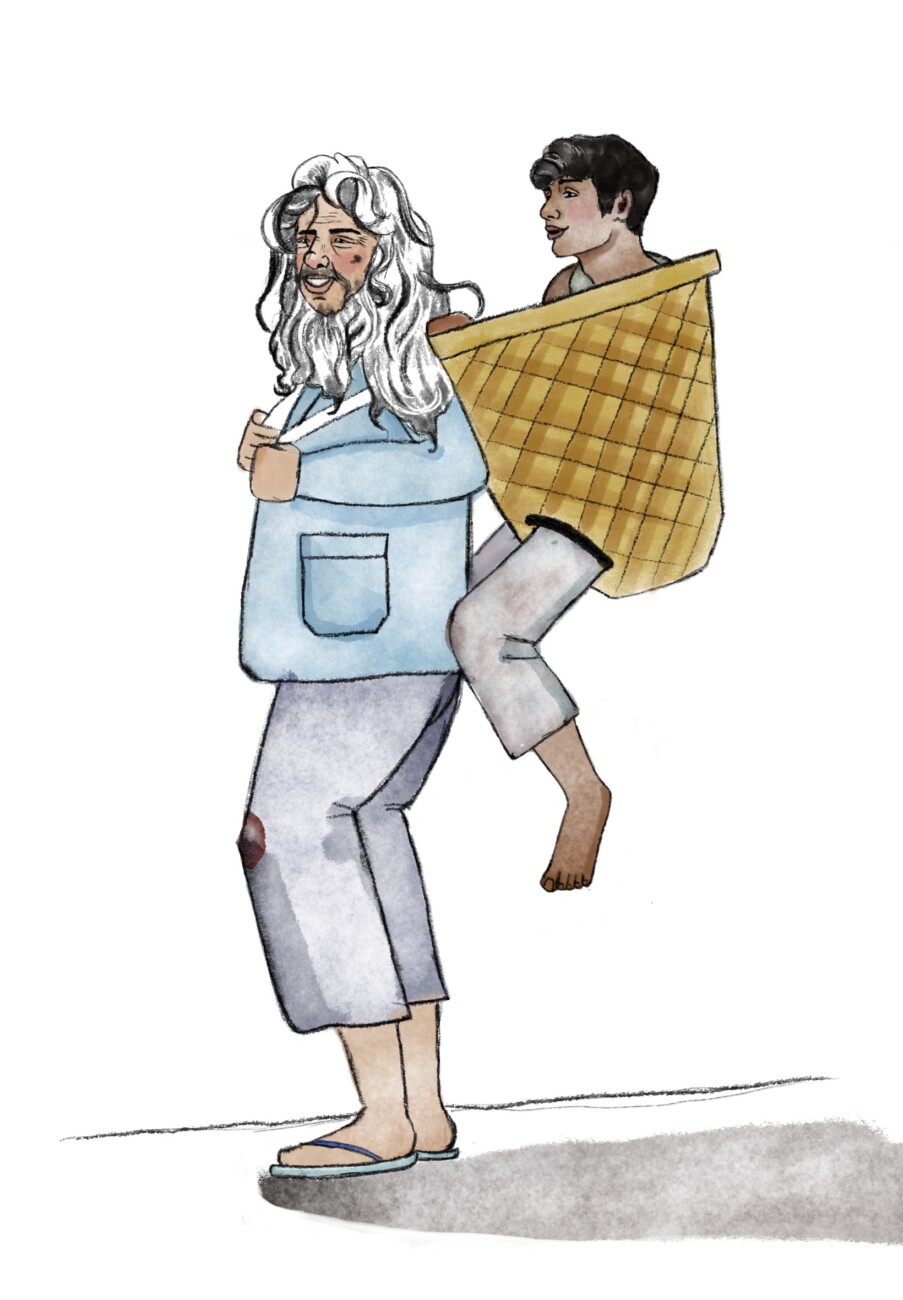
The strain travelled through him into the basket so that Saajan felt each correction, each imbalance.
The building stood open ahead. “Four floors. One. Two. Three. Four.”
Rambo began to climb. The first flight was slow. By the second, he stopped.
“Wait.” By the third, his breath grew louder, shoulders trembling.
By the fourth, he did not stop. He leaned forward and kept moving until he reached the top, stumbled, caught himself. They reached the terrace with Rambo leaning forward under the weight, his breath loud, the basket shifting against his back.
He stood there a moment before lowering the basket. Saajan slid partially out. Rambo looked up at the thin rods rising from the concrete. He smiled.
Rambo stepped onto them, testing each step, slipped once, caught himself, laughed, then sat and began to urinate. Mt. Kangchendzonga stood vast and silent.
“I’d piss everywhere, but not towards her.” He took out a crumpled packet and held a hundred-rupee note. On it, the mountain stood printed and contained. Behind him, the real one shifted between silver and ash.
A thin wind crossed. The note trembled. The mountain did not. For a moment, they aligned.
“See,” Rambo said. “To get her, I had to do it.” He tapped his face. “The slaps were worth it.”
The note trembled again. The mountain did not.
Rambo brought him down slowly, stopping once to breathe, then out into the lanes without looking back. They returned to Khandala, the abandoned house where they stayed, walls cracked, windows gone, the smell of stale liquor and damp cloth settled into everything. Rambo lowered the basket and sat against the wall, his legs trembling once before holding. Saajan pulled himself free while the basket remained where it had been placed, and no one asked anything.
~
The next day Rambo sat in the alley where alu chewra was served on torn schoolbook paper, oil soaking into old lessons, people eating with small cardboard spoons.
Rambo carried the bottle loosely. When he drank, the taste did not correct him at once; only after it settled did the difference begin. He coughed once, then again.
“Still here.” His breathing shortened, not suddenly but as if space within him were closing. The alley did not change.
“I piss everywhere,” he said, softer now, “but not towards my mountain.”
A pause. “Like that orchid…” The sentence did not finish. He tried to laugh. Nothing came. His body folded inward slowly.
~
A scooter passed at the mouth of the alley. Someone stepped aside. The alley continued. From inside, voices rose. “Dead.” “Pagla Rambo is dead.”
“Don’t touch.” “Leave it.” “Call the police.” The words remained.
Saajan turned. He did not move at once. Then he dragged himself forward, palms placing and pulling, until the alley opened before him. People stood around the body, not close, not far. No one touched him.
Saajan moved closer. The smell came first. Rambo lay where he had folded. Saajan waited. Nothing changed.
He reached out, pressed the shoulder once, then again, and as his hand slipped he caught the bottle, lifted it slightly, and the smell that rose was kerosene, sharp and thin, cutting through, and he held it there a moment before letting it rest.
His hand remained. Then withdrew. Saajan lowered himself beside him. The alley did not change.
“Police are coming,” someone said.
Saajan reached into the pocket and drew out the folded note. He looked at it briefly. Then kept it.
For a short while, Gangtokians said Pagla Rambo had died after consuming kerosene. The version held because it was easy to repeat. Some women were relieved. Even in death, he had done it with drama.
~
2011
To forget Rambo, Saajan moved. Not far. Just enough for the city to change its behaviour around him.
He settled near MG Marg, outside a public toilet where the rate had increased without announcement. People paused longer there now, calculating urgency against cost, some stepping away, some returning, their bladders negotiating what the city had begun to charge.
Traffic had thickened by then. Vehicles did not pass so much as accumulate, holding themselves in place until movement returned in short, reluctant bursts. Those caught between signals arrived at the toilet with a confusion that did not belong entirely to the body.
Some paid. Some did not. Relief adjusted accordingly. Saajan remained. The city continued to grow around him.
The day began under a sky that held the last of the monsoon without releasing it, the air damp and faintly metallic, carrying the residue of rain that had already passed. It was the eighteenth of September, late afternoon, and Gangtok wore its newer surfaces carefully, as though aware they had not always been there.
MG Marg had learnt how to behave. Once a road, it had been levelled into a promenade, its stones aligned, its benches placed with intention, its edges kept clean in ways that suggested supervision. Vehicles had been removed, and in their absence movement changed, no longer crossing but circulating, as though walking itself had been reorganised.
Below it, Lal Bazaar continued without instruction, close and functional, unwilling to widen itself for comfort, its goods arranged by use rather than symmetry, vegetables still carrying soil, voices negotiating without pause. If MG Marg presented the city, Lal Bazaar continued it.
Saajan had been moved by then, shifted from the corner near Denjong Cinema to the flyover above Sher-E-Punjab, where movement separated into levels and no longer paused long enough to notice him.
Nearby, alu chewra had changed its manners, now served on thin silver foil plates with plastic spoons that bent less but said more about improvement than taste.
The day assembled itself through small repetitions: prayer flags adjusting to uncertain wind, tea poured into glasses that held heat unevenly, voices overlapping without agreement.
Then the ground intervened.
At first, it felt like hesitation, something that might belong to the body, but it deepened quickly into something larger. The surface moved in uneven waves, sustained rather than sharp, as though the mountain had reconsidered its stillness.
Gangtok shifted.MG Marg held its order, though the buildings around it loosened slightly, lines adjusting without fully giving way. Lal Bazaar answered more directly, goods lifted and reset, continuation taking precedence over stability.
The shaking lasted long enough to remove doubt. Windows rattled, shutters struck against themselves, and utensils collided in uneven rhythm, a sound of breaking travelling without immediately revealing its source.
People moved without agreement; some running, others standing still—as though waiting for the ground to decide. Explanations followed and dissolved just as quickly.
“Earthquake!” “Strong one!” “Angry Gods!” “Kalyug!”
Phones appeared, lifted into the air, searching for signal, for confirmation, for something beyond what could be seen. Many did not connect. When the movement reduced, it withdrew rather than ended, leaving dust in the fading light and dampness returning beneath it.
Information followed in fragments: a strong earthquake, near magnitude seven, somewhere to the north. Names moved through conversation-Mangan, Chungthang, Singtam-each carrying damage that had not yet settled into certainty.
Numbers followed. They did not remain small.
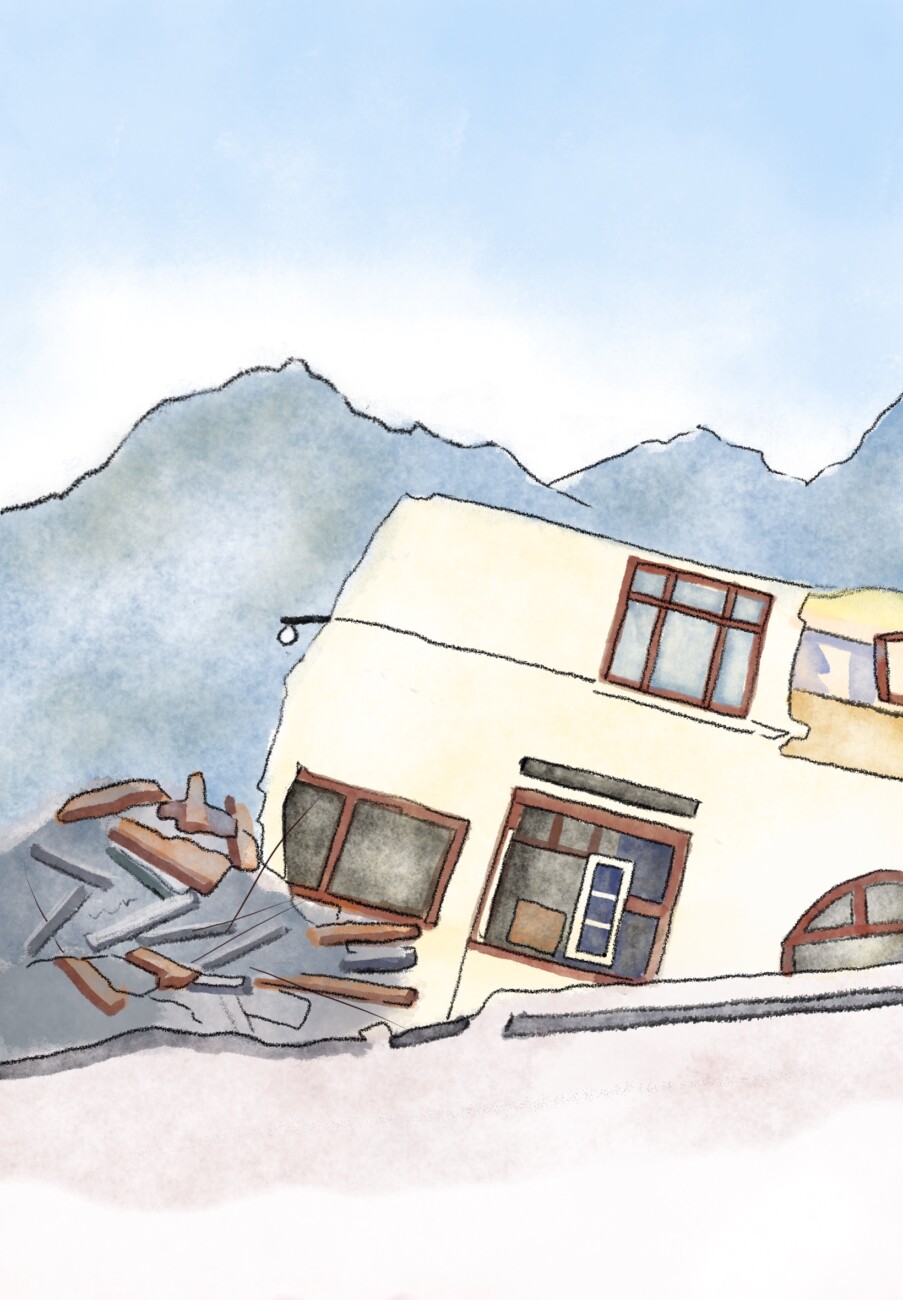
Roads were said to be cut by landslides that followed the shaking, as though the mountain had continued the event on its own terms. Buildings had fallen in places where stability had been assumed, and the count of the dead rose without settling.
Saajan remained where he was. The movement passed through him without displacing him, though the concrete beneath him shifted slightly, enough to register. Coins in his pouch struck each other during the shaking, their sound contained.
By evening, people gathered in open spaces.
Paljor Stadium filled first, offering distance from buildings that had briefly revealed their uncertainty. Families arrived carrying blankets and small bundles, sitting close together while looking upward more often than around.
The first tents appeared there before night settled. They were set by those who measured rather than feared-engineers and contractors who understood how structures held and how they failed-choosing open ground not from panic but from calculation.
Tarpaulin stretched across spaces, lifting and falling in uneven wind, producing a sound that repeated without pattern. People gathered beneath, repeating what they had heard, adjusting details without resolving them.
A child handed Saajan a biscuit. It had absorbed the air. Saajan held it briefly. Then ate it. The ground had shifted. The biscuit had not.
Helicopters moved through the valley later, their sound arriving before their shape.
The ground moved again that night, smaller but enough to unsettle what had begun to settle. Aftershocks followed in irregular intervals, making stillness unreliable.
Saajan lay awake. The city no longer arranged itself in familiar ways. Lines appeared where there were none; not cracks and not roads, but markings that suggested the movement had not finished. There was no one walking them. The memory remained. When Saajan opened his eyes, it was gone.
The ground held. For now.
~
2013-2020
Neon entered Gangtok gradually, not as an arrival but as accumulation, first appearing where it was not required and then remaining long enough to become part of the surface, until the night itself began to depend on it.
Evenings no longer dimmed evenly. Light settled across glass and concrete in colours that did not align but did not cancel one another, holding their place without resolving.
The air changed with it, holding less of the old dampness and more of what lingered between surfaces; heat, fuel, plastic, and food oil used beyond its first intention. After rain, the ground still darkened, but it did not remain so for long, and the smell of wet earth gave way quickly to something sharper.
Glass multiplied across buildings and storefronts, creating surfaces that reflected other surfaces, one window holding another, then another behind it, until depth appeared without resolving into distance. People moved through these reflections and did not always return whole, their shapes breaking slightly before reassembling, their expressions remaining a moment longer than the bodies that produced them.
Saajan remained where he had always been.
Screens settled into hands permanently, and people began to look downward more often than ahead, their attention held by movements that did not belong to the street. What appeared on those screens began to carry more weight than what stood directly before them.
Across the street, plastic orchids appeared in the windows of a building, arranged carefully behind glass, their colours consistent, their petals holding shape without adjustment, unaffected by air and untouched by time. They required nothing and responded to nothing.
People noticed. They did not say so. The real orchids reduced slowly, becoming occasional, then uncertain, then dependent on chance rather than placement.
One afternoon, during a brief return of rain, a real orchid appeared among them, placed within the same window across the street. Its petals were uneven; one edge already thinning as though time had continued through it while everything else had paused. Water gathered along its surface and slipped away without a pattern.
No one moved it. It remained through the day and into the next. Saajan watched from where he was. Then it was gone. The space it left held briefly before being filled again.
Across the street, the plastic orchids remained.
Elections continued, and the pamphlets changed with them, becoming thicker, smoother, more resistant to folding, their print sharper and their surfaces more durable. The faces appeared clearer, though they remained just as temporary.
The gesture did not change. They were still placed into Saajan’s hands in the same way, and Saajan accepted them without looking at the faces, noticing instead the paper-its texture, its stiffness, its use.
Convoys returned with the same pattern, though the vehicles improved, larger, darker, more enclosed, their surfaces reflecting more while revealing less. The siren remained unchanged, arriving before the vehicles and lingering after they passed.
Gangtok learnt to glow. The night no longer deepened but held its brightness in place, and shadows shortened, staying close to the objects that produced them instead of extending outward.
Then, in 2020, the city changed again.
The shift arrived through instruction, repeated across spaces until it became habit, the word COVID-19 circulating widely, spoken often enough to lose sharpness while gaining weight. Shutters closed and remained closed, and the streets emptied in a way that felt arranged rather than gradual, as though absence itself had been organised.
Movement reduced, and then paused, and the usual layering of sound thinned into something quieter that did not settle into silence but hovered just above it.
People appeared differently when they appeared at all, faces covered by masks worn correctly, incorrectly, or not at all, speech softened, distance measured and then forgotten. Circles were drawn outside shops, and people stood within them, moving forward only when the space ahead cleared, repeating the motion without conversation.
Small bottles appeared at entrances, pressed into hands before entry, their sharp alcohol smell cutting briefly through the air, leaving palms cold before drying into nothing. Hands learnt new habits, rubbing quickly and repeatedly, as though cleanliness could be confirmed through friction.
The air cleared for a while, and distant hills appeared more sharply than they had in years, the sky widening without changing, revealing what had been obscured by use.
Neon did not stop. It remained lit, holding its colour against empty streets as though presence had never been required.
Saajan remained.
From inside a closed shop, a song played at a volume that did not travel and did not disappear, repeating without variation as though it had been left on without intention—
“Jaha bagcha Teesta Rangeet, tya Kanchanjunga stit…” - Where the Teesta and Rangeet flow, there stands Mt. Kangchendzonga…
Inside, an old shopkeeper coughed once, then again, listening without adjusting the sound. From across the street, the plastic orchids held their place behind glass.
Later, people stood in new lines for vaccination, sleeves rolled, waiting not for cure but for permission to return to something that had already changed.
Days passed without marking themselves clearly. When movement returned, it did so carefully, shops opening partially before opening fully, voices returning in fragments before becoming continuous again, traffic resuming without its previous density.
The system continued. Saajan did not adjust. Saajan watched.
~
2025
By 2025, Gangtok had aligned itself without asking whether alignment was possible. Surfaces held. Reflections repeated. Nothing required depth.
A new mall rose above everything else. It could be seen from anywhere in the city, appearing between buildings, above roofs, behind turns, as though it had learnt how to enter every line of sight without invitation. It did not wait to be looked at. It imposed itself.
Rambo would have pointed at the mall, laughed and said it looked like a middle finger, not raised in anger but in habit.
From certain angles, it resembled a presence that did not withdraw, appearing where it was not required, its glass holding more than it revealed. It stood like an attention that could not turn away, as though the city had developed a habit of returning to the same surface even when nothing changed.
He and Rambo would not have been allowed inside. The thought remained, not because it required confirmation, but because it carried its own certainty. Entrances suggested openness, but the conditions were different now. Cleaner, controlled, measured in ways that did not include people like him.
The MG Marg above held its sharp edges, clean and arranged, where people once crossed freely but now moved in order. And a full-length statue of Mahatma Gandhi stood motionless in mid-step at the entrance.
Saajan remained where he was, the flyover. Below, he overheard a lady standing with her phone pressed between shoulder and ear, her voice moving while the road below did not.
“If the cable car started from Ranipool, I could reach before the attendance register decides otherwise… how long to keep explaining the same delay to the boss.” Her office was not far; she could have walked, but that measure had already been set aside. She glanced at the line of vehicles held in place. “The traffic stands,” she said softly. “Only the excuses arrive on time.” The call ended.
Time had moved through Saajan without announcement. The boy who had once sat on flattened cardboard at Hospital Dara had not disappeared, but he no longer occupied the same form. His hair had thinned and then given way to white, settling into an uneven beard as though it had followed its own logic rather than his. His face appeared narrow and sunken while his hands carried the same motion as before, but slower.
Between two buildings, a narrow gap held. At first, it appeared as brightness. Then it clarified into a line, a fragment of Mt. Kangchendzonga, silver and still, held in place by the space that allowed it to exist.
Looking at it, Saajan reached into his cloth pouch and took out the folded note. The paper had softened over time, its edges worn, its creases holding where they had been pressed and pressed again. The mountain printed upon it stood contained, reduced to ink and boundary. He held it up. The wind moved through the paper first. It trembled lightly between his fingers. He adjusted his hand once. Then again. Until the printed mountain and the distant line held together.
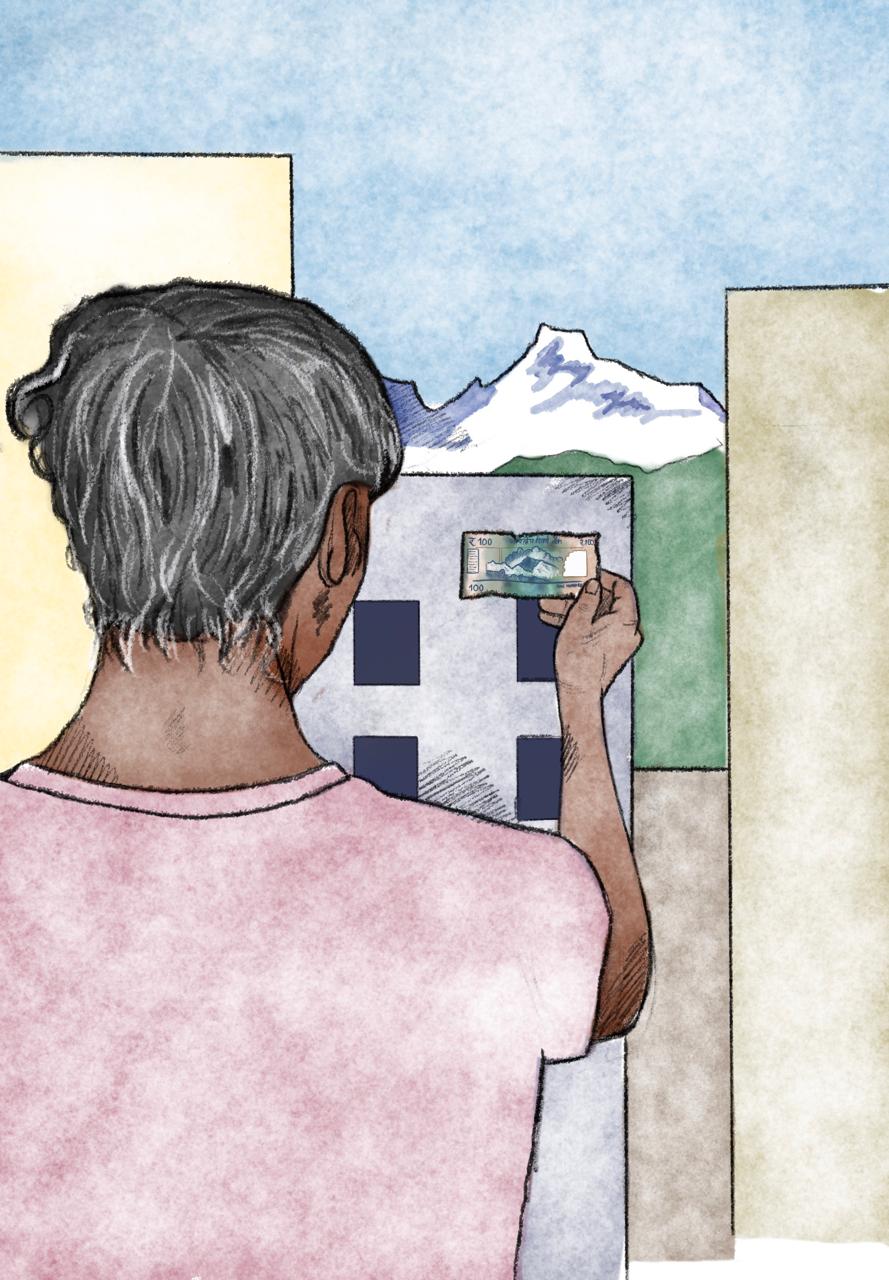
For a moment, they aligned. The paper shook. The mountain did not. He held it there a moment longer than required, the gesture settling into him as it had once belonged to someone else. The hand did not lower at once. When it did, it was careful. The note folded along its old crease, and the line between the buildings had already begun to reduce. He did not follow it.
Somewhere, without direction-
“O mere Saajan, Saajan, Saajan, Saajan…” Oh my beloved, beloved, beloved, beloved…
“Ishq mein jeena hai, ishq mein marna hai…” In love I want to live, in love I want to die.
The sound did not remain, replaced by a new gossip in the town. There was someone new now. A man who carried a stick and struck without warning. They had given him a name already. Aashiqui.
Saajan, on the other end, remained while the buildings in Gangtok continued to rise, not reaching but repeating, as though each new height practised, in glass and concrete, the shape of Mt. Kangchendzonga without ever arriving at it.
~
P.S.
- Gangtok once had a Rambo. Not the one from films. Someone smaller, local, and repeatedly remembered.
- Near Lal Bazaar, there is a place called Khandala. It does not appear on maps. People gather, sleep, disappear, and return. Everyone knows where it is. No one points.
- An earlier hundred-rupee note carried Mt. Kangchendzonga. The design changed. The note remained. The mountain remained.
Kalden Gyatso is a writer from the hills of Sikkim, devoted to the quiet discipline of storytelling. His fiction draws from fragments of places he has known and those he has only heard about in passing, carrying the familiar textures of mountain life, the quiet strengths, the small failings, and the unspoken hopes that bind people to the land. Kalden writes about these moments with a steady, unobtrusive voice, allowing the stories to speak for themselves and the landscape to reveal its truths in its own time.



Lovely story Kalden,through those eyes it brings back so many fond, thoughtful memories of Gangtok and how it has changed in so many small ways that gradually accumulate into new forms, those who have passed but we remember, times that come and go, songs sung but now forgotten, yet always the mountain above.
Dear Dr. Alex McKay,
Thank you for reading my reflection on a town becoming a city, layered and fragile. I return to memory, mine and others’, before it fades.
I am already reading "In Search of Mount Kailash". The writing is deeply absorbing, precise yet expansive, carrying both place and memory with quiet force stoning memory's every crow 🤠. I find myself living your lines, returning to what you once shared about the hippie trails.
Hope to see you soon for yet another of your lovely author's session.
Finally got some time to read something from a wonderful friend of mine.
You have so well expressed the story of our hometown . The familiar Lal bazaar and MG marg and many of the local places which have evolved for good over time. Rambo , Sajjan and so many others who have been a part of Gangtokians over years.
Your way of story telling over the years definitely speaks of your imagination and observation. Please keep writing
Dear Dr. Tshering Wangchuk,
To know the story carries back a dear childhood friend to those familiar streets is the finest reward any writer can receive. Thank you for reading with such warmth and memory.
I feel, places endure through those who remember them. And your kind words encourage me to keep listening, observing, and shaping these fragments of home into something that continues to live.
Dear Kalden,
This one sat with me long after I finished. Saajan’s stillness against Gangtok’s restless change— from coins as language to screens as Gods— is so gently devastating. You make the marginal central without a single loud word. The 2011 earthquake, 2020 silence, 2025’s mall like a middle finger… and through it all, that folded hundred-rupee note. “The paper shook. The mountain did not.” Chills.
Also, Suveksha’s paintings deserve their own exhibition.
Lines like, "if MG marg represented the city lall bazaar continued it." (Representing two faces of Gangtok. MG-marg as the PR for Gangtok and lall- bazaar as its pulse.)
"What appeared on phone screens began to carry more weight than what stood directly before them." (Modernization didn't just change buildings, it changed where we place value. Actually reality got demoted whithout people realising it.)
"I piss everywhere but not towards my mountain." (Even when Rambo is stripped of everything, place and belief can remain and those are the things the new Gangtok can't bulldoze.)
These lines were the most loaded moments, heart of Orchids in a Cardboard Kingdom. Keep growing brother...👏👏🫶🫶
Dear Ziang,
Thank you for your deep insight into this story.
With a quiet enthusiasm for impermanence, I found it best to portray my beloved Ghang-tok by chopping into its own time capsule, revealing only what I could faithfully gather.
Dear Kalden,
This story grows slowly for sure. I had to read it twice to feel it more.
I remember Rambo. He used to scare me and my friends a lot, now I laugh a little when I think of him. Funny how time changes that.
This story feels like that. It stays with you and becomes something nice to remember.
I liked it. Hope you write more of our yesteryears.
Dear Sumitra Ma’am,
“This story grows slowly for sure…” thank you sincerely for giving it the time and space to settle in your thoughts.
I know that, unlike my other works, this narrative asks for a quieter kind of patience and may feel slow at times. It comes from my deep affection for Gangtok, where I have tried, with care, to gather the everyday memories of a Gangtokian, from the past and from the present.
Dear Kald-salo,
tiptoeing
cardboard orchids
slippery streets
Love the dreamy lines
Warmly
Your shillong behna
Dearest Sensei-Bena,
My deepest Arigato!
I can offer nothing more fitting than this humble gift.
Mist over pine hills
Shillong whispers through soft rain
Sikkim clouds drift low
With much love,
Salo-Kald
A wonderful work. It was obvious that Saajan’s cardboard kingdom, fragile and stubbornly persistent, mirrored Gangtok itself. A city that appears to grow and modernize, yet rests on a precarious foundation. The only traces of authenticity seen are in fleeting moments, such as the orchids, real but temporary, and Rambo’s love for the mountain and the bond he shared with Saajan, no matter how short it was.
Dear Kursongkit,
Thank you for finding your way into this "Kursong 🌸" in Saajan's cardboard kingdom.
It means more than I can say that its fragile beauty, quiet longing, and fleeting truth could meet you there.
Tokche!
Effortlessly fluent narrative Kalden bringing to life Gangtokian figures of yore like Rambo and tracing the changes the city underwent over decades through the perspective of an often marginalised Sajan
Dearest Tshering,
Thank you very much for your kind words...that too coming from one of our "best hidden poets" just like the "Mayel Lyang" means a lot. Touched brother!
Dear Kalden,
The story is slow but nice. It shows life in a real way. Rambo is strange but interesting.
The part about plastic orchids is very clear. It shows how real things get replaced. The story feels a bit sad but honest. As always, love Suveksha's paintings.
Dear Anom,
Thank you for reading between the lines and discovering simplicity of an everyday sight vs. daily reflections.
Tokche! 🫡
Dear Kalden and Suveksha, This story feels very real and quiet. It does not try to impress with big events but shows life as it moves. The boy Saajan and the man Rambo stay in your mind for a long time. Their lives are small in the eyes of the city, but the story gives them weight and meaning.
The writing is slow and careful. Every place feels alive, from the hospital to Lal Bazaar to MG Marg. The changes in Gangtok are shown through small details like coins, food, plastic flowers, and buildings. You can see how the city grows but also forgets.
The ending is simple but strong. The moment with the note and the mountain says a lot without saying too much. It makes you think about what is real and what is just a copy. This story stays with you even after you finish reading. Thank you for letting me relive my beloved yet ever changing town.
Dear Mam,
Thank you for reliving the sights, sounds & smell of our beloved town slowly and progressively growing taller everyday that we've forgotten at times what lies beneath.
In a deliberate attempt to slow the pace, it was difficult to sculpt poetry in prose & vice versa but at the same time keep it simple. Thank you for noticing this.
Suveksha has done extraordinary justice with her brush strokes...her each painting depicts the plots with intricacies that it is believable when they say "a picture means a thousand words".
😊