Introduction: A City Being Remade
Baba used to ask us to look up when walking, while Aama suggested that we look at our feet now and then lest we miss a step. Growing up in Gangtok, looking up for me meant looking up to the TV Tower, at it, sometimes through it. When I lived in 6th Mile1, the Tower grew bigger as we approached the town2. As I grew older and moved to the Development Area, it rejected the general rule of thumb: what appears big when we are small looks smaller as we grow up. My movement and relocation in Gangtok metaphorically and physically mirrored my parents’ class mobility that facilitated it- we moved from near the base of the hill to somewhere around the top. The TV Tower retained its size and magnanimity.
The TV Tower, once synonymous with Gangtok’s skyline and visible from across the neighbouring hills, stood for 31 years before it was dismantled in 2024. My early memories of Gangtok are flooded with its image. It no longer exists, but it lives on.
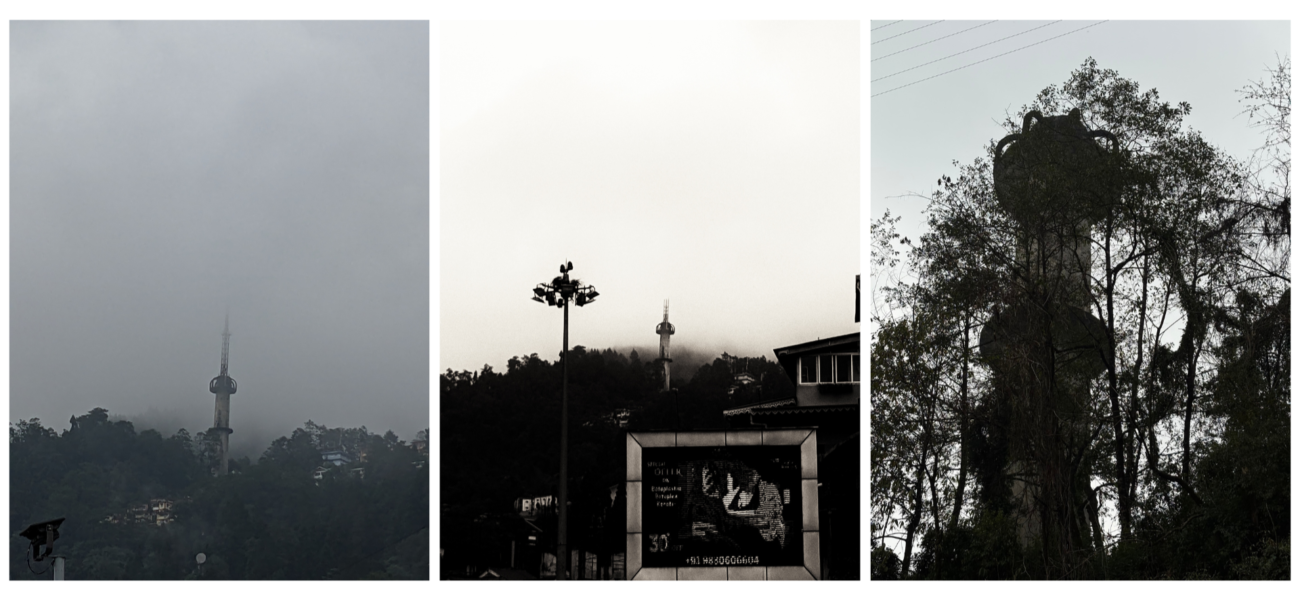
(June 2024, September 2024, March 2025)
Credit: Aakriti Thatal
Now, I ask, what makes a city familiar? Where do I feel I belong? How do I engage with a city that changes constantly?
These questions are large and constitute a multitude of worlds within themselves, but they stem from an individual’s experience of the city. For me, that experience has been one that shifts before one recognises, collapses before it corrects, and mutates before it accommodates.
Gangtok and the Promise of the Smart City
In 2015, the Government of India launched the National Smart Cities Mission (SCM). After several rounds of proposals, 100 cities were selected nationwide, Gangtok being one among them. The Ministry of Urban Development offers no clear definition of a “smart city”, however, it is supposed to be based on the needs of the people. Imagining a smart city entails changes in services and infrastructure, which are related to citizens’ aspirations (Appadurai, 2004). Aspirations, however, are never neutral; they are shaped by social and cultural context, and in Sikkim’s case, by the state’s promotion of tourism and the particular narratives it has built around Sikkimese culture.
Aspirations, however, are never neutral; they are shaped by social and cultural context..
The Gangtok SCM implemented numerous projects: the 14-storey West Point Tower, with its shopping complex, hotel, and parking lot; retrofitting of Lall Bazaar; work on the Ridge Park and Tsuklakhang Palace Complex; and improvements to pedestrian walkways, roads and junctions. While none of these signals a failure of implementation, there is a lack of a comprehensive view of development in the city.
For this essay, I take infrastructure to mean components of space that impress how people experience that space (Dourish & Bell, 2007) - the shifting boundaries between the material and the immaterial, the human and the non-human. Infrastructure also reveals power dynamics that interfere with the division between public and private, state and non-state. Furthermore, one must examine the making of these infrastructures: where are the resources drawn from, and to whom are these resources distributed? What role, if any, has public participation played in the planning of Gangtok’s urbanisation? A city has a life of its own, but that very life is infused by the people who live in that space, and the life that we imagine belongs to that city is also a relationship we have with it.
A landscape built for the present can become problematic later - when the needs of labour and capital shift (Harvey, 1985). Unfortunately, the Smart City Mission for Gangtok has taken this turn. It promises a secure public future even as the meaning of "public" is being contested. Habermas's (1991) prediction of the increasing privatisation of public spaces holds here: a space that becomes less public also becomes less democratic.
The Lives of Things Walk: Looking at What Usually Goes Unnoticed
Gangtok’s popular image conjures up landmarks like monasteries, viewpoints, markets and so on. But much of its everyday life unfolds through quieter, more intimate traces. On 18th April 2026, for World Heritage Day, I designed and led a walk with Sahapedia and Gangtok’s city-curator, Abhibyanjana Rubhi Thatal, built around a deliberate critique of “heritage”, shifting attention from the tangible to the intangible. Thirty-six participants, from Gangtok and outside it, moved through various points in the city, observing objects like signboards, plants, pathways, and even overt structures like the panda statue on MG Marg, pausing to observe details often ignored. Subtle modifications to shared urban spaces reveal how people continuously negotiate and remake Gangtok. Participants explored Gangtok through these material and sensory fragments. In doing so, it opened up new ways of imagining Gangtok as an evolving archive of lived experiences, shaped by the presence, absence, and, most importantly, the memory of everyday objects.
Structured as an exploratory walk, followed by an inconclusive discussion, this experience gave rise to the following points:
a. Public Space and Everyday Negotiations
The walk commenced at Denzong Cinema Hall in Lall Bazaar. Following a short debrief, we ascended Thaado Line toward MG Marg, dispersing across the old and new stretches, on to Hospital Darah, and ended at the Development Area. These points were chosen deliberately as an attempt to trace what remains of Gangtok’s public spaces.
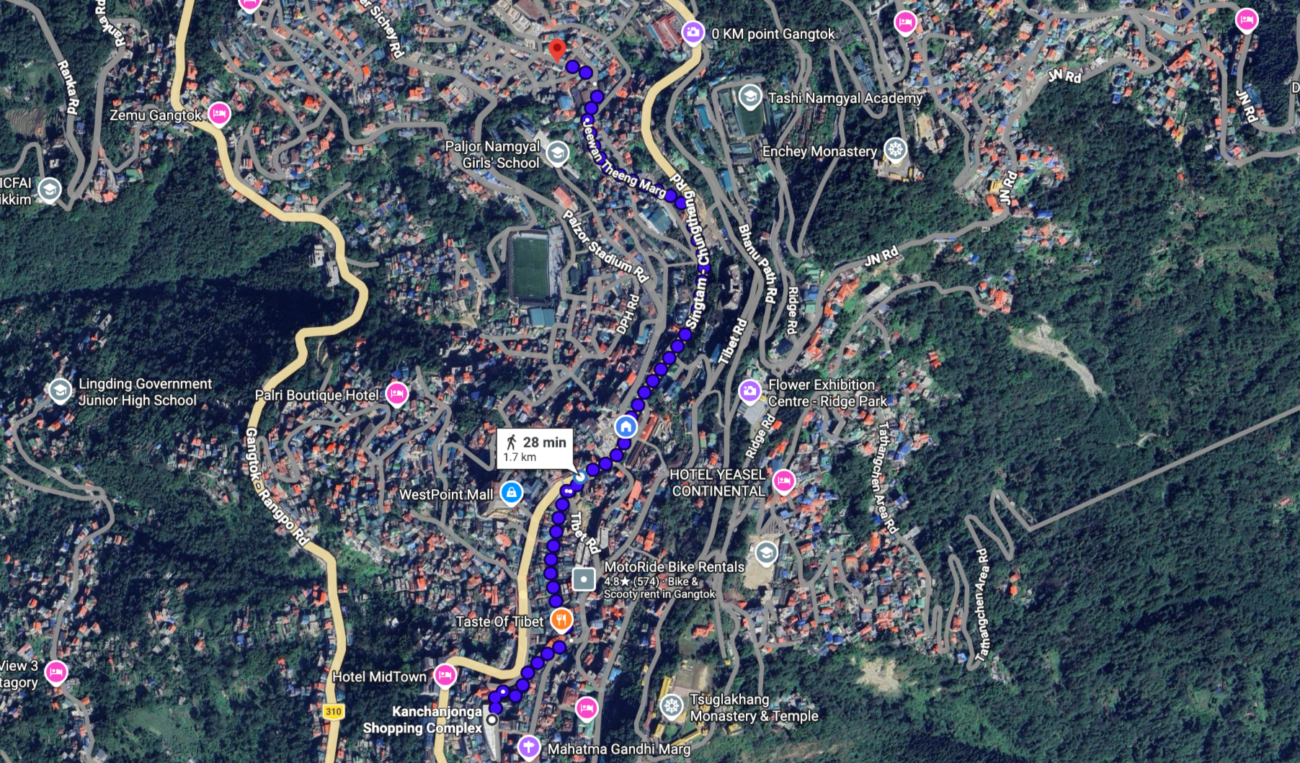
Link to Map with points
Several participants identified the route simply as an everyday path: one they use to reach town for recreation and leisure, or to walk to and from work. Some pushed back on it as a more “commercial” portrayal of the city, saying they’d have preferred the shortcuts or “chor baato,” through which their actual negotiation with the space happens. Attention to these shortcuts isn’t incidental: it points to what people want from the spaces they move through daily, an attention to sociality and how these spaces draw people in rather than simply being passed through (Simone, 2004).
Additionally, many cited that this route requires no entry fee, unlike the Wellness Park near Old STNM, or even parts of the Ridge Park3. The once-open-for-all but now-unsafe parking lot near Sangram Hall in the Development Area came up often too, remembered for its sunsets, and valued as a place to rest between walks, runs, or long days.
About half the participants were first-time visitors to Sikkim, and without a guide to steer them toward heritage hotspots, several described the early discomfort of having to engage with the city on their own; by the end, most said it worked better for them. It pushed them into conversations with people they might otherwise not have spoken to, toward something closer to a "local" read on the place, and toward noticing things on the route a guided tour would have skipped past. Rather than a tourist gaze that takes back only images of monasteries and mountains, participants’ engagements with everyday objects open their imaginations to how people in these cities actually live, making them more cognisant of their position and contribution as a traveller.
b. The Hyperlocal and the Borrowed
One participant, from Gujarat, photographed signages across town and noted “hyperlocal” touches, like the Tibetan lettering in front of fixtures on MG Marg, as well as a mix of more “modern” elements, pointing to digitally-made signage, alongside signs that spoke to a recent flurry of café and shopping businesses. Signage in Gangtok rarely exists in isolation; it's in constant dialogue with the signage around it, communicating as much about a business's ideals as about nostalgia or preservation.
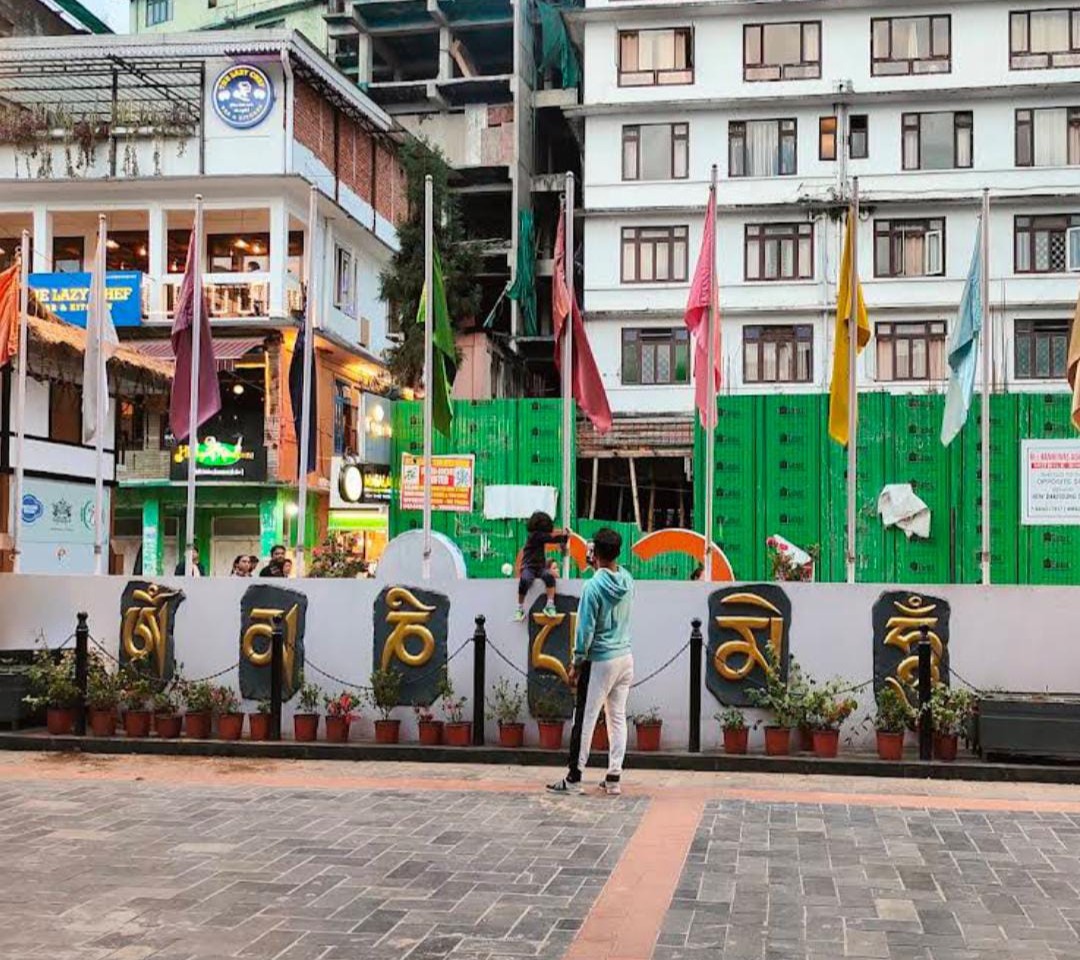
Credit: Sai Priya Tamang
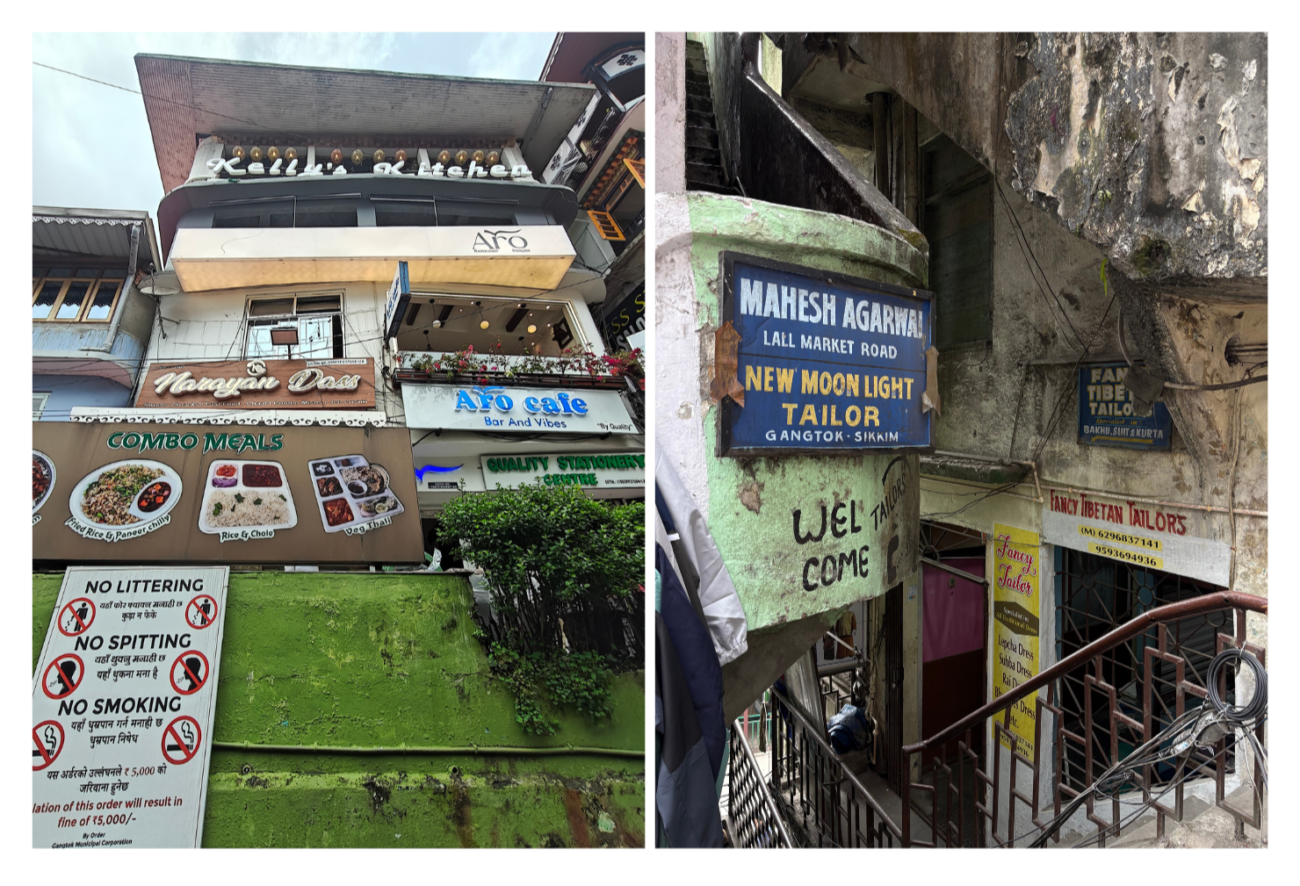
Credit: Rajan and Aakriti Thatal
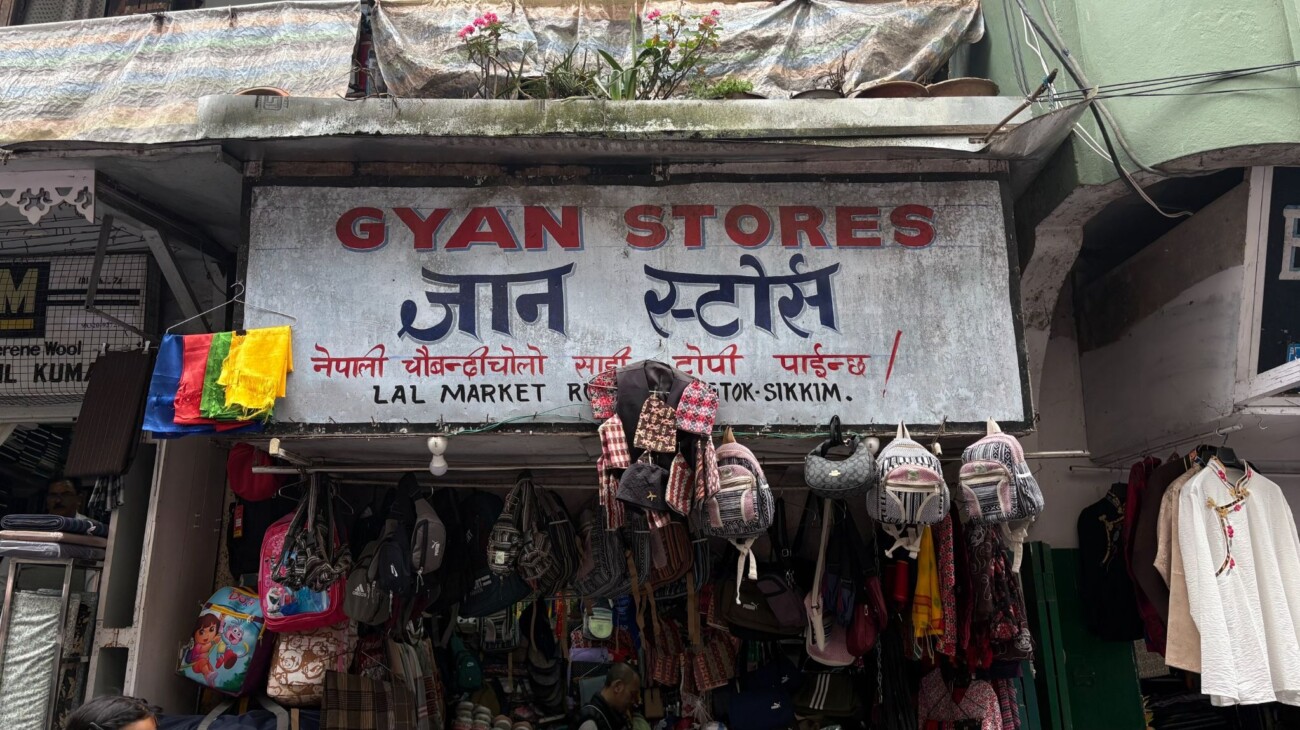
Credit: Aakriti Thatal
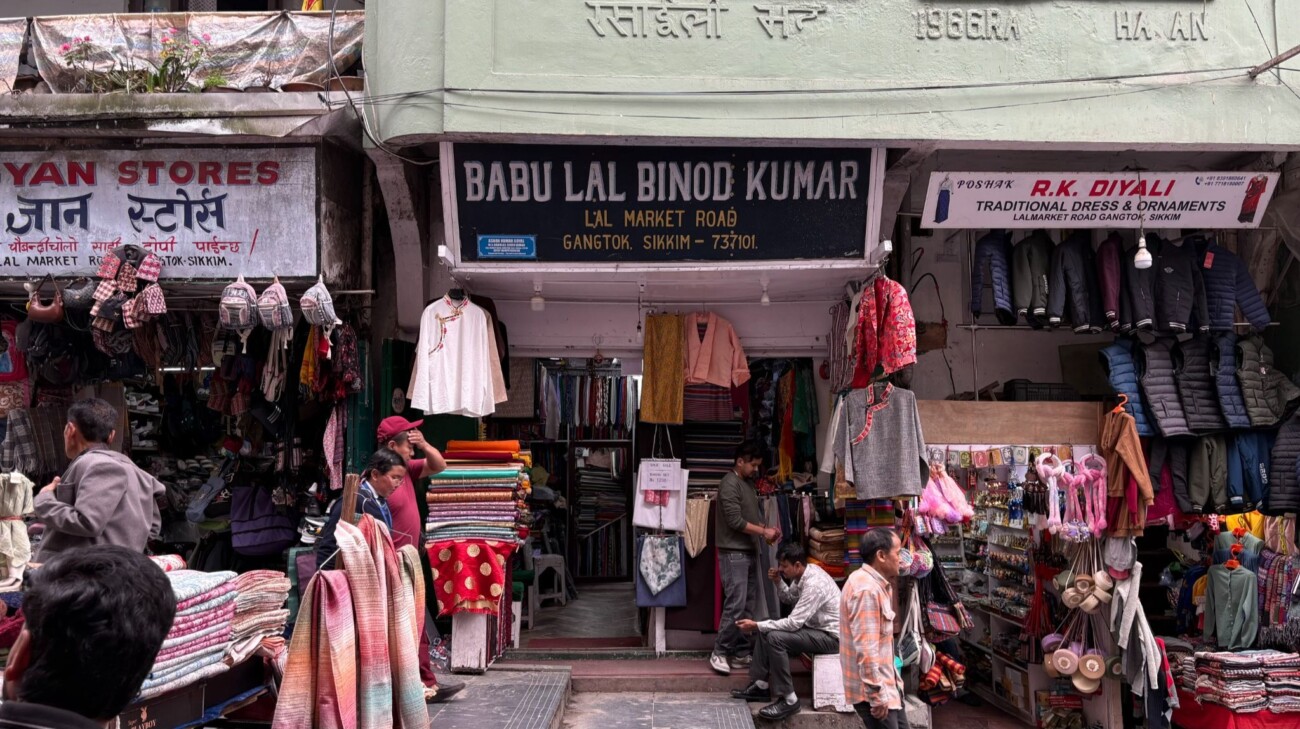
Credit: Aakriti Thatal
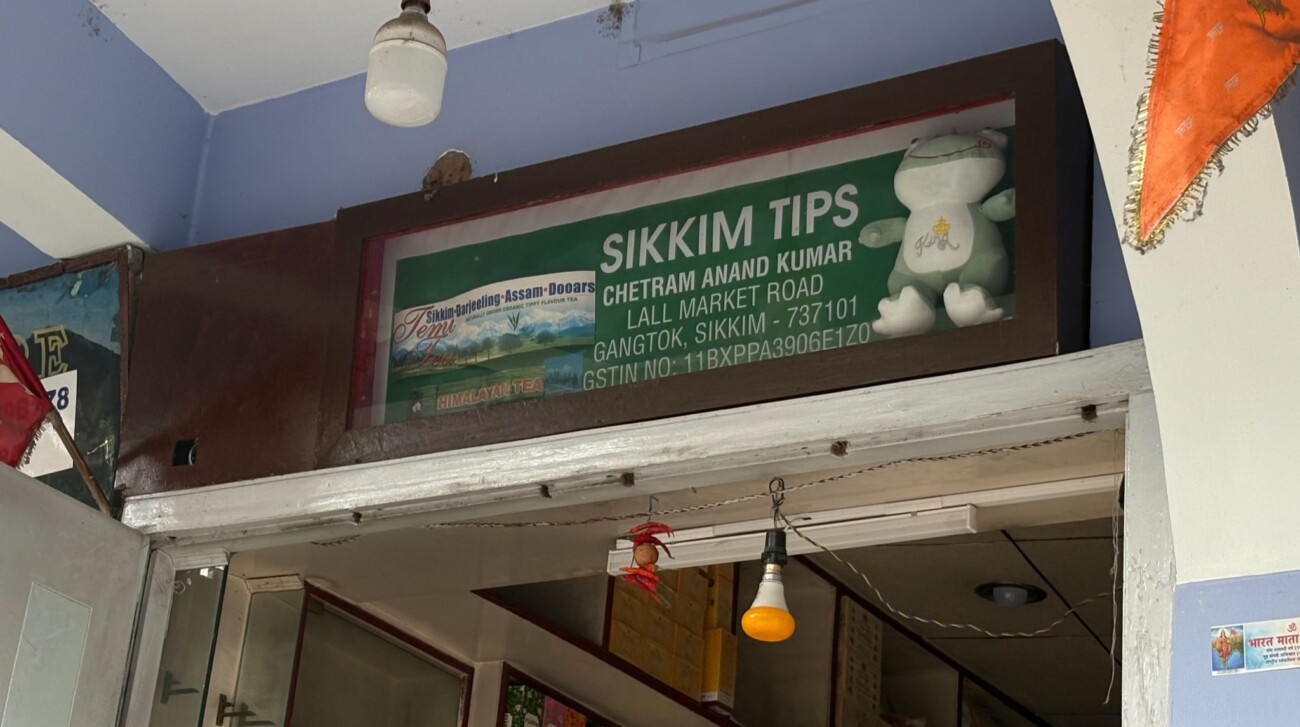
Credit: Aakriti Thatal
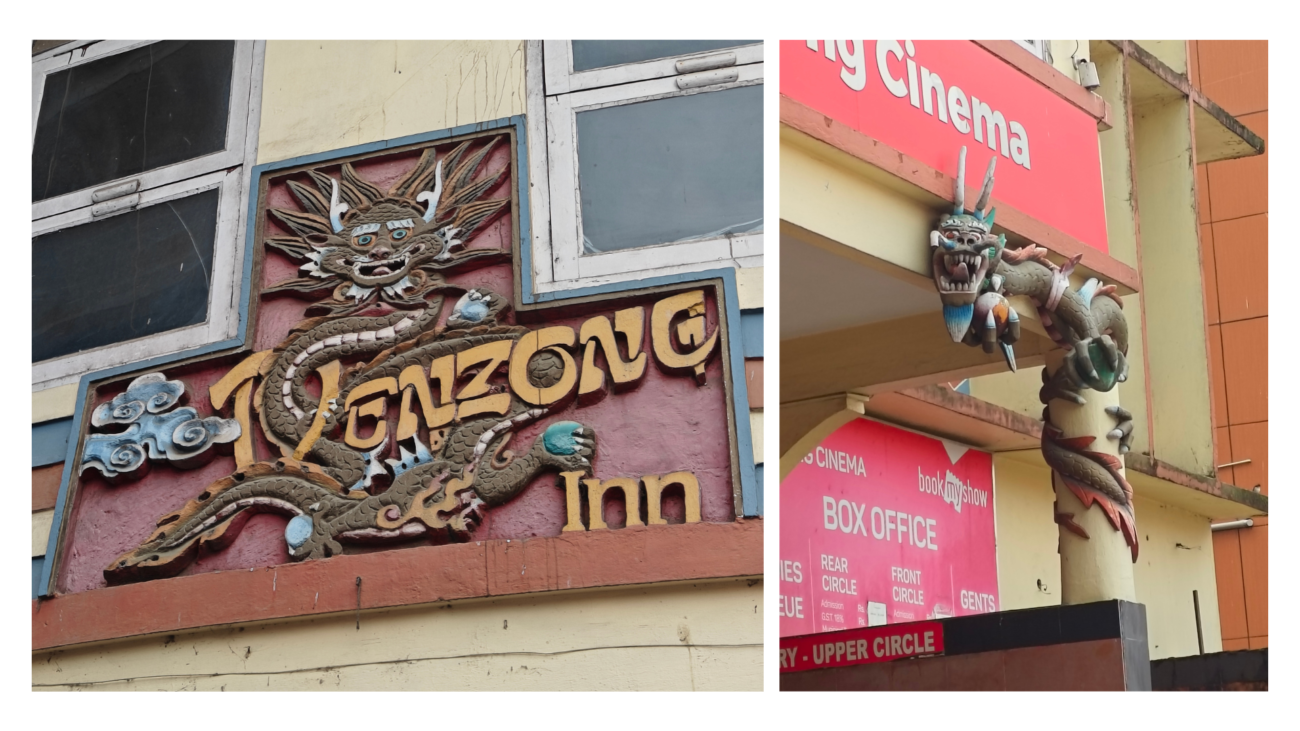
Another participant documented dragon imagery across roughly 20 points in town, carved into gates at Lall Bazaar, Denzong Cinema Hall, and the State Bank, painted on fridge magnets and thangkas in gift shops, in tattoo shops, sprayed as graffiti across town, making way into restaurants, most notably ‘The Dragon Wok,’ flown on the Bhutanese flag on MG Marg, and cast as statues outside the Thakurbaari temple.
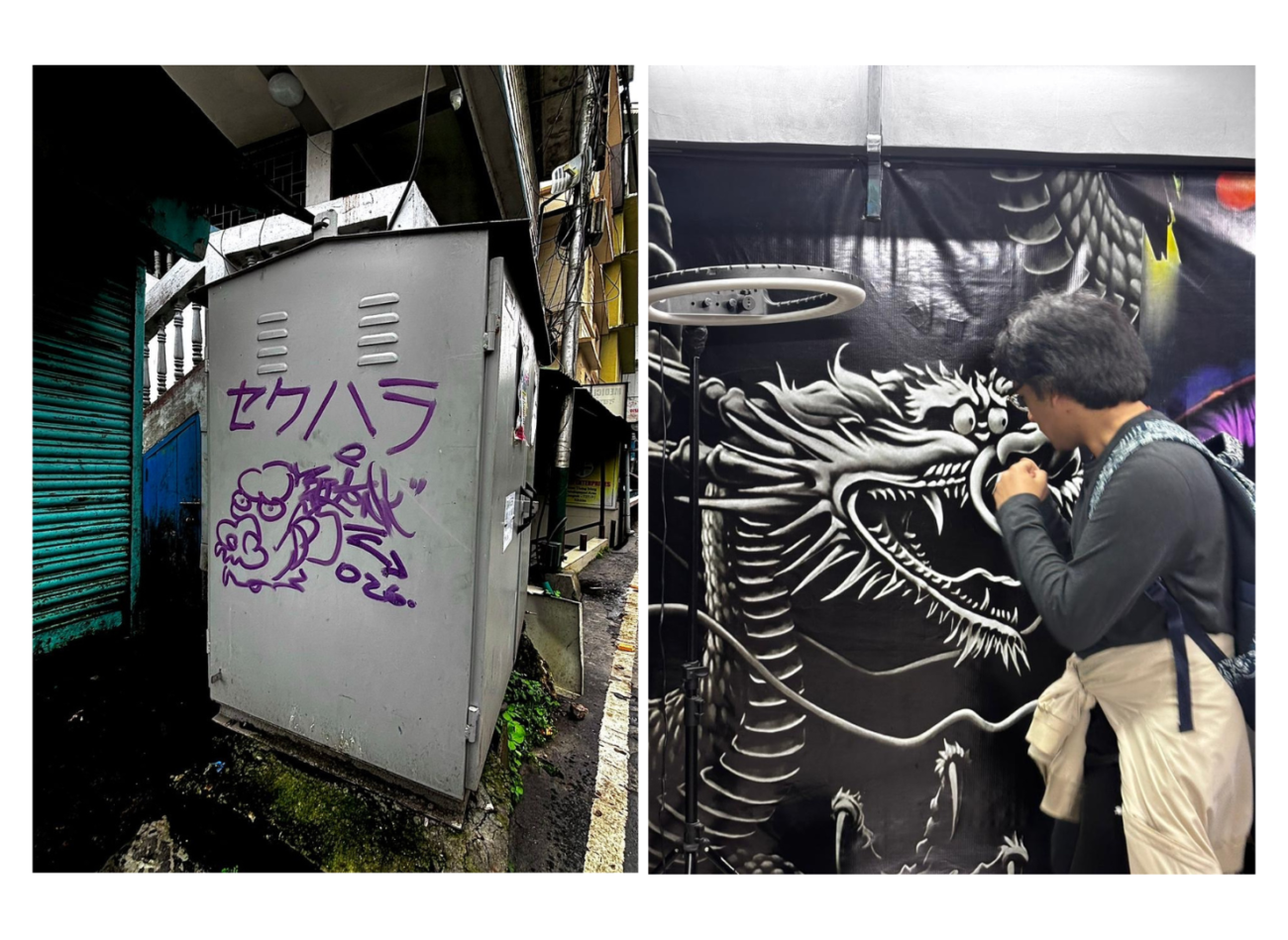
Credit: Aashis N. Sharma
Credit: Rajan
This opened a debate about whether the dragon is even a "Sikkimese" motif, or one borrowed from Tibetan and Chinese trade during Sikkim's founding as a Buddhist kingdom- a question beyond the scope of this article, except to say that the term "Sikkimese" itself resists a single definition (Thatal, 2023), and I'd rather it unsettle the reader's own assumptions than mine. The same is true of "hyperlocal," a term borrowed from Media Studies to describe a relationship to place: if the walk's participants weren't all locals, what counts as local - let alone hyperlocal - to them? I leave that open, along with the larger question of trade routes and cultural exchange it gestures toward.
c. How Do People Live with What Has Been (Re)built?
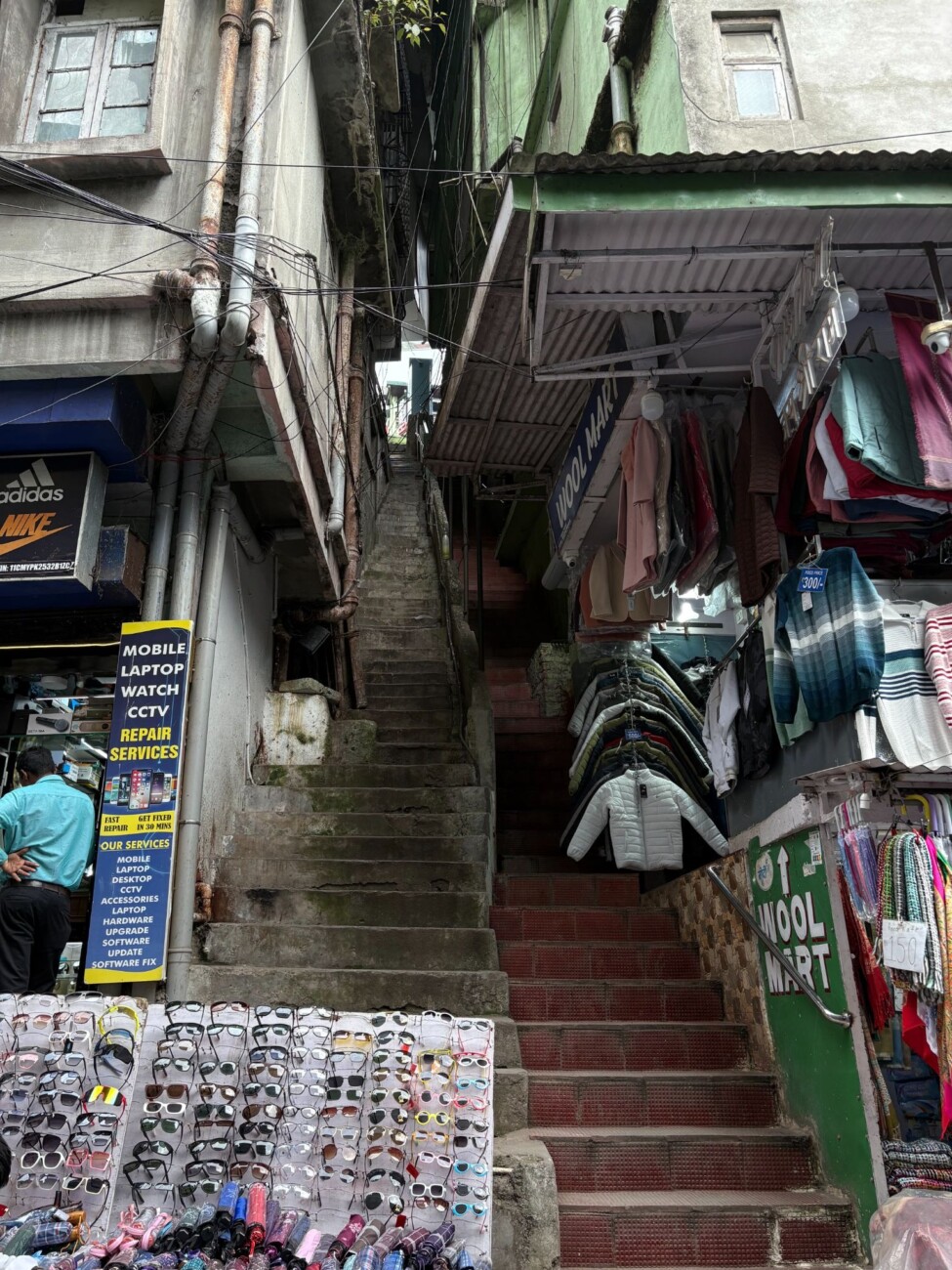
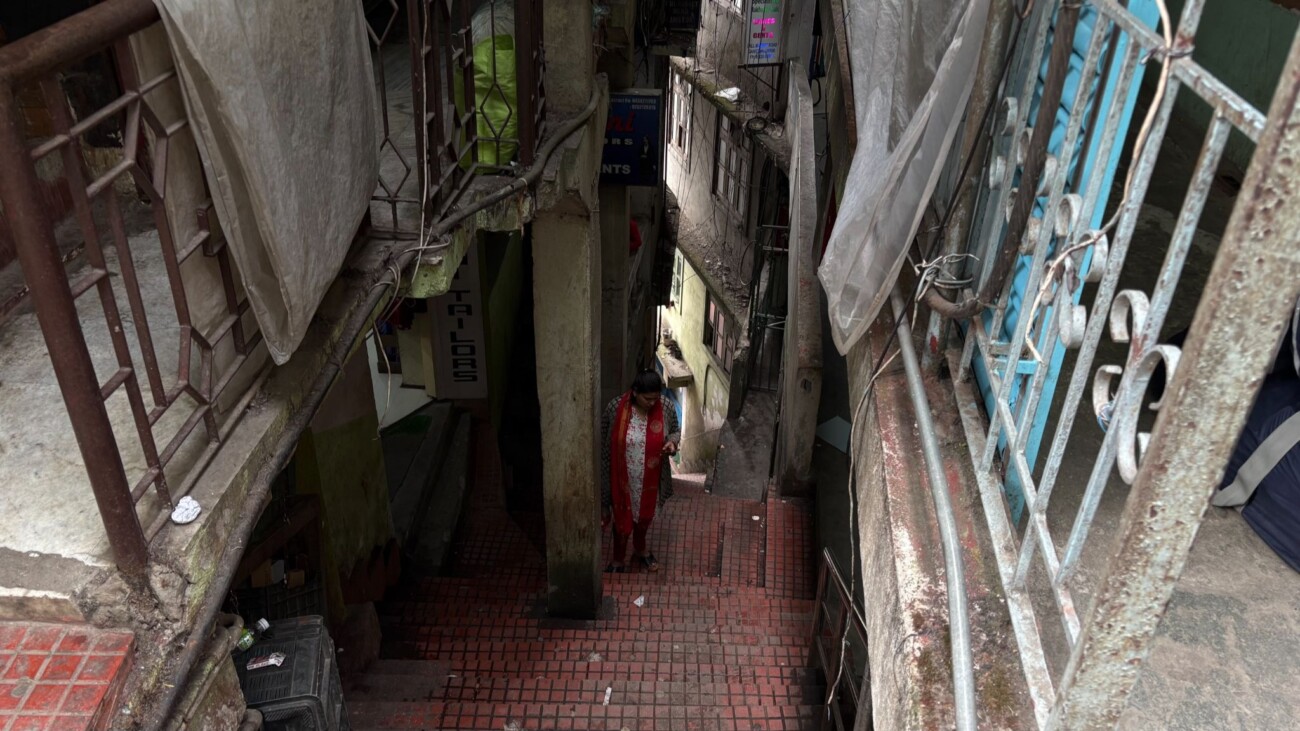
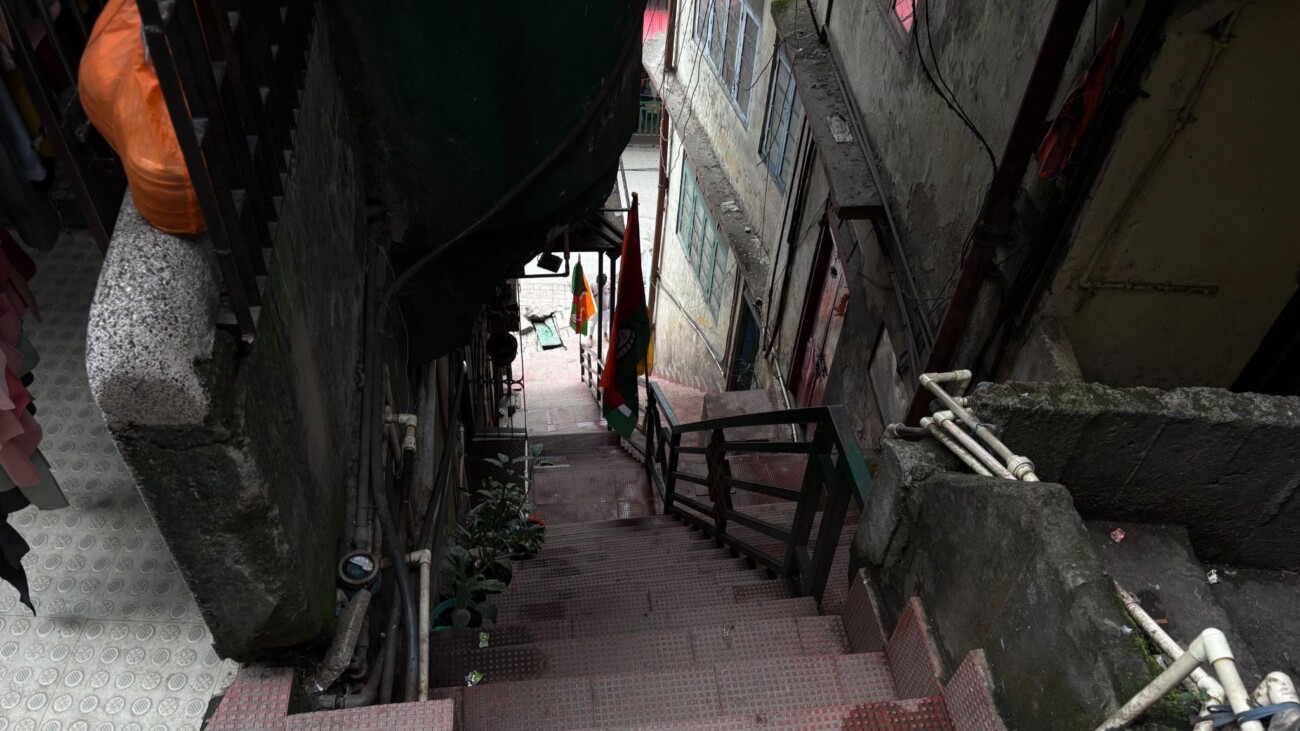
Public spaces are not static. Cities are not only planned from above; they are continually produced from every rung of society. One participant observed Gangtok’s staircases-witnesses to their meanderings and negotiations with the city, meeting points for friends, spaces to avoid some people, and shortcuts to get to places quickly- and how their preservation is crucial to their retaining a sense of belonging in the city.
Credit: Aakriti Thatal
Credit: Aakriti Thatal
Credit: Aakriti Thatal
I have a similar relationship with Gangtok’s footpaths, the cornerstone of my memory, serving as a safe perimeter to walk around Gangtok, remade tirelessly over the years into what is now an almost-continuous stretch from Ranipool to Gangtok with a few disjointed points along the way. The changes began before the SCM arrived, first with new tiles, then a wholly redesigned railing, and continued into the overhead roofs that now punctuate parts of the stretch. In theory, these roofs shelter walkers from Gangtok’s sun and its incessant rain; in practice, built for straight-falling water, they do little against the slanting rain that actually falls here. Cross ducts at strategic points remain largely absent, so pedestrians often climb over the footpath railing to cross; the foot-over bridges, at least, still do their job. The stretch, between the New Sadar Police Station and the entry to the Development Area, was built at the cost of hundreds of trees, which makes the shade-giving roofs a bitter irony: shelter from a sun made harsher by the cutting of the trees where a new shelter is built.
The images that once existed in our minds have now been colonised by structures that do not belong here, geographically and ecologically challenging our sense of belonging in the city.
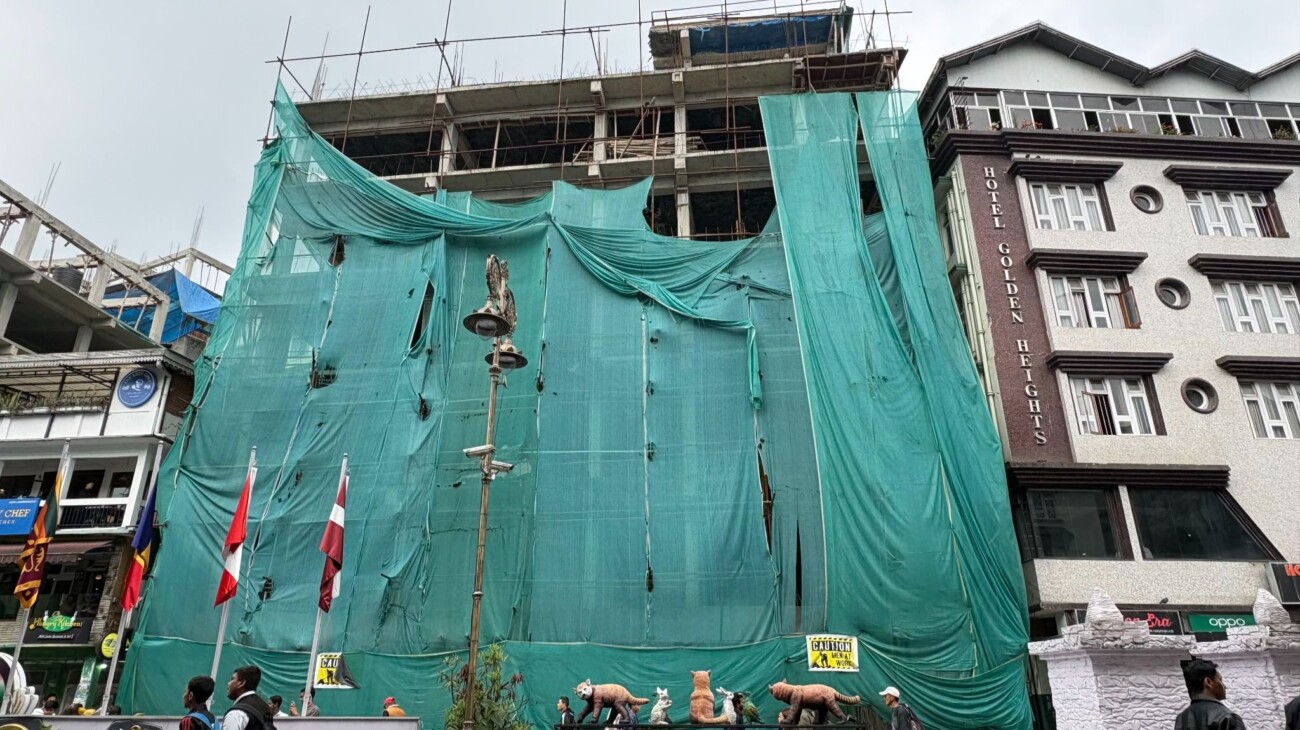
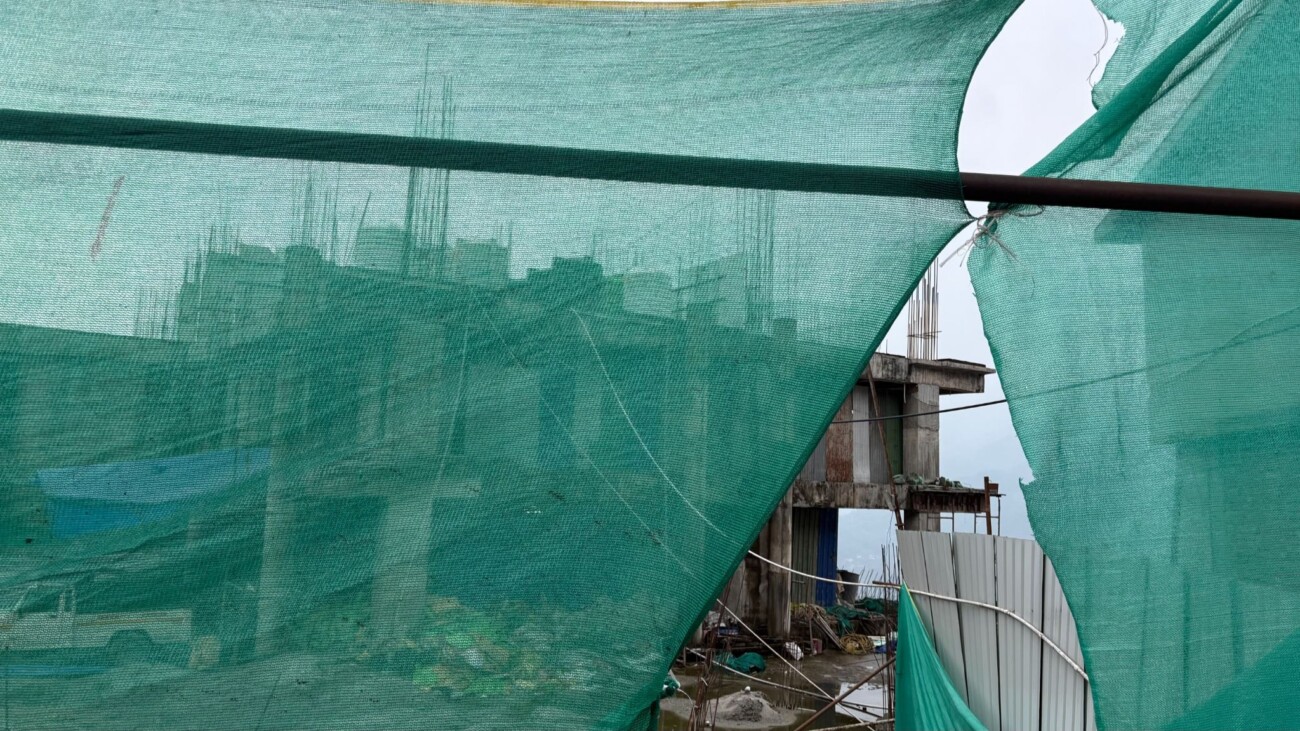
Several participants also spoke of the constant construction in Gangtok. They observed that the suggested route, which was once scenic with multiple viewpoints that offered not just aesthetics but also a respite from their daily lives, had now devolved into an urban jungle. This isn’t nostalgia so much as a changed relationship with the land: as the landscape shifts, so does the memoryscape. The images that once existed in our minds have now been colonised by structures that do not belong here, geographically and ecologically challenging our sense of belonging in the city.
Credit: Aakriti Thatal
Credit: Aakriti Thatal
Widely quoted and rightly so, change is inevitable, but only constructive and favourable when it takes into account those who experience that change. Change rooted in people’s experiences is the only kind that is palatable; otherwise, it risks becoming an unnecessary embellishment. Communities must feel responsible for change, and for one to assume that responsibility and accountability, they must be made part of the discourse around changes. Before one realises, our concerns are packed into small boxes and sold back to us as dreams and aspirations of rebuilding a place. Between windows, construction sheeting, shopfronts, labour, flags, motifs, lamp-posts, umbrellas, and posters, a city is experienced through its objects. And the removal, or worse, the dis-consideration of one’s experiences of the city from larger plans of city-planning suggests that things are being done to the city and not with it.
Concluding Thoughts: Gangtok as a Giant Construction Site
It bears reiterating that what’s recounted here is drawn from a more extensive, and necessarily incomplete, archive of experiences. This essay is as much a critique of the SCM as an attempt to render visible the repository of memories and lived experiences that residents carry of their city. Also, how these are being reshaped in the process. Yet, this reshaping has rarely been a negotiated process. The SCM, in its execution, has largely proceeded without meaningful public deliberation, treating the city as a site to be optimised rather than a space to be collectively imagined.
Holston and Appadurai (1996) contend that citizenship relies on the notion of a community of shared intention and commensurable citizens, which assumes that this community is devoted to forming a shared life suited to the conditions of modernity. However, this also assumes that all people are similar. Here, the idea of shared culture topples over since, in the face of modernity, one realises that citizens are not commensurable. This incommensurability among citizens, then, is not merely a social or a political fact, but fundamentally also a spatial one. If citizens cannot be assumed to share a single, unified intention, then neither can the spaces they inhabit be understood as singular.
But as the walk participants’ accounts made clear, what is delivered instead is not exclusion in any overt sense, but a steady, almost imperceptible pressure to adapt, to find workarounds for what is built without them in mind.
Let's consider this space “under construction.” The objective of the SCM does not meet Massey’s (2005) description of space as ‘the sphere of coexisting heterogeneity’ influenced by the co-occurrence of multiplicity. Without multiplicity, no space really exists at all. Sikkim’s push for tourism as an engine of growth has shaped Gangtok’s image as much as the Mission has (Thatal, 2023).
Finally, the promise of infrastructure in Gangtok has been of inclusivity and convenience: spaces that would let Gangtokians become their fuller selves. But as the walk participants’ accounts made clear, what is delivered instead is not exclusion in any overt sense, but a steady, almost imperceptible pressure to adapt, to find workarounds for what is built without them in mind. This is not the inclusivity that was promised. I do not raise this to argue for keeping Gangtok as it is, or as it was, blindly challenging all development projects; the very idea of a ‘pristine’ place reeks of privilege, and anyone who has lived in one knows it means a constant negotiation between surviving and being seen. Rather, this is an attempt at recalibrating our aspirations, as a society, toward a better future for our city. Our identities are inherently attached to a place, and when a place changes faster than we can make sense of it, we lose facets of ourselves before we even recognise them. With urban redesign comes the redesign of the social fabric of the city we all share, actualised in how the everyday objects around us are transformed. Every beautification drive has a price, most often paid by the land we stand on and the air we breathe. The question was never whether development is happening, but who gets to imagine the city being built, and whether residents are made part of it, or merely informed of it after. If Gangtok is to keep becoming, it must do so with its people.
Perhaps, then, to truly see Gangtok for what it is, and not merely as the SCM envisions it, one must learn to do both: to look up, as Baba urged, and down, as Aama cautioned, holding together what is imagined and what is already underfoot.
Note:
Some of the images taken by participants of the walk can be accessed at: https://drive.google.com/drive/folders/1WTm73dvjboo4jTUaC8ZJMnIWmtz1jG7I?usp=sharing
All images have been uploaded by the makers with prior consent sought and the use of the images made aware. Do not use these images without consent, and without rightfully crediting the makers.
1 A relatively busy, centrally located neighbourhood along the NH-10
2Gangtok Bazaar
3 Vis-a-vis the Orchidarium
Bibliography: (217 words)
- About the mission | Smartcities. (n.d.). Ministry of Housing and Urban Affairs, Government of India. Retrieved July 1, 2026, from https://smartcities.gov.in/about-the-mission
- Anand, N., Gupta, A., & Appel, H. (Eds). (2018). The Promise of Infrastructure. Duke University Press. https://doi.org/10.2307/j.ctv12101q3
- Appadurai, A. (2004). The capacity to aspire: culture and the terms of recognition. In V. Rao & M. Walton (Eds.), Culture and Public Action. Stanford University Press.
- Dourish, P., & Bell, G. (2007). The Infrastructure of Experience and the Experience of Infrastructure: Meaning and Structure in Everyday Encounters with Space. Environment and Planning B Planning and Design, 34(3), 414–430. https://doi.org/10.1068/b32035t
- Gangtok Smart City Development Limited. (n.d.). Gangtok Smart City Development Limited. Retrieved July 1, 2026, from https://smartcitygangtok.com/
- Habermas, J. (1991). The structural transformation of the public sphere: An inquiry into a category of bourgeois society. MIT Press (MA).
- Harvey, D. (1985). The urbanization of capital. Johns Hopkins University Press.
- Holston, J., & Appadurai, A. (1998). Cities and citizenship. Public Culture, 8, 187–204. https://doi.org/10.2307/j.ctv11cw70j
- Massey, D. (2005). For space. SAGE Publications Limited.
- Simone, A. (2004). People as infrastructure: Intersecting fragments in Johannesburg. Public Culture, 16(3), 407–429. https://doi.org/10.1215/08992363-16-3-407
- Thatal, A. (2023). Café Culture: Exploring the roles of cafés in cultural production among the urban middle class in Gangtok, Sikkim. [MA Thesis]. Tata Institute of Social Sciences.
Aakriti Thatal (she/they) is a multidisciplinary artist-researcher working across writing, photography, and film. With a background in Media & Cultural Studies and Anthropology, she engages critically with questions of identity, culture, and belonging. Her work engages with the idea of home, exploring public participation in urban spaces and how its presence or absence shapes urban life, material landscapes, and urban aspirations. Her work is informed by the layered inclusions and exclusions produced by caste and gender. Aakriti’s current research focuses on making and recording memory through still and moving images and its engagement with rapid urbanisation in Gangtok, as well as how art can act as a catalyst for critical thinking. She previously worked with the NGOs Humsafar Trust and PRADAN, as a production assistant at Scroll.In and a Media Studies teacher at Bishop Cotton Girls' School. She is currently a fellow with India Development Review.



Congratulations! Well expressed.... keep it up...My best wishes for ur future endeavours.
Very well written!
She has come up with a very different approach of writing on the things which is and which should have been. Its dynamism and references, what makes it a well researched and much needed article.
The words can take you places....A poetic essay..the compliments for awesome photography too.
Amazingly beautiful.
Deeply resonant from a sustainable development perspective. So well-articulated on the human cost of top-down urban planning.
I liked how naturally the essay juxtaposes themes, feelings, and observations. As we look up and look down, read through and beyond, it creates a space wide open for our own contemplation, allowing us to consider what living with this city means to us.
The essay opens a curtain onto the city from a bunch of different angles, educates us about them, and, to its greatest credit, allows us to breathe a life of our own into it.
Good stuff.
Wonderful projection of the transition that is happening, with an underlying message of where we are heading towards.