Cities grow because they bring people, enterprise, and ideas into close proximity. This concentration creates economic efficiency, social diversity, and opportunity—forces that draw people in and drive urbanisation. But while cities grow organically, they do not thrive without intent. Planning is what separates a liveable city from an unmanageable one.
Unlike cities in the plains, mountain cities operate under severe constraints—limited land, fragile ecology, and difficult mobility. Most urban planning frameworks are designed for flat and gentler terrain.As a result, places like Gangtok grow without a model.Congestion, poor last-mile connectivity, pressure on water and services, lack of public space, and increasing vulnerability to disasters are the consequences of unplanned urbanization.
Unlike cities in the plains, mountain cities operate under severe constraints—limited land, fragile ecology, and difficult mobility. Most urban planning frameworks are designed for flat and gentler terrain.As a result, places like Gangtok grow without a model.Congestion, poor last-mile connectivity, pressure on water and services, lack of public space, and increasing vulnerability to disasters are the consequences of unplanned urbanization.
Gangtok’s growth has been largely organic, not by design but by default. This is not due to a lack of imagination, but the lack of a shared vision—and the confidence to pursue it. If we continue this way, we risk locking ourselves into a future of compounding problems.
Mobility as the Foundation of Urban Form
Urbanisation begins with access In the mountains, where terrain makes movement difficult, mobility does not just support the city—it shapes it. The way we move determines how we build, where we live, and how communities connect.
Today, road-based mobility dominates, but roads are land-intensive and inefficient on steep terrain. As population and vehicle numbers grow, congestion inevitably worsen, leading to gridlock.If mobility is the foundation of urban form, then rethinking mobility is the key to rethinking the city itself.
Contour Urbanism: Building Along the Terrain
In the mountains, flat land is rare—but where it exists, life thrives. Instead of large plazas, what the terrain offers are linear stretches along contours. These can become car-free pedestrian pathways—“strips of life”—that form the backbone of urban habitation. [Fig.1]
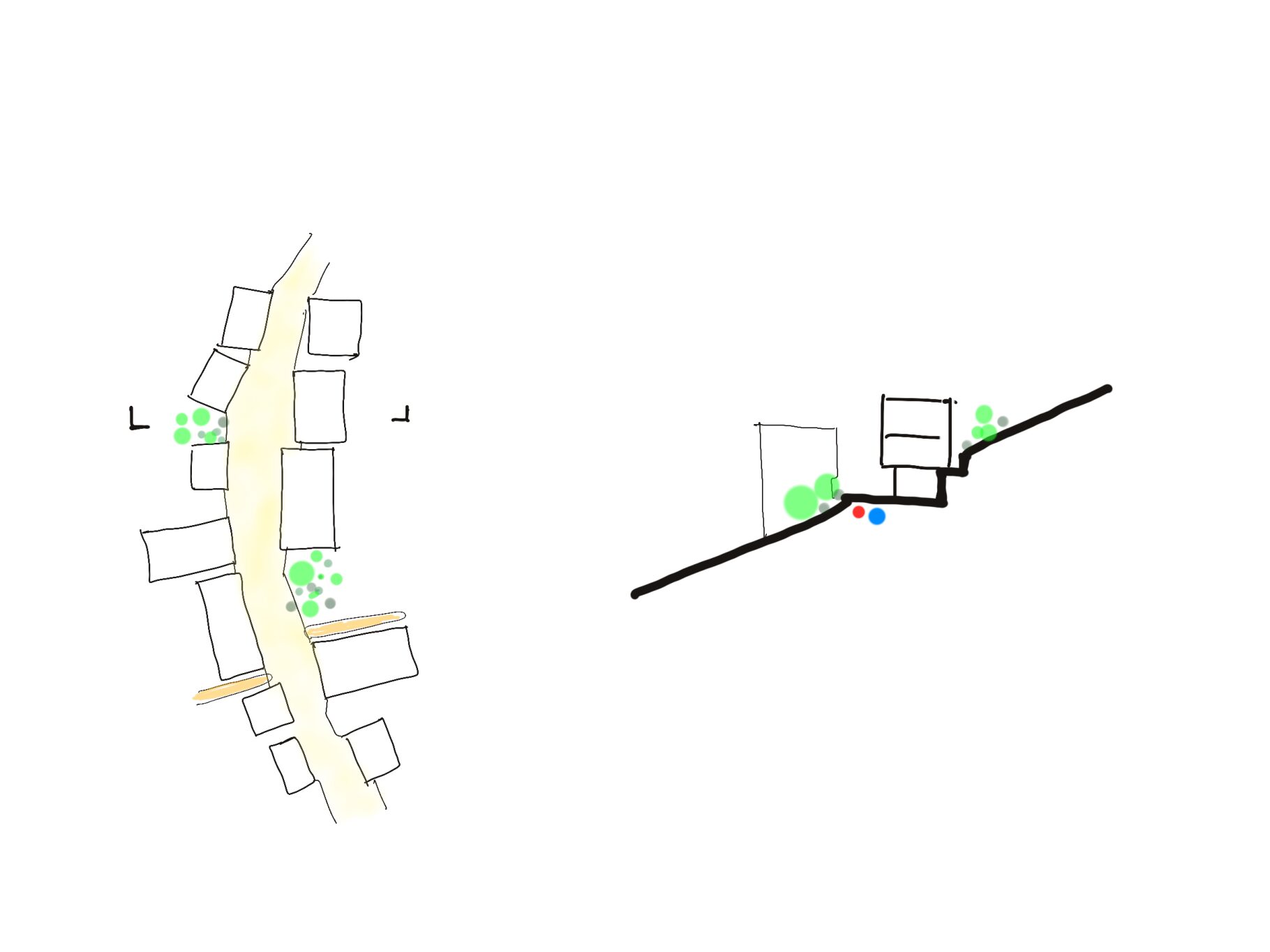
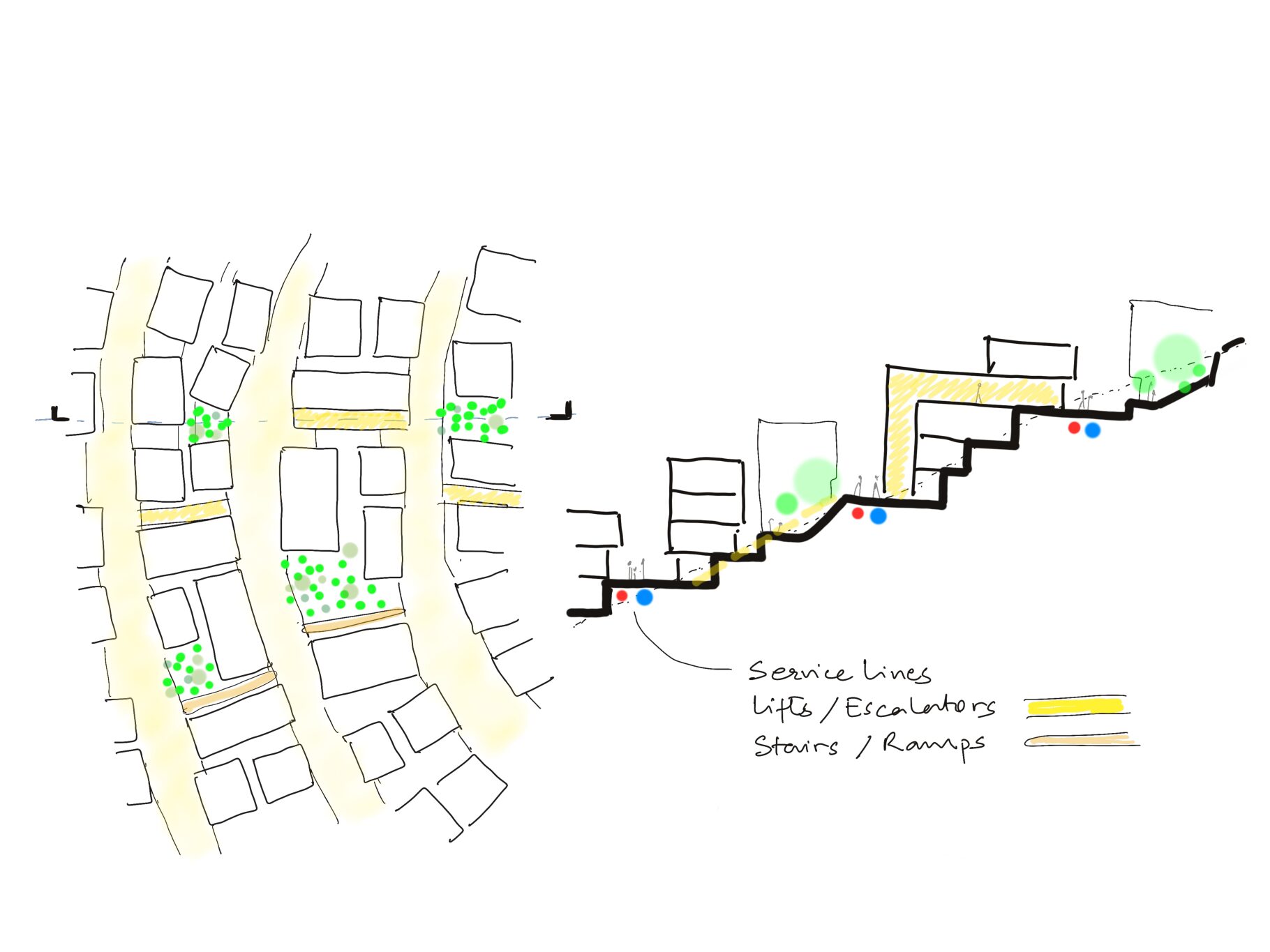
Clusters of these horizontal walkways, connected vertically by lifts, escalators, and ramps, can create accessible, inclusive neighbourhoods. Such a system supports walking, encourages community interaction, and provides a structured framework for services like water, sewage, and electricity. [Fig. 2]
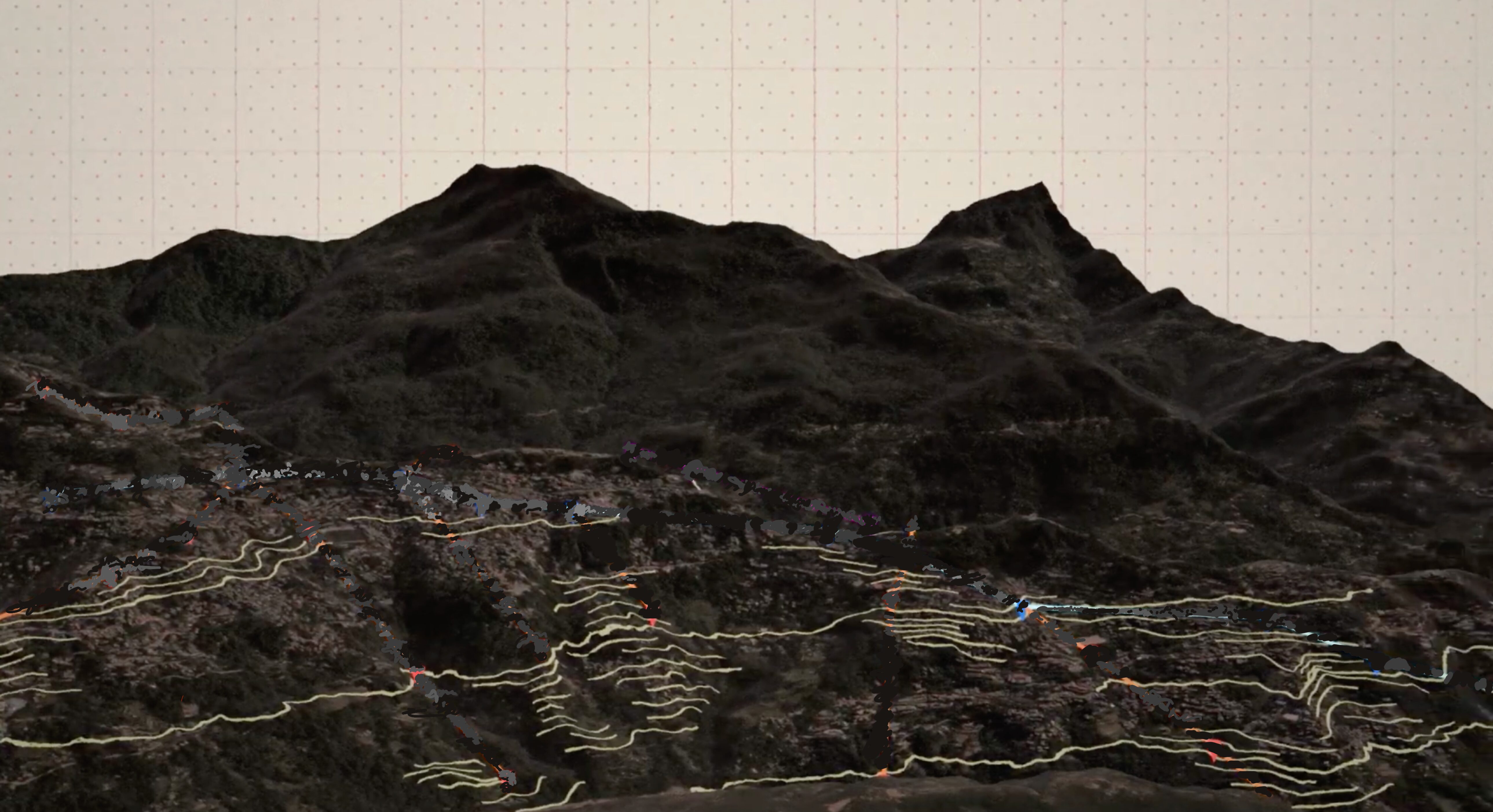
At a larger scale, neighbourhoods can be connected through a network of these pathways, forming a city-wide mobility layer that is human-centric rather than vehicle-dependent. [Fig. 3]
Ropeways: A Mountain Solution
For longer distances and steep gradients, ropeways offer a compelling alternative.Unlike roads, they require minimal land, traverse slopes efficiently, and operate without adding to ground congestion. They are environmentally cleaner, quieter, and less disruptive to fragile mountain ecosystems. Modern systems can carry not just passengers, but goods and emergency services as well.Of course, ropeways come with concerns—privacy, visual impact, and questions of ownership. But these are design and governance challenges, not reasons for dismissal.
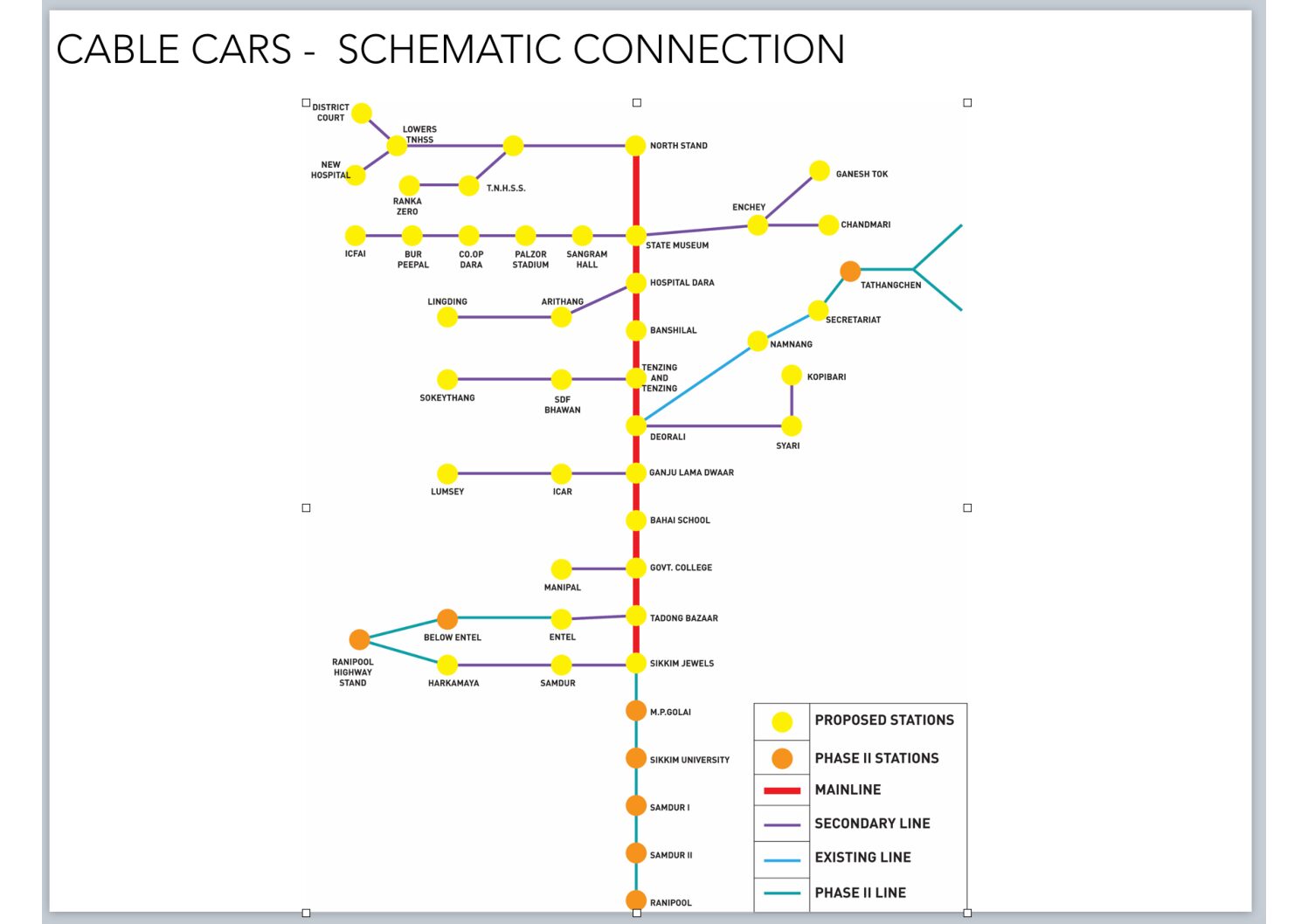
Ropeways, unlike roads, demand a design approach that leverages their ability to traverse steep slopes and sharply reduce travel distances. In a ridge-based city like Gangtok, lines should run perpendicular to the ridge to enable efficient uphill and downhill movement.
Ropeways, unlike roads, demand a design approach that leverages their ability to traverse steep slopes and sharply reduce travel distances. In a ridge-based city like Gangtok, lines should run perpendicular to the ridge to enable efficient uphill and downhill movement. A linear spine from Ranipul to Bojoghari can connect these lines and facilitate longer-distance travel. [Fig. 4]
If integrated thoughtfully with pedestrian networks, ropeways can fundamentally transform how Gangtok moves—and, by extension, how it grows.
Planning Through Mobility
Mobility is not just a transport issue; it is a planning tool. Choosing the right mobility system can help address multiple urban challenges simultaneously—housing, congestion, service delivery, public space, and even disaster management.
Mobility is not just a transport issue; it is a planning tool. Choosing the right mobility system can help address multiple urban challenges simultaneously—housing, congestion, service delivery, public space, and even disaster management.
Imagine a parallel, car-free layer across the city: a network of walkways, vertical connectors, and ropeways that allows people to move without relying on vehicles. Such a system could revitalise neglected neighbourhoods, stimulate local economies, and improve quality of life where it is needed most.Even existing neighbourhoods can be retrofitted. By connecting and reorganising current paths into coherent horizontal networks, accessibility can be significantly improved. With genuine public participation, such transformations are not only possible but likely to gain support.
Beyond Infrastructure: The Question of Ownership
How we build is as important as what we build. The prevailing development model—often driven by large, externally executed projects—prioritises infrastructure over people. It limits local participation, erodes ownership, and misses precious opportunities to build local capacity. Conventional public-private partnership (PPP) frameworks, while widely used, may not be optimal in contexts where institutional capacity is limited and socio-economic equity is a priority.
How we build is as important as what we build...Gangtok needs an approach that involves community-oriented ownership structures, where local stakeholders—including residents, landowners, professionals, and government—participate directly in the planning, financing, and operation of infrastructure systems.
Gangtok needs an approach that involves community-oriented ownership structures, where local stakeholders—including residents, landowners, professionals, and government—participate directly in the planning, financing, and operation of infrastructure systems.
Such models offer several advantages:
• Enhanced local ownership and accountability
• Retention of economic benefits within the region
• Opportunities for skill development and capacity building [especially for a transformative technology for mobility in the mountains like ropeways]
• Greater alignment with community needs and priorities
External technical expertise can be incorporated in a consultative role, ensuring quality while preserving local agency. While ownership should remain local, the benefits of a ropeway system must be widely shared to avoid monopolies. An alternative to a conventional PPP model is a community-led consortium that conceives, builds, and operates the system, supported by international technical experts as advisors.
Equity can be distributed among key local stakeholders based on agreed contributions, creating an ownership structure aligned with community interests [Fig. 5]
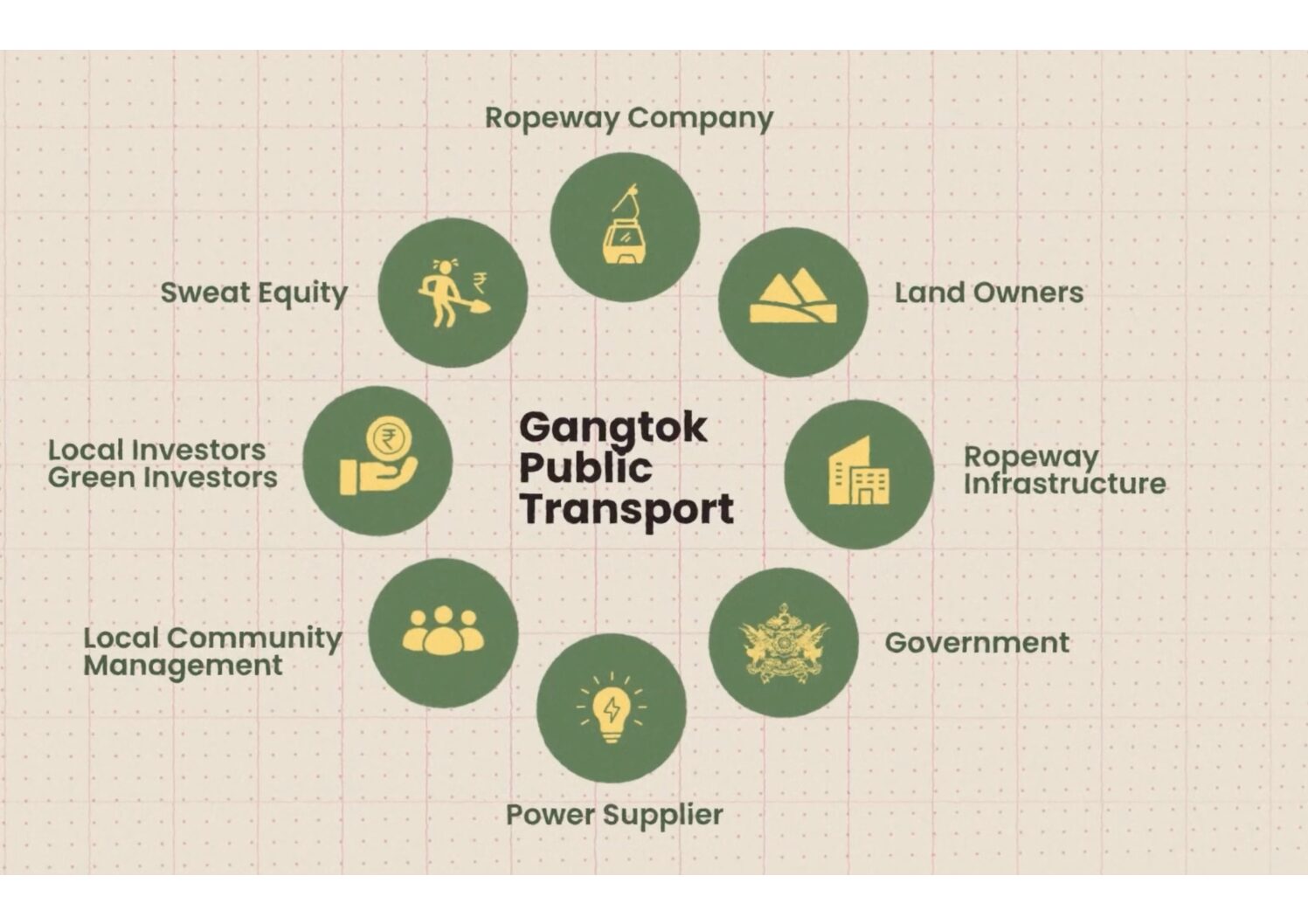
- Promoters (Sweat Equity): Entrepreneurs, designers, planners, contractors, and professionals who initiate and steward the project.
- Landowners: Given land scarcity in Gangtok, owners—especially at station sites—can contribute land as equity; government land can be similarly valued.
- Contractors: Construction partners can take equity in lieu of cash payments, reducing capital expenditure and debt reliance.
- Government: A key stakeholder through land and power contributions, requiring a more enabling and flexible institutional approach.
- Local Neighbourhoods: Representation in governance ensures accountability and alignment with community needs.
- Ropeway Company (Strategic Partner): A reputable international firm could come on board under aligned CSR objectives, providing expertise and potentially reducing dependence on external financing.
This model distributes ownership, lowers upfront costs, and embeds the project within the local socio-economic fabric.
External technical expertise can be incorporated in a consultative role, ensuring quality while preserving local agency.This is not just about equity; it is about long-term resilience. A city that understands and manages its own systems is better equipped to adapt and thrive.
External technical expertise can be incorporated in a consultative role, ensuring quality while preserving local agency.This is not just about equity; it is about long-term resilience. A city that understands and manages its own systems is better equipped to adapt and thrive.
The Governance Gap
None of this is possible without clarity in governance. Today, there is ambiguity over who is responsible for planning and managing the city. This situation undermines long-term thinking and allows short-term, ad hoc decisions to prevail. Without a coherent vision and accountable leadership, even the best ideas cannot be implemented effectively.
Planning is, fundamentally, an act of governance. It requires intent, coordination, and the ability to think beyond immediate pressures. A community-based ownership model will have the inherent checks and balances to help it succeed and can possibly grow to fill the vacuum of stewarding the city.
Planning is, fundamentally, an act of governance. It requires intent, coordination, and the ability to think beyond immediate pressures. A community-based ownership model will have the inherent checks and balances to help it succeed and can possibly grow to fill the vacuum of stewarding the city.
A Choice About the Future
Gangtok stands at crossroads. It can continue on its current path—reactive, fragmented, and increasingly strained. Or it can choose to evolve deliberately, using its constraints as a framework for innovation.This is not just about infrastructure or mobility. It is about the kind of city we want to become—and the kind of society we want to be.
Development, if understood as evolution, demands direction. It requires us to define what matters, to take responsibility for our future, and to ensure that growth strengthens rather than erodes our social fabric. In the end, cities reflect their people. Their values, their governance, and their sense of collective purpose are embedded in the spaces they create. If Gangtok is to thrive, it must not only build differently—it must think differently.
In the end, cities reflect their people. Their values, their governance, and their sense of collective purpose are embedded in the spaces they create. If Gangtok is to thrive, it must not only build differently—it must think differently.
Kailash Pradhan graduated from CEPT University, Ahmedabad, in 1990 and was the first architect from Sikkim to start a private practice (1991). After a 5-year stint in Bhutan (2004 - 09), he co-founded ‘Studio Interweave’ with Upendra Gurung and continues to seek an architectural language that responds to the region's climatic, environmental, social, and economic context. He contested the 2021 Gangtok Municipal elections and the 2024 Legislative Assembly elections as an independent candidate on the plank of planning and revitalising Gangtok. He is also the founder member of ‘Green Circle’, an environmental NGO and ‘Architects of Sikkim’ [AS]. He currently divides his time between Architecture and Civic activism.



A well-conceived urban ropeway network, of the kind envisioned and consistently advocated by Kailash Pradhan, has the potential to transform Gangtok as wonderfully as the metro rail transformed Delhi. In a poorly planned mountainous city like Gangtok with rising vehicular congestion, conventional urban transport solutions offer only incremental relief. Ropeway-based mass transit is uniquely suited to our topography. It will surely be spatially efficient, environmentally less intrusive, energy-efficient, and capable of bypassing the constraints that make surface mobility increasingly unsustainable.
What makes the proposal particularly compelling is that it is not merely an engineering idea but a systems-level reimagination of urban mobility for hill cities.
Sadly visionary proposals originating outside political and bureaucratic ecosystems often struggle to receive institutional attention. Administrative cultures tend to privilege incrementalism, departmental silos and conventionally sanctioned expertise over disruptive, interdisciplinary thinking.
Transformative ideas advanced by independent thinkers frequently remain underexamined until crisis makes innovation unavoidable.
The larger issue, therefore, is not merely whether Gangtok builds a ropeway network but whether governance systems are capable of recognising and nurturing anticipatory, future-oriented thinking irrespective of where it originates. Cities that leap forward are often those willing to listen to unconventional but contextually intelligent ideas before they become obvious necessities.
Enjoyed the write up!
Comment: Of Immediate Concern: Ropeways as a viable public transport mode being acknowledged by the Government is great news, but the PPP proposal being pushed forward by them is based on a tentative scheme made 10 years ago solely for the purpose of conducting a Techno-economic feasibility study. When asked about the planning parameters of the alignment, the UDD said then that the Station locations were hypothetical and urban planning issues would be worth considering only if the data substantiated the feasibility of ropeways as public transport. The outcome of the study was positive, but the subsequent urban design exercise was sidestepped and now the exact same proposal is being considered for implementation. It lacks the design input that such a massive urban intervention demands and points to institutional negligence. Gangtok’s challenges extend beyond traffic and it is easy to fall into the trap of looking at mobility in isolation in today’s ‘project mode’ system of functioning. Mobility should be understood not merely as transport, but as a planning tool capable of reorganising the city and improving the built environment. Integrated thoughtfully into the urban fabric, mobility infrastructure can become a catalyst for urban renewal and social inclusion. Decisions with long-term consequences for the city needs to be transparent, participatory and guided by public rather than special interests. The lesson from Sikkim’s hydropower experience is clear: surrendering ownership of critical public assets risks alienating local communities from their own future. Gangtok’s mobility transition should therefore not only solve transport problems, but also strengthen democratic planning, protect public ownership and improve the everyday quality of urban life