In 1894, Thutob Namgyal, the 9th Chogyal of Sikkim, shifted the capital of Sikkim from Tumlong to Gangtok. Gangtok’s urbanisation journey has its roots in the administrative headquarters of the British Agency in Sikkim, its calculated placement and importance as a route to Indo-Tibetan trade (Kharel, 2005). The British recognized that the shortest route from the plains of Bengal to Lhasa, the Tibetan capital, was through Sikkim. Today, Gangtok represents a shifting urban space, where high rise buildings obscure the mountain's sacred presence. Occasionally, traces of its past surface in the city’s layered history through the visual tracing of Gangtok’s historical evolution and its continuing importance as a socio-political and cultural hub of Sikkim.
The article aims to use the method of 'walking ethnography' to examine the streets of Gangtok, specifically Mahatma Gandhi Marg and Tibet Road. This is also my ongoing process of immersive urban ethnographic fieldwork. By placing visual and spatial observations within broader cultural and ecological contexts, this perspective reflects on the interplay between everyday lives and cultural negotiations.
Tracing the Intersections of Street Art and Everyday Life in Tibet Road
Tibet Road in Gangtok is a historically significant urban corridor that once connected Sikkim to the trans-Himalayan trade networks leading into Tibet. Its name echoes these older mobilities and exchanges, situating the street within the histories of commerce, migration, and cultural encounter in the Eastern Himalayas. Today, the road has transformed from its mercantile past into a layered urban landscape, where everyday practices, visual expressions, and memories intersect. Tibet Road comes alive through the sights of shopkeepers, schoolchildren, migrant workers, and passersby who make the street by their everyday functioning routines. Yet its present texture is also shaped by wall art. They are made up of images of mountains, trekkers, prayer flags, and cyclists, altering the visual landscape and offering alternative perspectives on history, identity, and belonging. They turn the road into a living slate where the past can be reinterpreted and the present visually negotiated.
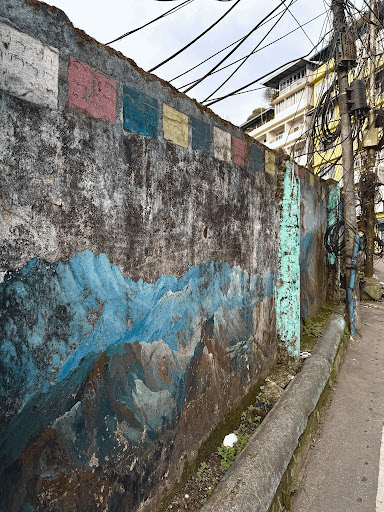
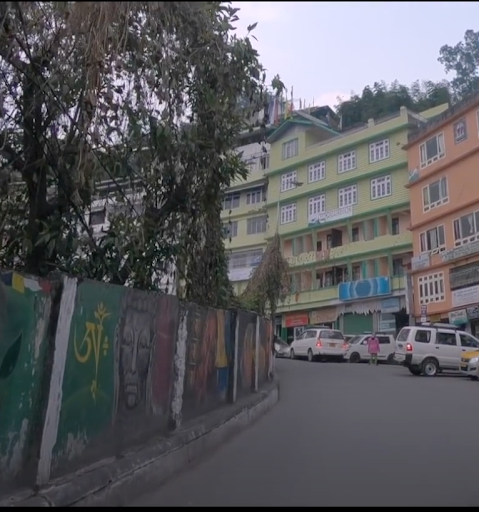
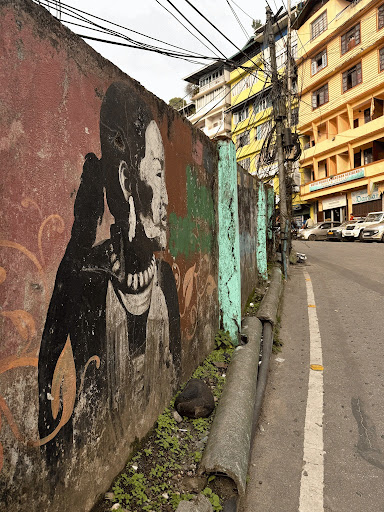
Once a site of traders on horseback and surrounded by Tibetan settlements decorated with prayer flags, the road embodied a cultural and spiritual landscape. Now, Tibet Road is mostly dominated by hotels, and restaurants. However, trekker shops selling trekking essentials in the street are a window to the past traders’ route and a contemporary trekkers' hub. The wall art depicting Lord Buddha, accompanied by Tibetan inscriptions of Om Mani Padme Hum, reflects the religious sensibilities of the residents of Tibet Road. As one of the fifty-year-old residents reflects, ‘This makes me still believe in Sikkim as a sacred place, where sacred forces will help us endure the disasters that may come.’ The art, therefore, may be placed at the intersection of the historical and spiritual character of the area. At the same time, it also highlights tensions with contemporary ethnic politics, where the Buddhist narrative of Sikkim is challenged by alternative socio-political imaginaries.
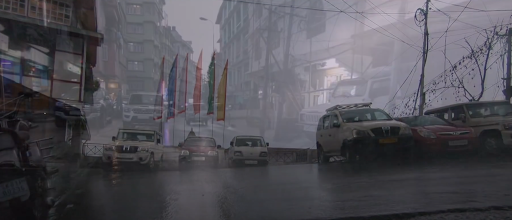
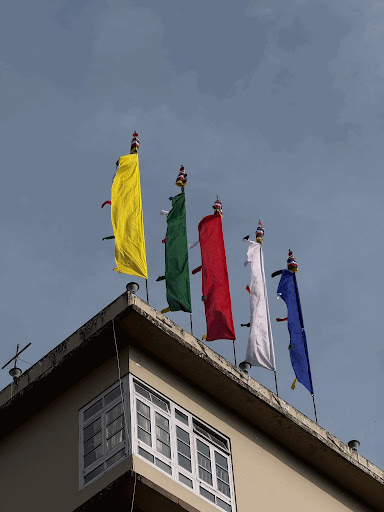
Prayer flags of Tibet Road stand resilient amidst the dense urban transformations, serving as sacred visuals that articulate the road’s cultural identity. From a visual anthropological perspective, the prayer flags reflect the continuity of spiritual memory. Beyond their religious symbolism, the flags also signal a form of cultural sustainability that preserve intangible heritage, maintain a sense of place, and foster community attachment in an environment shaped by rapid modernization.
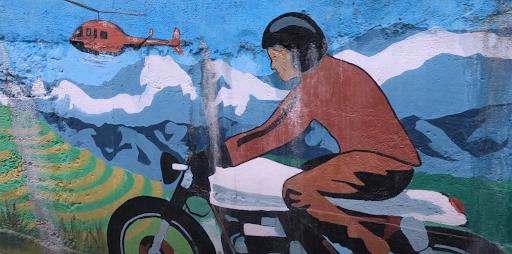
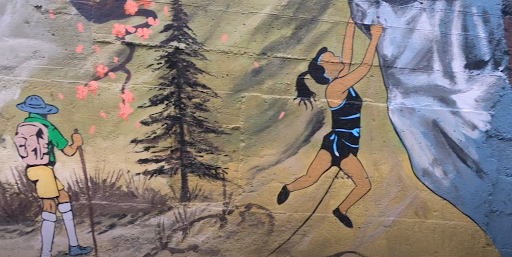
The visual depictions of mountains serve as powerful mediators of the sacred mountain and deity relationship. Within local cosmologies, such paintings are not passive representations but active visual practices that embody reverence, protection, and continuity of belief. Even as the imagery of Kanchendzonga is reappropriated within contemporary tourism that market adventure, trekking, and exploration, its sacred aura remains embedded in the cultural imagination of the people. They function as cultural texts, where sacred symbolism and commodification coexist, revealing the layered ways in which communities engage with their surroundings.
Street Art, Statues, and Commercial Signage in Shaping Urban Spaces
Mahatma Gandhi Marg is the main “marketplace” of Gangtok where business communities, some of whom are the “Old Settlers” of Sikkim, live and work. It is also the public space where people of Gangtok meet for social gatherings, and political demonstrations. It is the main tourist attraction for shopping and eating. It lies at the center of Gangtok’s urban imagination. Historically, it has functioned as a marketplace where traders met for commerce. Now, it has residents, and visitors. Over time, tourism and enhancement projects by state Mahatma Gandhi Marg transformed into a carefully curated pedestrian zone with tiled walkways, benches, flowerbeds, and controlled traffic producing a regulated version of “public space” that emphasizes both order and spectacle.
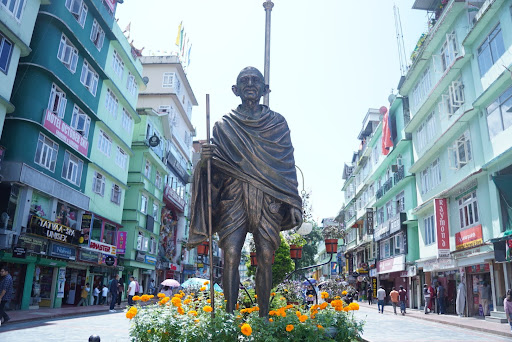
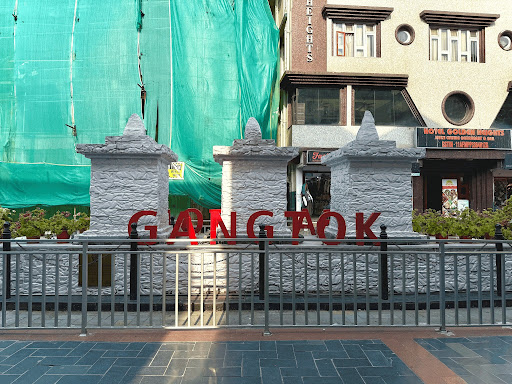
Within this regulated environment, street art, murals, and statues have begun to appear as both decorative and discursive elements. These visuals shape Mahatma G andhi Marg’s identity as a tourist-friendly cultural space, while also reflecting the tensions between everyday practices and the state’s commercial vision of the street. The visuals are often a part of the projects of beautification and branding that align with Gangtok’s image as a clean and cosmopolitan capital. At the same time, Mahatma Gandhi Marg retains its character as a marketplace, where local vendors, shops, and cultural practices make the street. Thus, these visuals are not merely a presence but constitute the ongoing negotiation over what counts as public culture in a city balancing tourism, commerce, and everyday life. Comparatively, Gangtok’s visual dynamics resonate with patterns observed in global urban contexts.
Commercial signages in M.G Marg
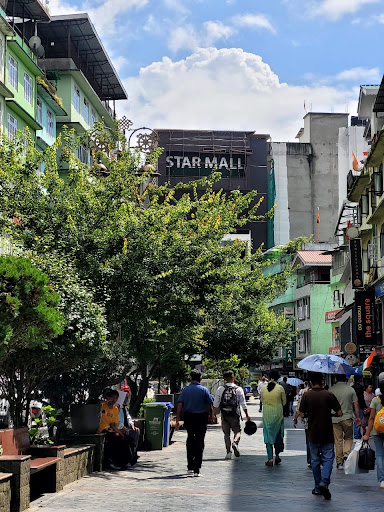
Once a theatre hall, is now being converted into a high-rise shopping mall. Malls have become popular in the region, often the main reason for disrupting the “mountain” view. It is a contested development as Gangtok is a fragile terrain and falls into Seismic Zone VI.
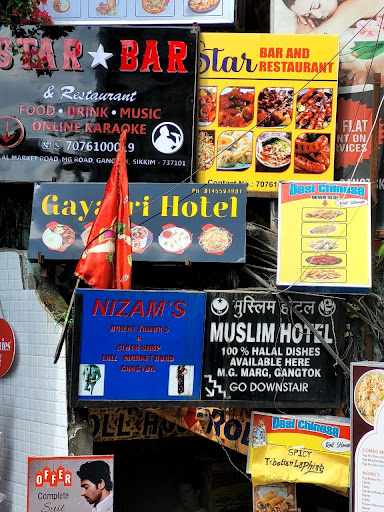
The multicultural composition of signboards such as the long-standing ‘Muslim Hotel’ and the historic ‘Star Bar’, is one of Gangtok’s earliest bars, earlier situated below the old Star Cinema. These establishments on the visual landscape reflect the histories of migration, commerce, and sociability that have shaped the street over decades. The signage further illustrates cultural fusion, as seen in culinary representations like the hybridized ‘Desi Tibetan Laphing,’ an adaptation of the Tibetan snack. Such signboards act as semiotic texts, capturing both continuity and transformation, where community identities, economic practices, and cultural syncretism are negotiated in the everyday life of Mahatma Gandhi Marg.
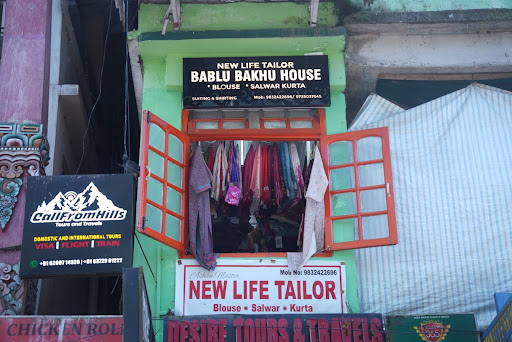
From a visual anthropological perspective, the shop acts as a counter to homogenized urban aesthetics. By sustaining traditional specialization within a modern business environment, the shop not only negotiates its economic survival but also visually affirms the continuity of Bhutia heritage in an increasingly commodified urban landscape.
Flags as bearers of the changing urban landscape
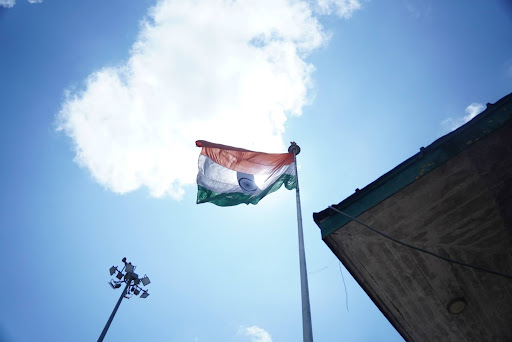
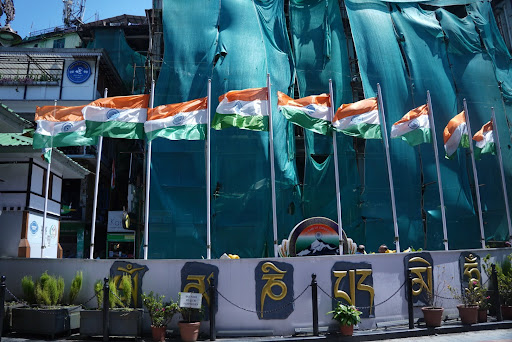
National flags are a visual proof of allegiance to the state, invoking civic identity and participation in the imagined national community. Their presence in a commercial or domestic landscape signals a negotiation between personal, communal, and national belonging. The street is also not just a public space but also private spaces for the residents. Thus, such visuals re-define the very meaning of spaces.
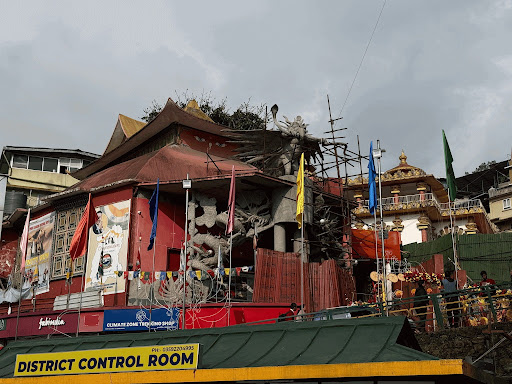
Prayer flags and Buddha eyes seen in the community building embody religious and spiritual cosmologies of the Buddhist community, functioning as instruments of auspiciousness, and cultural continuity. These elements accentuate how everyday spaces are sites of ritual and moral inscription, persisting amid urban transformation. Advertising billboards represent the commercial and globalizing forces shaping the urban milieu. Their presence juxtaposes spiritual and civic symbols with market-oriented communication, signaling the capitalist aesthetics into traditional spaces.
Anthropologically, the layering of these signs indicates a liminal space drawing from Victor Turner's idea of the “in-between”. One that is neither fully sacred nor fully profane, neither strictly communal nor entirely commercial. This layering allows for coexistence of multiple ideas such as patriotism, spirituality, commercial engagement within the same spatial and temporal frame.
Source: Walking Ethnography
Source: Walking Ethnography.
Source: Walking Ethnography
Source: Walking Ethnography
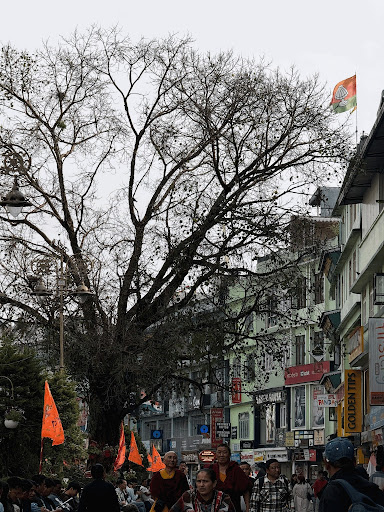
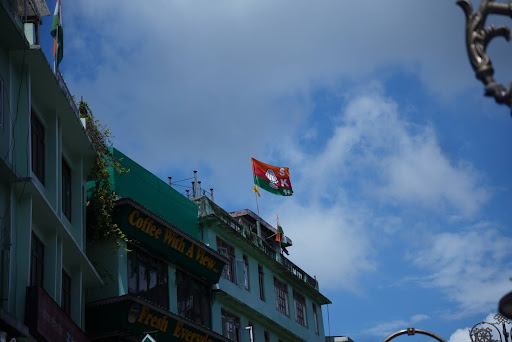
Political flags visually assert a party’s presence, influence, and territorial claim within a community. In urban spaces, where multiple social groups coexist, these flags are not just decorative but they signal the spatial and social reach of political actors.
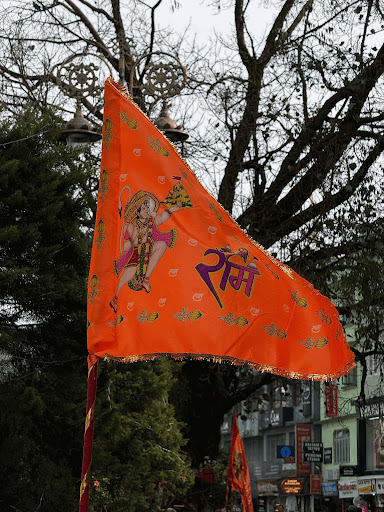
In recent decades, many phrases and flags have been appropriated by religious and political ideologies into symbols of assertive identities. Anthropologically, this shift illustrates how material culture can be politicized, where sacred objects are used to assert dominance, territoriality, and ideological power. At the same time, the flag exists in a liminal symbolic space sacred and political, devotional and forceful. Its display can signify godliness for some, yet intimidation or exclusion for others, demonstrating how material symbols mediate power relations, and social hierarchies. This defines how people negotiate these spaces as well.
These elements in such spaces including the presence or decline of prayer flags, limited wall art, and the semiotics of street names and commercial signage are not merely what it directly reflects but reflects the deeper processes of identity formation, and cultural negotiation. In doing so, this endeavour through walking ethnography is just a beginner’s reflection of Gangtok as a site. The main drawback of these reflections is the researcher’s dual role as resident and observer that carries risks of bias, time constraints and restricted observation of seasonal or long-term changes. This is an on-going ethnographic process and the article does not cover every essence in detail but as the work progresses the researcher hopes to explore further.
Bibliography
Fransberg, M., Myllylä, M., & Tolonen, J. (2023). Embodied graffiti and street art research. Qualitative Research, 23(2), 362–379. https://doi.org/xxxx
Hannerz, U. (1980). Exploring the city: Inquiries toward urban anthropology. Columbia University Press.
Jacobs, J. M. (1993). The city unbound: Qualitative approaches to the city. Urban Studies, 30(4–5), 827–848. https://doi.org/xxxx
Low, S. M. (1996). The anthropology of cities: Imagining and theorizing the city. Annual Review of Anthropology, 25(1), 383–409. https://doi.org/10.1146/annurev.anthro.25.1.383
Schneider, A. (Ed.). (2017). Alternative art and anthropology: Global encounters. Taylor & Francis. https://doi.org/10.4324/
Riga, C. (2025). Anthropology and the city. Street art in Medellín’s Comuna 13: A city-making practice and an ethnographic tool. Antipoda. Revista de Antropología y Arqueología, (58), 203–229.
Schacter, R. (2008). An ethnography of iconoclash: An investigation into the production, consumption and destruction of street-art in London. Journal of Material Culture, 13(1), 35–61.
Turner, V., Abrahams, R., Harris, A. (2017). The Ritual Process: Structure and Anti-Structure. United Kingdom: Taylor & Francis.
Kharel, S.(2005). Gangtok : metamorphosis of stereotype-Sikkim-urban conglomerate into a colonial hill-station (1889-1950) : a historical construct. Thesis, University of North Bengal, 2005. http://hdl.handle.net/123456789/1229