Invitation, Reversal, and the Manufacture of a Stateless Population
Abstract
This is the first of a two-part article revisiting the Lhotshampa crisis: the expulsion of an estimated 100,000 ethnic Nepali citizens of Bhutan between the late 1980s and early 1990s. Much of the existing literature, journalistic and scholarly alike, narrates this crisis as a closed historical episode. Part I argues instead that the crisis originates in a specific and traceable administrative sequence rather than a spontaneous ethnic conflict. Drawing on historical and legal scholarship together with testimonial and comparative evidence, this part traces the crisis across three registers: the history of invited migration and formal integration that preceded it; the 1985 Citizenship Act and the 1988–89 census through which a settled population was retroactively reclassified as stateless; and the contested archive of personal testimony, corroborated by international monitors, through which the crisis has most often reached outside audiences. A concluding section situates Bhutan's citizenship politics within a wider South Asian pattern of 'suspect citizenship' directed at transborder and linguistically distinct minorities, from Nepal's own Madhesi population to India's Gorkha diaspora. Part II, published separately, examines the failed bilateral verification process between Bhutan and Nepal, the resettlement programme that followed it, and the crisis's unresolved and actively reopening present, including the 2025-2026 U.S. deportations of resettled refugees and the continued detention of Bhutanese political prisoners.
Introduction: Beyond the Brand
For much of the past three decades, the Kingdom of Bhutan has occupied an unusually favourable place in the global imagination. Its policy of Gross National Happiness (GNH), formally adopted as a development framework and elevated, particularly after 2008, into the organizing rhetoric of the state (Munro 2016), has made Bhutan a recurring reference point in conversations about alternative models of progress, environmental stewardship, and cultural preservation. This reputation is not undeserved: Bhutan's record on forest cover, its constitutional commitment to carbon neutrality, and its careful management of tourism are real and frequently studied achievements. The difficulty is not that this image is false, but that it is partial, and the part it omits-a forty-year history of contested citizenship, expulsion, and unresolved statelessness affecting the kingdom's ethnic Nepali minority, known as the Lhotshampa, or "southerners"- rarely enters the same conversation.
This article is the product of a collaboration between two writers with different relationships to that omission: one of us works within an academic institution and approaches the subject through the comparative literature on citizenship, statelessness, and South Asian state-making; the other writes from within the cultural and geographic borderlands of the Eastern Himalaya, where the Lhotshampa diaspora is not an abstraction but a set of neighbours, sources, and family histories. What is in question is whether the specific legal and administrative mechanisms used to unmake that population's citizenship between 1985 and the early 1990s, and the way their consequences have been managed, or left unmanaged, in the decades since, can be examined without either flattening Bhutan into a caricature of repression or allowing the GNH brand to function, in Michael Hutt's (2003) phrase, as a shield against scrutiny.
Much existing writing on the Lhotshampa crisis falls into one of two modes. The first is descriptive history, anchored in Hutt's (2003) indispensable Unbecoming Citizens and a handful of subsequent monographs, which narrates the expulsion and its causes but largely concludes its account around the turn of the millennium, when the refugee camps in eastern Nepal were at their largest. The second is advocacy journalism, which periodically rediscovers the crisis, often through human-interest profiles of individual refugees, without situating it within the legal architecture of statelessness or following its more recent developments. Neither mode has fully absorbed what we consider the most analytically interesting fact about this case: that the crisis did not end with the resettlement of more than 100,000 refugees to third countries between 2007 and 2016. It was, instead, displaced again: first into a residual population of several thousand elderly and infirm refugees left behind in two consolidated camps in Nepal, and then, in 2025, into a wholly new register, when the United States began deporting Bhutanese-born refugees whom Bhutan itself refused to receive, producing a small but legally significant cohort of people rendered stateless for a second time, nearly two decades after the international community had declared their situation durably solved.
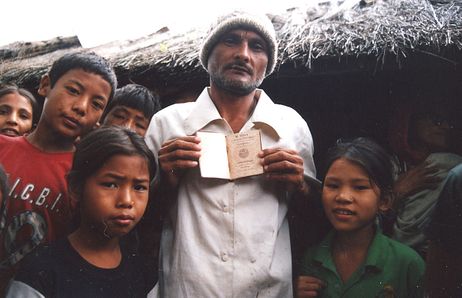
This first part of the article establishes the historical and legal foundations of that claim. We begin with the historical formation of the Lhotshampa community and its administrative unmaking through citizenship law and census; we then turn to the contested archive of personal testimony through which the crisis has most often reached outside audiences, and to the regional pattern of "suspect citizenship" of which it forms a part. Part II takes up the failed bilateral verification process between Bhutan and Nepal, the resettlement programme that followed it, and the crisis's least-examined recent chapter: the 2025-2026 reopening of statelessness through deportation, alongside the continued detention, and in one case death, of Bhutan's remaining political prisoners.
Historical Foundations: Migration, Invitation, and Integration
The Lhotshampa are frequently described, in both Bhutanese government statements and unsympathetic commentary, as a population whose presence in southern Bhutan was unauthorized or marginal until relatively recently. The historical record complicates this framing considerably, though it does not resolve into a simple counter-narrative either. Contact between the Himalayan courts of Nepal and Bhutan predates the period of mass migration by more than two centuries: Hutt (2003) documents cordial relations between King Ram Shah of Gorkha and the Shabdrung Ngawang Namgyal, the seventeenth-century unifier of Bhutan, including reciprocal religious privileges and the summoning of Bhutanese lamas to Nepali courts. These early ties are not, by themselves, evidence of large-scale settlement, but they establish that the two polities were never strangers to one another, a fact that complicates later characterizations of the Lhotshampa as a wholly foreign population with no prior relationship to the Bhutanese state.
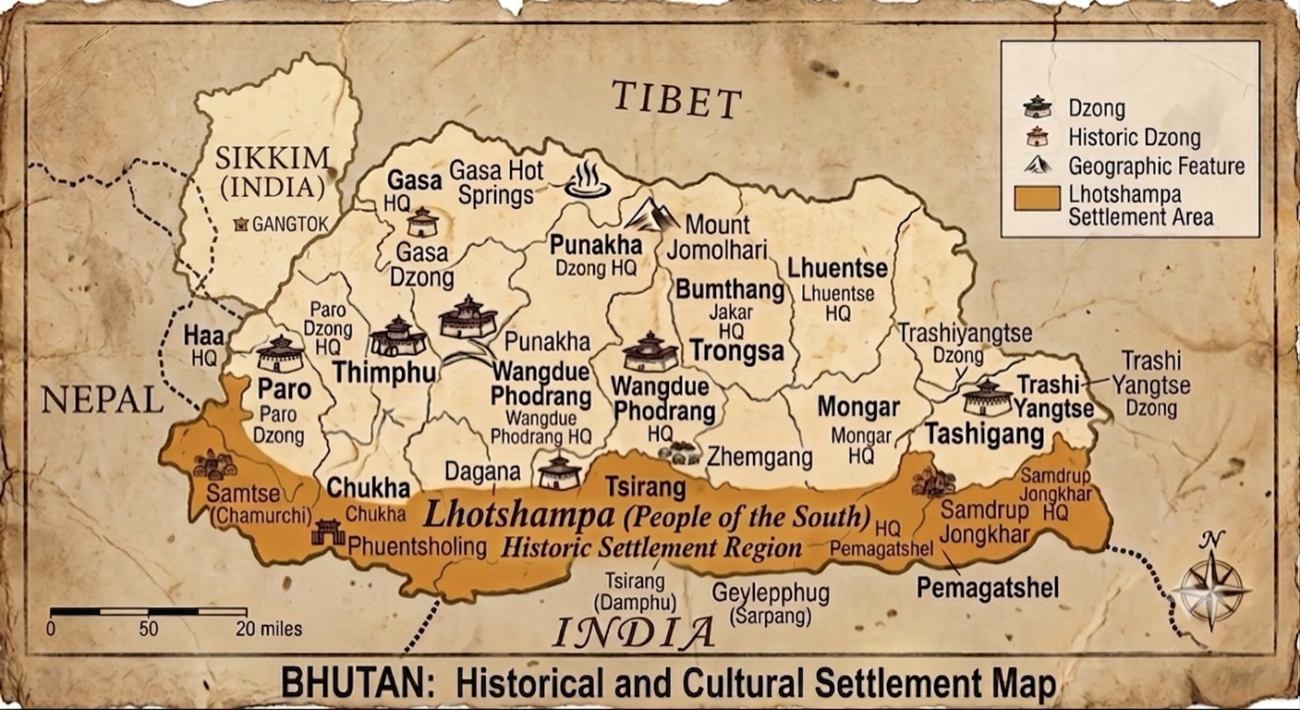
Sustained migration into Bhutan's southern lowlands, by contrast, is a phenomenon of the mid-to-late nineteenth and early twentieth centuries, and it was substantially encouraged rather than merely tolerated by Bhutanese authorities. Following the 1865 Treaty of Sinchula, which concluded the Anglo-Bhutanese Duar War and ceded the Bengal Duars to British India, Bhutan's remaining low-lying southern territory-malarial, densely forested, and largely unsuited to the agricultural practices of the Drukpa-majority north-remained sparsely populated and underdeveloped (Hutt 2003). Bhutanese regional authorities, including the Dorji family of Ha Valley acting under royal decree (kasho), employed local labour contractors (thikadars) to recruit Nepali-speaking settlers to clear and cultivate these lowlands around the turn of the twentieth century (Hutt 2003; Dhakal & Strawn 1994). The settlers introduced sedentary, terraced wet-rice cultivation in place of the shifting cultivation practised in the north, and by the mid-twentieth century the south's agricultural output had become a substantial part of the kingdom's economy.
The historiographical dispute is less about whether migration occurred-it plainly did, in both invited and informal forms- than about how much of it, and which generations of settlers, the state was later willing to recognize as having occurred with its consent.
This is also the point at which a more even-handed reading becomes necessary. Bhutan's own later accounts of this period, and some Western reporting sympathetic to the Bhutanese government's position, describe the same migration not as state-sponsored settlement but as a steady, largely unregulated influx of Nepali labourers drawn by Bhutan's comparatively low population density, free land, and eventually free education and healthcare, which by the late twentieth century the state itself characterized as having outpaced its capacity to track or absorb (O'Brien 2010). Both readings can be true at once: that the initial waves of settlement were actively invited and administratively organized, and that subsequent decades saw migration the Bhutanese state came to regard, rightly or wrongly, as exceeding what it had sanctioned. The historiographical dispute is less about whether migration occurred-it plainly did, in both invited and informal forms-than about how much of it, and which generations of settlers, the state was later willing to recognize as having occurred with its consent.
What is not seriously disputed is that a substantial Lhotshampa population was formally and unambiguously naturalized. The Lhotshampa, far from a monolithic ethnic bloc, comprised Rai, Limbu, Tamang, Gurung, Magar, and various Indo-Aryan caste groups, predominantly Hindu but including Tibeto-Burman-speaking Buddhists and a smaller Christian minority (Hutt 2003). Their economic integration was followed by formal political recognition: the 1958 Nationality Law, promulgated under the modernizing third king, Jigme Dorje Wangchuck, granted citizenship to Lhotshampa residents and explicitly recognized them as Bhutanese "southerners" (Hutt 2003). For three decades thereafter, Lhotshampa citizens served in the civil service, the Royal Bhutan Army, and early development administration; localized political organizing, such as the short-lived Bhutan State Congress founded in 1950, concerned itself principally with taxation and local civil grievances rather than separatism, and in fact helped prompt the very legal inclusions that followed. By any reasonable historical accounting, the Lhotshampa of the mid-twentieth century were not a marginal or unauthorized population on the periphery of the Bhutanese state; they were one of its constituent communities, formally naturalized and materially central to its southern economy. What changed, beginning in the 1980s, was not the historical record of their arrival but the political utility of contesting it.
The Reversal: Citizenship Law, Census, and the Manufacture of Statelessness
The reversal of this settled status did not occur through a single decree but through the sequential operation of legislation and administrative procedure, precisely the combination that the international legal scholar Neha Jain (2022), in an influential recent analysis, terms the "manufacturing" of statelessness: the use of facially neutral bureaucratic criteria of time, documentation, and geography to produce, rather than merely record, a population without citizenship.
This is a common nationalist ideological state concern posed as demographic anxiety; small states bordered by much larger neighbours routinely cite demographic anxiety as a basis for restrictive citizenship and immigration policy, and Bhutan is not historically unique in this regard.
By the late 1970s, the Drukpa-led political establishment had come to view the Lhotshampa's demographic growth and distinct cultural practices as a potential threat to a cohesive Bhutanese national identity, a concern Bhutanese officials and sympathetic commentators have since framed in terms of demographic inundation- a small, sparsely populated kingdom of fewer than a million people situated between two demographic giants, anxious that an unintegrated and rapidly growing minority along its southern frontier could, over time, alter the kingdom's political character entirely (O'Brien 2010). This is a common nationalist ideological state concern posed as demographic anxiety; small states bordered by much larger neighbours routinely cite demographic anxiety as a basis for restrictive citizenship and immigration policy, and Bhutan is not historically unique in this regard. The question is not whether such a concern existed, but whether the legal instruments used to address it were proportionate, prospectively applied, and consistent with basic guarantees against arbitrary deprivation of nationality under Article 15 of the Universal Declaration of Human Rights (United Nations 1948).
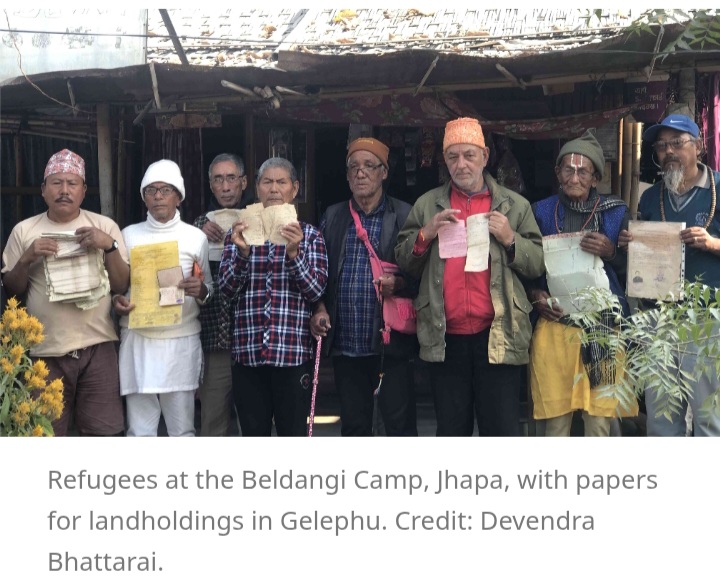
The 1985 Citizenship Act tightened naturalization requirements considerably and, crucially, was applied with retroactive effect: it established 31 December 1958 as a cutoff date by which residence had to be documented, typically through land tax receipts, in order to establish citizenship (Hutt 2003; Jain 2022). The demand for this specific category of documentary proof was, as the U.S. State Department itself noted at the time, difficult to reconcile with the widespread illiteracy and limited administrative capacity that characterized rural Bhutan in 1958, meaning that many families who had lived in the kingdom for generations, and who held later citizenship identity cards issued under earlier procedures, could not produce the singular document the new law required (Neikirk & Nickson 2024). The 1988-89 census that implemented the Act compounded this difficulty by being conducted exclusively in the Nepali-speaking southern districts, sorting residents into a series of numbered categories from genuine citizens down through categories denoting non-national women married to Bhutanese men, returned migrants, and, at the bottom, those to be treated as illegal immigrants regardless of any documentation they held (Human Rights Watch 2007; Neikirk & Nickson 2024). The selective geography of the census, applied only where the Nepali-speaking population resided, is among the strongest pieces of evidence cited by international observers for the proposition that this was not a neutral citizenship review applied uniformly across the kingdom, but a targeted mechanism of exclusion (Jain 2022).
The legal reclassification was accompanied by a cultural one. The state's "One Nation, One People" policy elevated the customs of the Ngalop Drukpa elite-dress, language, and religious practice-into compulsory national standards (Saul 2000; Neikirk & Nickson 2024). The 1989 royal decree requiring all citizens to wear the national dress (gho for men, kira for women) in public, and the restriction of Nepali-language instruction in southern schools under the Driglam Namzha code of conduct, transformed routine cultural practice into a site of state enforcement, policed through on-the-spot fines (Neikirk & Nickson 2024). Bhutanese officials defended these measures, then and since, as necessary cultural preservation in a small kingdom that, in a phrase attributed to the king at the time, could not afford the luxury of cultural pluralism (Hutt 2003, cited in Neikirk & Nickson 2024)-a justification that finds an uncomfortable echo across the region's other minority-citizenship disputes, discussed below, but one that Bhutanese authorities have continued to advance in good faith as a matter of small-state survival rather than ethnic animus.
Beginning in 1988, the government formally encouraged emigration, and from 1990 onward combined this with arrest and the destruction of homes; a U.S. State Department refugee official, Terry Rusch, described the process at the time as people being expelled in what she called a little-noticed but very real ethnic cleansing exercise (O'Brien 2010, quoted in Neikirk & Nickson 2024).
Whatever its intent, the policy's effect was to convert Lhotshampa political organizing, much of it initially focused on civil rights and representation rather than secession, into evidence of disloyalty that further justified denaturalization (Neikirk & Nickson 2024). Beginning in 1988, the government formally encouraged emigration, and from 1990 onward combined this with arrest and the destruction of homes; a U.S. State Department refugee official, Terry Rusch, described the process at the time as people being expelled in what she called a little-noticed but very real ethnic cleansing exercise (O'Brien 2010, quoted in Neikirk & Nickson 2024). Within roughly three years, more than 100,000 people-at the time, close to one-sixth of Bhutan's resident population-had left or been expelled (Human Rights Watch 2007). The Bhutanese government's position, then and largely since, has been that this figure substantially overstates the number of genuine Bhutanese citizens involved, and that many who joined the exodus were recent or undocumented migrants exploiting the camps' humanitarian assistance to claim a citizenship they had never legitimately held (Human Rights Watch 2007). This dispute over numbers-not merely a rhetorical disagreement but the central unresolved question of the bilateral verification process discussed in Part II-has never been authoritatively settled, and any honest account of the crisis has to hold both the scale of documented exclusion and the genuine uncertainty over its precise demographic boundaries in view at once.
Lived Histories: Testimony and the Limits of the Archive
Statistics and statutes describe a policy; they do not, on their own, convey what it meant to live through one. For this reason, much of the most cited writing on the Lhotshampa crisis, including Hutt's (2003) own account, turns to individual testimony, and it is worth pausing on both the value and the limits of this method.
Hutt's portrait of a woman he calls Dil Maya remains one of the most frequently invoked personal narratives in the literature. An agrarian woman who, in her own description, had never owned a pair of shoes before her displacement, Dil Maya experienced the policies discussed above not as abstract legislation but as a sequence of intimate disruptions: restrictions on her language, the closure of familiar local institutions, and ultimately the forced separation of her family, as she spent decades in a refugee camp in Nepal while a son remained in Bhutan, legally and physically cut off from her (Hutt 2003). What makes her account analytically significant, beyond its emotional weight, is her own framing of it: Hutt records her describing her process of recollection as chat-két garnu, "sorting things out"- a deliberate, reflective reconstruction of events that resists the passive, generic category of "refugee" through which her experience might otherwise be flattened. This is close to what C. Wright Mills (1959), writing in a wholly different context, called the sociological imagination: the capacity to locate one's own biography within a structural and historical process, rather than experiencing it merely as private misfortune.
A different kind of testimony comes from Tek Nath Rizal, a former Royal Advisory Councillor who became one of the most prominent Lhotshampa political dissidents after petitioning the king to review the 1985 Act and the 1988 census. Rizal's memoir, written after his own extended imprisonment, documents in detail the conditions he says were faced by Lhotshampa detainees during the late 1980s and 1990s, including prolonged isolation, physical restraint, and what he and other former detainees describe as deliberate psychological pressure (Rizal 2009). Independent corroboration of mistreatment during this period comes from contemporaneous reporting by Amnesty International and the U.S. State Department, both of which documented arbitrary arrest, torture, and the use of bonded labour against detained Lhotshampa during the same years (Neikirk & Nickson 2024). Two brief excerpts from Rizal's memoir illustrate the register in which this testimony is written:
"Once again for a month, I was served food mixed with pieces of broken glasses... I was allowed to eat my food only after smoking forty cigarettes." (Rizal 2009: 39)
"The mechanism was torturing my inner soul, leaving me with unbearable pain... I had been transformed into a dead body with only the consciousness alive." (Rizal 2009: 32)
Evans's (2010) subsequent fieldwork among Lhotshampa communities adds a further, less dramatic but no less significant layer: accounts of relatives who remained in Bhutan after family members fled being denied the "no objection certificates" required for travel, higher education, and formal employment-an administrative, rather than physically violent, form of exclusion that nonetheless entrenched a durable second-class status for those who stayed.
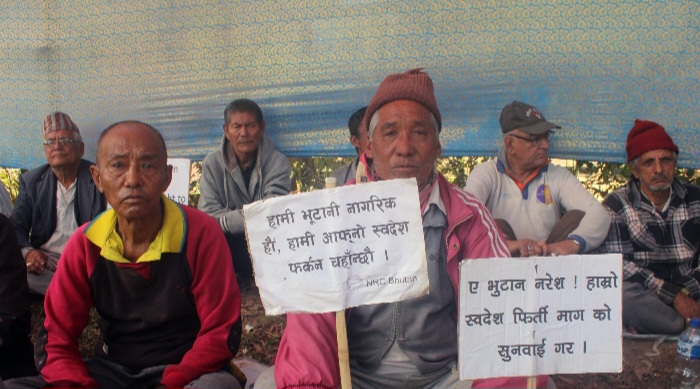
These accounts deserve to be taken seriously as evidence, not merely as colour. At the same time, an honest reckoning with this archive requires acknowledging its asymmetry. Virtually all of the widely circulated personal testimony on this crisis comes from refugees, exiled dissidents, or researchers working with refugee populations; there is, by the nature of the situation, very little comparable testimonial record from Lhotshampa who remained in Bhutan, since the same legal and political conditions that produced the exodus also constrain independent reporting from within the kingdom. Neikirk and Nickson (2024) note that Nepali-speaking Bhutanese who remain in the country are not permitted to form rights-related associations and are themselves viewed with official suspicion. This is not a reason to discount the testimony that does exist-corroboration from independent international monitors over more than three decades is, by ordinary evidentiary standards, substantial-but it is a reason to be precise about what kind of claim the testimonial record supports. It supports, with considerable confidence, the claim that a documented and substantial number of Lhotshampa experienced arbitrary citizenship deprivation, family separation, and, in many recorded cases, custodial mistreatment. It does not, on its own, resolve the separate and more contested question of exactly how many people were affected, nor does it capture whatever account the Bhutanese state and the Lhotshampa who remained within it might offer of the same years-an account that, for reasons rooted in the politics of the kingdom itself, remains comparatively undocumented in any independent or verifiable form.
Regional Resonances: Suspect Citizenship in South Asia
Read in isolation, the Lhotshampa crisis can appear to be either a uniquely Bhutanese aberration, incompatible with the kingdom's pacific international image, or, in more polemical accounts, a singular indictment of Buddhist statecraft. Neither framing withstands comparison with the broader region. Mary Des Chene's (2007) influential argument that postcolonial South Asian studies has systematically under-attended to Nepal and the Himalayan states-treating them as anthropological curiosities rather than as nation-states with ordinary, comparable politics of exclusion-applies with equal force to Bhutan. Once the kingdom's "Shangri-La" branding is set aside (Ferraro 2012; Walcott 2011), its citizenship politics align closely with patterns documented across its neighbours.
Mary Des Chene's (2007) influential argument that postcolonial South Asian studies has systematically under-attended to Nepal and the Himalayan states-treating them as anthropological curiosities rather than as nation-states with ordinary, comparable politics of exclusion-applies with equal force to Bhutan.
The clearest parallel is the Madhesi population of Nepal's own Tarai plains, whose Indian-influenced dialects, dress, and cross-border kinship ties have for decades made their loyalty to the Nepali state a recurring subject of suspicion, and whose access to citizenship documentation has been correspondingly difficult, particularly for women seeking to transmit citizenship to their children (Saul 2000). The structural irony-a state that itself displaced its Nepali-speaking minority on grounds of insufficiently demonstrated loyalty sits adjacent to a state that subjects its own Nepali-affiliated minority to a strikingly similar test-has been noted by several scholars working across both cases, though the legal mechanisms, party politics, and historical grievances involved in each are distinct enough that the comparison should illuminate rather than collapse the two situations into one.
A second resonance lies further east, in India's north-eastern states, where ethnic Nepali communities collectively known as the Gorkha diaspora have long navigated the same basic distinction between an indigenous "son of the soil" and an outsider variously labelled bahiragat or videshi. The implementation of the National Register of Citizens in Assam, intended to distinguish lawful long-term residents from undocumented migrants, produced-much as Bhutan's 1988 census did-a sorting exercise in which the burden of historical documentary proof fell disproportionately on linguistic and religious minorities, generating a population rendered stateless or quasi-stateless by an ostensibly neutral administrative procedure rather than by an explicit ethnic decree. Miyamoto et al. (2021) and Munro (2016), writing on Bhutan specifically but drawing on this wider literature, both note that the conflation of majority religious or ethnic culture with official national identity, whether through Bhutan's Driglam Namzha or through comparable projects elsewhere in the region, is less an exception within South Asian state-making than one of its more common instruments.
The relevant point is narrower and, we think, more useful: the specific combination of retroactive legal cut-offs, geographically selective implementation, and the political reclassification of civic organizing as disloyalty is a recognizable and recurring South Asian pattern of producing "suspect citizens" out of transborder or linguistically distinct populations.
None of this is offered to relativize Bhutan's record by diffusing responsibility across a regional pattern, nor to suggest that documentation-based citizenship review is inherently illegitimate; nearly every modern state, including long-established liberal democracies, relies on some combination of jus soli and jus sanguinis rules that inevitably exclude some long-resident populations. The relevant point is narrower and, we think, more useful: the specific combination of retroactive legal cut-offs, geographically selective implementation, and the political reclassification of civic organizing as disloyalty is a recognizable and recurring South Asian pattern of producing "suspect citizens" out of transborder or linguistically distinct populations. Recognizing Bhutan's policies as an instance of this pattern, rather than as either a uniquely Bhutanese failing or an isolated historical accident, is itself part of what a more rigorous, less sensationalized account of the crisis requires.
Part II of this article turns from this historical and evidentiary foundation to the crisis's unresolved policy afterlife: the failed bilateral verification process between Bhutan and Nepal, the resettlement programme that followed it, and the events of 2025-2026 that reopened the question of Lhotshampa statelessness in a register neither Bhutan nor Nepal anticipated.
References
Des Chene, M. (2007). Is Nepal in South Asia? The condition of non-postcoloniality. Studies in Nepali History and Society, 12(2), 207–223.
Dhakal, D. N. S., & Strawn, C. (1994). Bhutan: A Movement in Exile. Nirala Publications.
Evans, R. (2010). The perils of being a borderland people: On the Lhotshampas of Bhutan. Contemporary South Asia, 18(1), 25–42.
Ferraro, M. (2012). Stateless in Shangri-La: Minority rights, citizenship, and belonging in Bhutan. Stanford Journal of International Law, 48(2), 405–435.
Human Rights Watch. (2007, February 14). Stateless refugee children from Bhutan living in Nepal. Human Rights Watch.
Hutt, M. (2003). Unbecoming Citizens: Culture, Nationhood, and the Flight of Refugees from Bhutan. Oxford University Press.
Jain, N. (2022). Manufacturing statelessness. American Journal of International Law, 116(2), 237–288.
Mills, C. W. (1959). The Sociological Imagination. Oxford University Press.
Miyamoto, M., et al. (2021). Animal slaughter and religious nationalism in Bhutan. Asian Ethnology, 80(1), 121–145.
Munro, L. T. (2016). Where did Bhutan's Gross National Happiness come from? The origins of an invented tradition. Asian Affairs, 47(1), 71–92.
Neikirk, A., & Nickson, R. (2024). Transitions without justice: Bhutanese refugees in Nepal. International Journal of Transitional Justice, 18(2), 267–280.
O'Brien, M. (2010, August 28). Fears of "demographic inundation" behind Bhutan's refugee crisis. East Bay Times.
Rizal, T. N. (2009). Torture Killing Me Softly: Bhutan Through the Eyes of a Mind-Control Victim.
Saul, B. (2000). Cultural nationalism, self-determination and human rights in Bhutan. International Journal of Refugee Law, 12(3), 321–353.
United Nations. (1948). Universal Declaration of Human Rights.
Walcott, S. (2011). One of a kind: Bhutan and the modernity challenge. National Identities, 13(3), 253–265.
Kalyani Rai is an independent author from Kurseong whose work explores the complex socioeconomic landscapes of the Eastern Himalayas. A contributor to the Sikkim Project and a published fiction writer with Zubaan Books, Kalyani’s work balances urgent social critique and evocative literary style as she continues to document the intersections of displacement, identity, and memory. She is presently employed as UDC at Darjeeling Polytechnic, Kurseong.
Rahul Ganguly is Senior Research at IIT Delhi, working on the relationship between urbanism, development, and identity formation in Darjeeling and Kalimpong. He completed his BA and MA in Sociology from Presidency University, Kolkata. His research interests include urban futures, political sociology, ethnicity, and the Eastern Himalayan region. When not working on his dissertation, he enjoys playing football and cooking.



Very well researched and written!