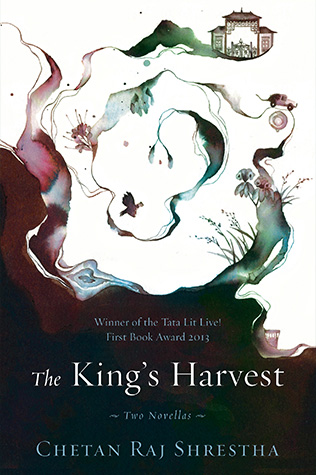
Beyond the Himalayan Landscape: Reading Chetan Raj Shrestha’s The King’s Harvest
The King’s Harvest by Chetan Raj Shrestha, Rachna Books, Gangtok. ISBN: 978-81-89602-16-1
Like many readers, I spent my formative years reading books set in England which introduced me to unfamiliar cultures, histories and cities. However, there is something particularly gratifying about reading a book that is rooted in a landscape one knows. Chetan Raj Shrestha’s The King’s Harvest provides precisely such an experience. The book extends beyond literary pleasures as it emerges from a region that has always been marginalized in the mainstream Indian literary discourse. Against this backdrop, The King’s Harvest acquires a particular significance. The book broadens the imagination of Indian literature by directing the attention towards a region which was always at the periphery of literature representation. Reading a fiction based on the social and cultural milieu of one’s own region creates a unique sense of connection.
The King’s Harvest consists of two separate novellas, An Open-and-Shut Case and The King’s Harvest. An Open and Shut Case is a gripping mystery centered around a seemingly straightforward crime. As the narrative progresses, what initially appeared to be a simple case develops into a more intricate exploration of justice, truth and the limitations of institutional authority. The story is centered around a woman named Kamala who murders her husband by cutting his body into forty-seven pieces and then surrenders herself to the police. At the first glance it appears to be a conventional crime story but the novella dismantles this assumption since Kamala openly confesses to the murder. The investigation then intends to seek to uncover the circumstances that compelled her to commit such an extreme act. The investigation for this case is led by Dechen OC, a bold Police officer. As she digs deeper, the case gets more complicated. The focus then shifts from who committed the murder? To what does guilt actually mean? It compels the readers to reconsider the nature of guilt, justice and punishment. Puran, the husband who was murdered emerges as a figure whose outward respectability conceals profound moral corruption. Through revelations of his abusive behaviour, manipulation and exploitation, the novella blurs the distinction between legal guilt and moral culpability, inviting readers to question whether the law alone can adequately deliver justice. The story therefore asks an unsettling question: when law arrives after long private suffering, can it still claim moral authority? Dechen OC, the investigating officer, is also an equally important part of the story because she embodies the tension between procedure and conscience. Even though she is obligated to uphold the law and treat the case as a homicide, her understanding of Kamala’s experience forces her to confront the inadequacies of the justice system that fails to protect victims before violence occurs. An Open-and-Shut Case invites readers to reflect on the complexities of crime, punishment and the human cost of institutional failure. Beneath the veneer of an idyllic Himalayan paradise, An Open-and-Shut Case reveals the unsettling realities that lurk within the private sphere. The novella is permeated by themes of domestic violence, patriarchal domination and the structural injustices inflicted upon women, exposing how gendered suffering is often normalised and rendered invisible.
The King’s Harvest follows Tontem, an unassuming and deeply isolated farmer who spends thirty-two years cultivating a remote piece of land in unwavering devotion to his sovereign. He lives in near-complete seclusion yet he faithfully sets aside a portion of each harvest for the King, believing it to be his moral obligation and the highest expression of his loyalty. His life is governed by an unquestioning faith in a monarch whom he has met only once but whose authority remains absolute in his imagination. Tontem’s reality is suspended in time and is untouched by the political and social transformations unfolding beyond the boundaries of his farm. When Tontem finally embarks on a journey to deliver the accumulated royal share of his harvest, he realises that the kingdom to which he dedicated his life has irrevocably changed. He realises that the ideals upon which he had built his identity no longer correspond to the realities of the contemporary world. Shrestha in this novella has masterfully blended realism with the timeless qualities of a moral fable creating a narrative that universally resonant in its exploration of human experience. Tontem emerges as a tragic yet dignified figure whose steadfast commitment, once a source of meaning, ultimately renders him vulnerable in a world that has moved beyond the ideals he continues to cherish.
The two novellas in The King’s Harvest are united less by plot than by mood, setting and a shared concern with human vulnerability. One story moves through urban Sikkim and the other through rural, mountain Sikkim, but both use the region to show how lives are shaped by isolation, longing, fear and the gap between appearance and truth. The book has played an important role in Sikkimese representation in fiction. Shrestha’s portrayal of Sikkim departs significantly from the romanticised imagery that has long dominated popular representations of the Himalayan state. Rather than reducing the region to a picturesque landscape of snow-capped peaks, monasteries and tourist attractions, he foregrounds its social complexities, emotional tensions and historical transformations. Kamala’s story questions whether legal institutions can adequately respond to prolonged private suffering, Tontem’s journey reflects on the emotional consequences of unwavering loyalty in a world transformed by history. Despite their distinct narratives, both protagonists are individuals, whose lives are shaped by forces far greater than themselves, rendering them vulnerable to systems of power, tradition and social neglect. Ultimately, The King’s Harvest succeeds not because it provides definitive answers but because it compels readers to confront difficult moral and political questions. Whether examining domestic violence, institutional justice, loyalty or historical change, the novellas reveal the quiet struggles of ordinary individuals whose lives are shaped by forces beyond their control.
The author is working as an Assistant Professor in Department of Political Science at Sanchaman Limboo Government College Gyalshing, West Sikkim.