Bounded by Family, Bordered by Countries: Reimagining the Nepali Diaspora
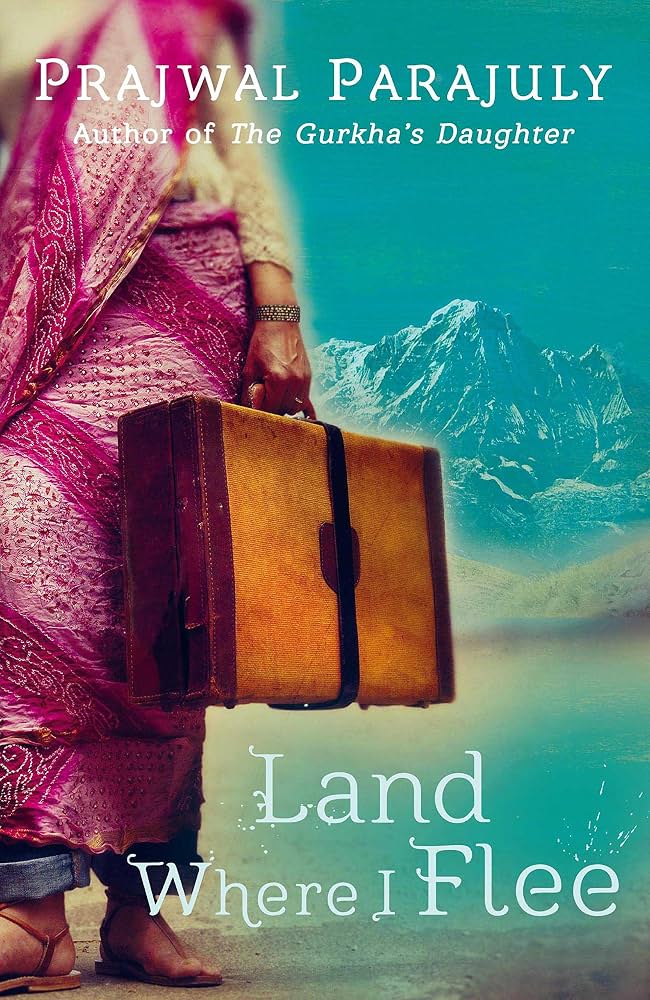
Land Where I Flee by Prajwal Parajuly. Quercus Books, UK, Hachette India (2015). ISBN: 978-1623654573
Nature gave us continuous land, but humans divided it with political borders, and those borders continue to shape and confine our lives. This fundamental premise animates Prajwal Parajuly’s Land Where I Flee, a novel that uses the claustrophobic space of a family reunion to dissect the complex geopolitics of identity in the Eastern Himalayas. Following his acclaimed short-story collection The Gurkha’s Daughter, Parajuly’s debut novel cements his role as an insightful voice on the Nepali diaspora and the subtleties of Sikkimese life. While popular discourse often views borders through the binary lens of nation-states (India versus the foreign other), Parajuly directs his gaze inward. He reveals that within India’s borders and among its neighbouring Himalayan states, internal claims to cultural and social superiority are no less fierce. The title functions as a metaphor for a recurring theme: people detach themselves from their heritage, family, and homeland, yet stay bound to the very structures they try to leave behind.
Set against the backdrop of Sikkim, the narrative weaves together the cultural threads linking the state to Nepal, Bhutan, and West Bengal. The inciting incident is the preparation for a Chaurasi, a traditional celebration marking a person’s 84th birthday in Nepali Hindu culture. Unlike Western traditions that highlight silver or golden jubilees, the number eighty-four carries deep spiritual weight in mainstream Hindu thought, symbolising the eighty-four lakh birth chances in the cycle of reincarnation. In Parajuly’s hands, this auspicious milestone becomes the setting for an explosive family reunion.
The matriarch at the centre of this storm is Chitralekha Neupaney, an unyielding, bidi-smoking grandmother who has raised her grandchildren with an iron hand. Her four estranged, displaced grandchildren return to Gangtok after eighteen years of separation. Agastaya, a successful doctor based in New York, grapples with hidden internal struggles; Manasa, an Oxford-educated woman, is trapped in domestic duties and routine sacrifices; Bhagwati, is ostracised for eloping across caste and national lines with a Bhutanese-Nepali man who is considered Damaai (a lower caste) relative to her high-caste Baahun (Brahmin) heritage; and Ruthwa is the family’s black sheep and a controversial novelist whose presence sparks friction. Adding further complexity to this domestic dynamic is Prasanti, a eunuch servant whose position oscillates between marginalised domestic worker and indispensable family member (especially to the grandmother).
Parajuly uses these characters to explore daily life in Sikkim. The drive for economic independence exists alongside rigid caste hierarchies and traditional gender roles. This can be gleaned from Chitralekha, runs a business and attempts to be the stoic, unyielding head of her family. The gendered perspectives that emerge through Prasanti, the household’s eunuch servant, also show the need for economic stability and independence. Economic stability and security preoccupy each sibling, and the siblings and their families try to undercut one another over what each can or cannot afford. Undercurrents of the social fabric of the Eastern Himalayas can be seen in the family dynamics through caste and social status. As a matriarch, Chitralekha demeans Bhagwati for running away with a Damaai. This feeling is also emphasised by Prasanti, who tries to act socially superior while balancing the jibes by stating that she is just a servant. Rather than offering the idealised view of Himalayan life that we all romanticise, the book highlights the social friction created by overlapping tribal identities, cross-border migration, and political history.
The core strength of Land Where I Flee lies in its sharp dialogue and unwillingness to romanticise its characters. Chitralekha Neupaney is a compelling figure, a formidable matriarch whose stoic cruelty and constant belittling mask a deep, unacknowledged loneliness. The interactions among the four siblings are filled with biting jabs and passive-aggressive confrontations. Bhagwati emerges as a prime example of how social structures are set up in Nepali families settled in the Northeast. Someone of one’s own caste and country is always seen as family, whereas mixing with a person from another country is not accepted. Chitralekha keeps up the distinction by addressing Bhagwati’s husband as “Damaai” (a lower caste). Moreover, an exiled person falls even further down Chitralekha’s list of those worth speaking to politely. Prasanti refers to Bhagwati’s husband as a second-class citizen. Both are aware of the political exile and refugee status of Bhagwati and her husband. This physical exile therefore fractures family interactions. After eighteen years, Bhagwati is still seen as an eloper who married an exiled low-caste man of Bhutanese-Nepali origin. Manasa avoids responding to talk about her in-laws and how diminished their social status has become in their own homeland. Parajuly demonstrates how emotional displacement mirrors physical exile and the fractured adult lives of the siblings. They project their insecurities through harshness and avoidance in their interactions with each other.
However, the novel occasionally struggles under the weight of its narrative scope, especially in relation to the social constructs and the caste system. The introduction of an external observer, Nicholas (Agastaya’s boyfriend), a foreigner from the West, adds an interesting angle to this. Certain customs that we already know are explained to Nicholas.These include removing the shoes, eating with fingers, and certain food habits that are normal for us but not for them. This is an injected narrative device intended to explain local customs to an international audience. It momentarily provides a respite for international readers but becomes slightly drawn out for Indian readers. India is known as the land of hospitality, yet foreigners might find these customs awkward, and they prevail in the household without any consideration of who enters. The customs and traditions explained to Nicholas do not reflect on Prasanti Chitralekha as hosts. They are quite set in their behaviours regarding castes and foreigners. In this context, their character development as hosts hardly plays a significant role. Despite these minor injections, Parajuly maintains a subtle balance between family melodrama and broader geopolitical analysis.
Land Where I Flee occupies a distinctive place in South Asian Anglophone literature. Unlike the majority of Indian English writing, which tends to concentrate on major metropolises such as Delhi and Mumbai or the southern diaspora, Parajuly highlights the Nepali-speaking diaspora in the Himalayan border regions. In doing so, he illuminates the complex interplay between Sikkim, Nepal, and Bhutan while drawing necessary attention to pivotal historical realities, including the displacement of Bhutanese-Nepali refugees.
In its depiction of domestic tension and generational divides, the book shares thematic ground with Jhumpa Lahiri’s The Lowland or Kiran Desai’s The Inheritance of Loss. Yet Parajuly’s tone is distinctly sharper and more irreverent. He avoids exoticising the Sikkimese landscape; Gangtok is presented not as a serene tourist getaway, but as a living urban space marked by political history, class divisions, and daily struggles.
Reading Land Where I Flee challenges the assumption that regional or border communities are culturally uniform. It forces the reader to confront how easily individuals absorb social biases: casteism, classism, and homophobia, even while living in hyper-globalised environments. By the time the Chaurasi celebrations conclude alongside Tihaar (Diwali), the novel provides a detailed view of the food, language, politics, and social structures of a Sikkimese-Nepali family. The distinctive references to sel-roti, a fried sweet native to the region; the local politics of the fight for the creation of Gorkhaland; and the chauvinism of the Neupaney family as members of the Baahun caste at the top of the caste structure are peppered throughout the story.
Parajuly’s novel succeeds because it frames the home as the primary borderland. It demonstrates that physical distance from one’s origins is often far easier to achieve than emotional liberation from family expectations. Chitralekha’s haughty bearing towards her grandchildren, who have defied caste and embraced foreign relationships; Prasanti’s ambiguous identity within the family dynamics; and each grandchild’s poor attempts to reconcile with their origins and to emerge with a new identity- all of these create borders within the home itself. Land Where I Flee is a valuable read for anyone seeking to understand the human realities within the family and also behind the borders of Northeast India and its neighbouring nations.
Kavita Jhala is a founder of the literary community Kaffeinated Konversations and an author of three books. She is also an avid reader, writer, and cultural reviewer with a keen interest in South Asian literature, regional narratives, and diaspora studies.