Remembering Like a River: Reading Abrona Aden's The River of Blood and Dreams
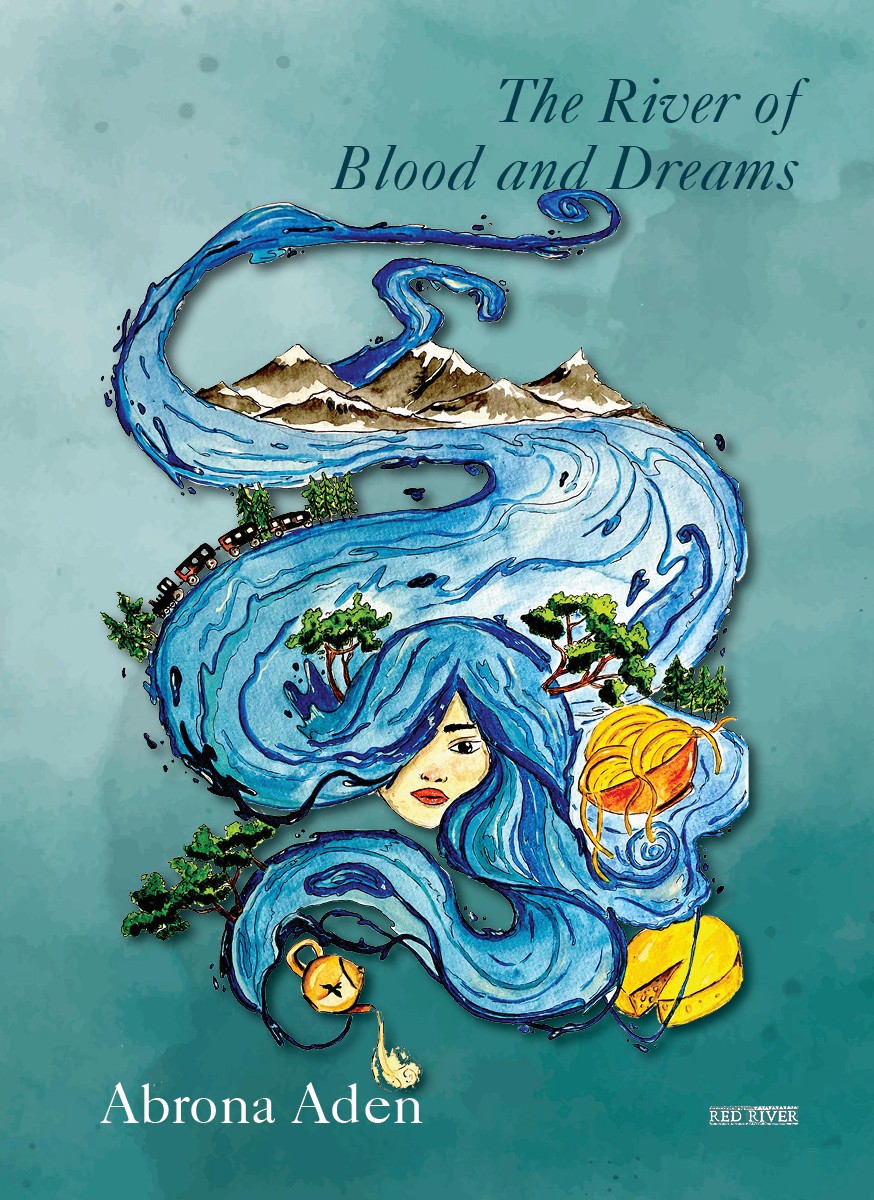
The River of Blood and Dreams by Abrona Aden. Red River Press (2026). ISBN:978-93-48111-34-0
Some poetry collections arrive as inheritance, and not merely as books. Abrona Aden’s The River of Blood and Dreams is one such collection. Comprising thirty-one poems, her debut does not merely narrate individual experiences; it gathers voices, memories and histories that have long existed at the margins of official narratives. These poems move between the intimate and the collective, between grief and hope, becoming letters from rivers, mothers, teachers and ancestral lands that refuse to disappear. Throughout the collection, Aden writes with remarkable honesty and emotional restraint, allowing memory to flow naturally rather than forcing it into grand declarations.
The line - “I do not speak in only my voice/ but in the voice of my people,” (“Things We Mean to say in a Poem” 53) encapsulates the spirit of the collection. The poet insists that her voice is inseparable from the voices of her people. This is not simply a poetic gesture but an ethical position. Aden understands poetry as a communal act of remembering, where personal experience becomes inseparable from collective history. Her poems consistently resist the isolation of the lyric “I”, choosing instead to speak from and for a larger community.
This commitment becomes even clearer in the afterword, where Aden writes that her poetry emerges from her people and the place to which she belongs. She acknowledges the silences that have historically erased Lepcha histories and identities and declares writing itself as an act of recovery. As she writes, “My poetry is my history, my protest, my power, my people’s power” (71). This statement is not simply a declaration of purpose; it becomes the organising principle of the entire collection.
The poems converse with a rich intellectual and literary tradition. Aden invokes figures such as Virginia Woolf, Simone de Beauvoir, Joy Harjo, Alice Te Punga Somerville and Kynpham Singh Nongkynrih. Yet these references never feel ornamental or borrowed. Instead, they situate Lepcha experiences within wider conversations on feminism, indigeneity, memory and decolonisation. The result is a poetry that is deeply rooted in its own landscape while remaining in dialogue with global literary traditions.
Reading The River of Blood and Dreams inevitably recalls Toni Morrison’s meditation on memory in The Site of Memory. Morrison writes:
You know, they straightened out the Mississippi River in places, to make room for houses and livable acreage. Occasionally the river floods these places. “Floods” is the word they use, but in fact it is not flooding; it is remembering. Remembering where it used to be. All water has a perfect memory and is forever trying to get back to where it was. Writers are like that: remembering where we were, what valley we ran through, what the banks were like, the light that was there and the route back to our original place. It is emotional memory- what the nerves and the skin remember as well as how it appeared. And a rush of imagination is our “flooding” (99).
Morrison’s metaphor offers a powerful way of understanding Aden’s poetry. Like the river that remembers its original course, Aden’s poems continually return to landscapes, languages and histories that colonial modernity has attempted to contain or erase. Her writing becomes an act of remembering rather than nostalgia. The river in her poetry refuses confinement because memory itself refuses disappearance.
One of the recurring images in the collection is that of the room. Aden repeatedly asks who is allowed space to exist, speak and create. In “No Room for Rivers”, she writes:
“We have no room for rivers here/ But we can make room enough/ For roads, highways, tunnels” (62).
The river here is not simply a geographical feature but a metaphor for identities and histories displaced in the name of development. Roads and tunnels become symbols of modernity’s selective vision, one that creates space for infrastructure while leaving little room for indigenous worlds, ecological memory or alternative ways of belonging.
The metaphor of the room acquires another dimension in “The Room”. Echoing Virginia Woolf’s A Room of One’s Own, Aden recalls how every room in the house was shared, leaving her to write at the kitchen table with “the pickle jars cheering her on” (41). The image is quietly humorous yet profoundly political. Creativity emerges not from ideal conditions but from everyday negotiations within domestic life. Rather than romanticising the struggle, Aden transforms ordinary domestic objects into companions in the act of writing, subtly challenging inherited ideas about literary production.
Perhaps the collection’s greatest achievement lies in the way it centres Lepcha identity without reducing it to ‘ethnographic’ representation. Poems such as “Mayel Lyang”, “Looking for the Lepchas”, and “My Rong Tongue” become acts of cultural reclamation. “Mayel Lyang” celebrates the Lepcha homeland as “the land of eternal paradise” (13), while the latter poems confront the violence of colonialism, linguistic erasure and the gradual alienation of indigenous communities from their own histories.
The italicised lines in “Looking for the Lepchas”-
“The Lepchas are docile, shy…/ They don’t speak, they whisper…” (15)
are particularly striking. They immediately recall Alice Te Punga Somerville’s Always Italicise: How to Write While Colonised, where typography itself becomes a site of colonial power. Aden’s use of italics invites readers to question inherited descriptions of indigenous peoples and exposes the ways in which colonial archives continue to shape public imagination. Rather than accepting these narratives, the poem reclaims the authority to speak for itself.
One of the most admirable aspects of the collection is its refusal to remain confined within a single thematic frame. Aden writes as a daughter, wife, teacher, poet and member of an indigenous community. These identities do not compete with one another; instead, they illuminate the many ways in which gender, labour, language and belonging intersect. The poems move effortlessly between personal reflection and collective testimony, making the collection emotionally expansive without losing its political urgency.
If there is a limitation, it lies in the collection’s occasional reliance on direct declaration. At times, the poems tell the reader what they wish to communicate rather than allowing the images to carry the emotional weight on their own. Yet these moments are relatively few and do little to diminish the overall strength of the collection. More often than not, Aden trusts the quiet power of image, memory and landscape, allowing them to speak with remarkable clarity.
The visual artwork by Rongnyoo Lepcha and Adronicus Aden deserves special mention. Far from serving as decorative additions, the illustrations deepen the emotional and cultural landscape of the poems, creating a dialogue between image and text that enriches the reading experience.
The River of Blood and Dreams announce Abrona Aden as an important new voice in contemporary Indian poetry and Indigenous writing. More significantly, it demonstrates how poetry can become an archive where history survives, language returns and forgotten landscapes continue to speak. These poems do not merely preserve memory; they insist that memory remains alive, moving like a river that always remembers its course.
Francis Ekka is currently a research scholar in the English department at Sikkim University. He has published research papers in journals indexed by the Web of Science and UGC CARE. Alongside his academic work, he holds a strong passion for poetry and creative writing. His poems have been featured in Rhythm of the River: An Anthology of Tribal Poetry.