What Hope Is There In Life?
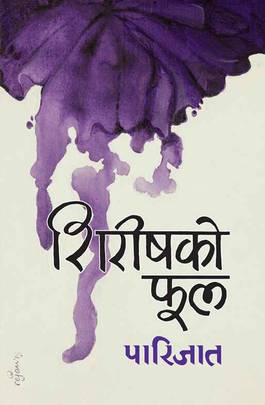
Shirish ko Phool (The Blue Mimosa, 1964) by Bishnu Kumari Waiba. Sajha Prakashan, Nepal (Lalitpur), 23rd edition (2022). ISBN: 9789937322997 .
Shirish ko Phool (The Blue Mimosa, 1964) is widely regarded as one of the landmark works of modern Nepali literature. Written by Bishnu Kumari Waiba under the pen name Parijat, it won the Madan Puraskar in 1965. A slim, intense novel written in an introspective register, it is remarkable not only for its richly drawn characters but for the boldness with which it engages with questions that were, for its time and context, deeply transgressive. The meaning of existence, the oppression of women, the psychological cost of war, and the violence that ordinary social arrangements normalise and conceal.
In Shirish ko Phool,Parijatexplores these questions through Suyogvir, a middle-aged former soldier whose worldview is fundamentally nihilistic. It is within the framework of his search for meaning, or rather, his conviction that none exists, that the novel’s other themes unfold. Set in Kathmandu, the novel is narrated through Suyogvir’s perspective; his voice shapes the entire narrative. It is through the habit of drinking that he forms a friendship with Shivraj and, through this association, encounters Shivraj’s sister Sakambari (referred to as Bari), a young woman in her twenties. The novel focuses on Suyogvir’s interactions with these characters, particularly his obsessive and conflicted feelings towards Bari. Through flashbacks and internal monologues, Parijat portrays how this character understands life, relationships, and how he reacts to them.
Parijat uses Suyogvir’s wartime memories from the Second World War to reveal the roots of his despair and to establish the psychological and biographical contours of his character. Through these, she explores the novel’s central themes of existentialism and the absence of meaning, a pervasive nihilism that defines Suyogvir’s worldview. These episodes expose his past romantic and sexual relationships, many of which involved coercion. Suyogvir regards his own life as fundamentally devoid of meaning, as evidenced by his remark, “Here not only mine but even your life carries no existence” (pg. 35), and extends this emptiness to everyone around him. He mobilises this conviction as a justification for his transgressions against the women he encounters, using his nihilistic reasoning to rationalise actions taken without their consent. Crucially, this disposition is not confined to his youth; it persists into his later years, manifesting in his choice to remain unmarried and childless, and fuelling his heavy drinking. His nihilism is not merely a philosophy; it is also a weapon.
The novel reveals how people become prisoners of their own assumptions. Suyogvir repeatedly projects his beliefs onto others, most notably assuming Bari’s fury without ever confronting her, thus trapping himself in isolation and ensuring that Bari is never allowed to voice her response. He does the same with Shivraj, assuming after Bari’s passing that both their lives have been rendered meaningless. He chooses self-reflection over confrontation and thus remains a prisoner to his nihilistic views. Parijat foreshadows the tragic outcome of Suyogvir’s connection with Bari through a parallel subplot involving a shopkeeper’s wife and her teenage lover. When the woman dies and the affair ends, Parijat suggests that because the relationship existed in a vacuum of meaning, it was always already insignificant. A structural commentary on the impermanence of all human connections in the novel.
The character of Bari has been used to question the meaning of life and to challenge the traditional norms of Nepali society. Her rebellious spirit is fuelled by her rejection of the metanarratives that govern women’s lives. Her rejection of religion is apparent when she compares God to a rock. She also rejects the social institution of marriage and the patriarchal system through the striking metaphor of a bee and a flower, remarking, “To accept the inevitable wilting, is it necessary to be violated by the bee?”, concluding, “It is possible to live alone” (pg. 12). Her rejection of these social prescriptions prevents her from being the conventional Nepali woman- the dutiful wife, the compliant daughter, instead making her a genuinely free individual. Yet the novel ultimately punishes her for this freedom, suggesting that society has little tolerance for women who refuse to conform.
The oppression of women is another area that Parijat examines. Suyogvir’s actions against women during the Second World War, in Burma and among the tribal dwellings of the Nagas, reveal multiple layers of violation. First, the violation of women’s consent, as with the daughter of the headhunter and the buffalo-herding Burmese girl. Second, the objectification of women, when the British officer instructs Suyogvir to procure for him the “orchid beauty” (pg. 41). Thirdly, violence within a romantic relationship, as seen in how Suyogvir treats Matinchi. Suyogvir’s assault on Bari extends this pattern throughout the novel. Not only is this a violation of Bari as an individual, but the author also portrays how a free and defiant woman such as Bari cannot raise her voice against what has been done to her. The invisible walls within her family and society ensure that she can neither protest nor confide, revealing the limits that society places even on those who refuse to conform.
Parijat renders the consequences of war with unflinching clarity. The effects on civilians and women are made visible through the flashbacks, but the long-term psychological impact on soldiers is addressed with equal honesty. Parijat foregrounds the particular experience of Gurkha soldiers in the Second World War, fighting as expendable combatants in what Suyogvir bitterly refers to as “death valley” (pg. 44). The author shows the futility of soldiers fighting another person’s war. The colonial dimension is unmistakable, as these are soldiers whose sacrifices are appropriated by an imperial power that offers little in return. In the aftermath, while some are decorated, many, like Suyogvir, are left with nothing but the hollow question, “Where is the V. C., the medal, the congratulations?” (pg. 46)
Shirish ko Phool is ultimately a cold and unsparing novel. Parijat offers neither redemption nor resolution. It is a tale of violence, oppression, and creeping nihilism. The rebellious Bari, who had a liking for the insect-killing orchid, perhaps much like a Shirish ko phool herself, becomes a sensitive bloom destroyed by a bee it never invited. Suyogvir declares that both his own life and Shivraj’s have been reduced to meaningless existence amidst nothingness. Yet the novel’s final ambiguity lingers. Suyogvir thinks to himself, “My time might be dragging me, yet quickly I continue to walk” (page 65). Whether Parijat is gesturing towards some residual hope or merely acknowledging that for those who remain, life continues regardless of meaning, is left deliberately unresolved.
What makes the novel remarkable is that it sustains this ambiguity without sentimentality. Parijat gives us a nihilist narrator and a rebellious heroine, and allows both to be destroyed, one by society’s invisible walls, the other by his own assumptions. In doing so, she asks the reader a question she refuses to answer on their behalf: “What hope is there in life?” It is a question the novel earns the right to ask, and one that has kept readers returning to it for over sixty years.
Bedant Tamang is currently a student in the Department of International Relations at Jadavpur University. His interests include literature, politics, and Japanese cultural studies.