Take the question, “what is Gangtok like?” and consider the possible answers. For tourists their answers might be ‘picturesque’, ‘green’, or even ‘exotic’. For new migrants their answers might be ‘big’ or ‘expensive’, or perhaps ‘distant’ or ‘steep’ depending on where they’ve come from. For residents the answer is likely drawn from deeper resonances, based on relationships, memories, and belonging. Residents answers are likely shaped by other factors too, from age to class to ethnicity to religion; the young might say ‘boring’, the upwardly mobile might say ‘fashionable’, the devout might say ‘sacred’.
Through almost 20 years visiting Gangtok, the answer that comes to my mind is ‘dense’. My answer would be very disappointing for the authorities responsible for promoting Gangtok. However for residents, density structures urban life, manifesting in everything from traffic jams to waste disposal.
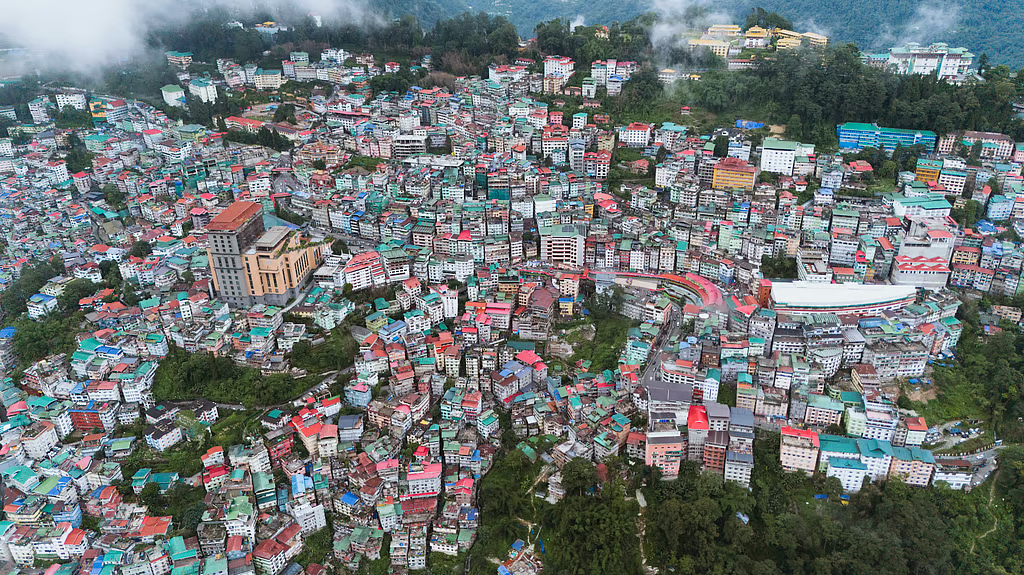
Density matters for planners too. Planning documents stress density as the major urban challenge. Across time—from the 1987 document Gangtok Integrated Development Plan- 2000 (Local Self-Government and Housing Department, 1987) to the 2023 document Gangtok 2041 (Urban Development Department, 2023)—the challenge for planners remains how to accommodate accelerating demand for housing and services with a limited supply of land?
To me density is neither negative or positive, rather it’s the defining characteristic of urbanization in Gangtok and mountain cities more generally. In this article, I explore ways of thinking about urban density that go beyond numerical measurement to the ways density is experienced using the concept of ‘urban atmospheres’.
Gangtok’s Density
Since 1972 Gangtok has added a lot of people, while the area of the city has grown slowly, especially since 1991. The Gangtok Municipal Corporation lists the city’s total area at 19.28 sq. km. Other studies using multi-temporal satellite images have it higher at 24.87 sq.km. (to 2015, see Diksha and Kumar, 2017: 113). The same satellite data demonstrates a net increase of 7.09km sq. from 1972-2015 with only 2.76% growth in area after 1991 (Diksha and Kumar, 2017: 117-118). The population has grown rapidly in the same period; from 25,024 in 1991 to 100,286 in 2011, to an estimated 191,619 in 2021 and a projected 287,433 to 2031 (Urban Development Department, 2023: 35-36).
With limits on horizontal sprawl, Gangtok has grown vertically. Floors are added on top of existing buildings, new, taller buildings are built in place of old ones, and multi-floor buildings are built down the steep slopes connecting to lower roads. Some buildings have expanded into ‘air space’; ground level floors may conform to property boundaries, subsequent floors jut out into the air, especially if the building hangs over a ridge or street space. While the Sikkim Government controls building height to between 1.5 to 5.5 floors, buildings routinely reach 6-8 floors.
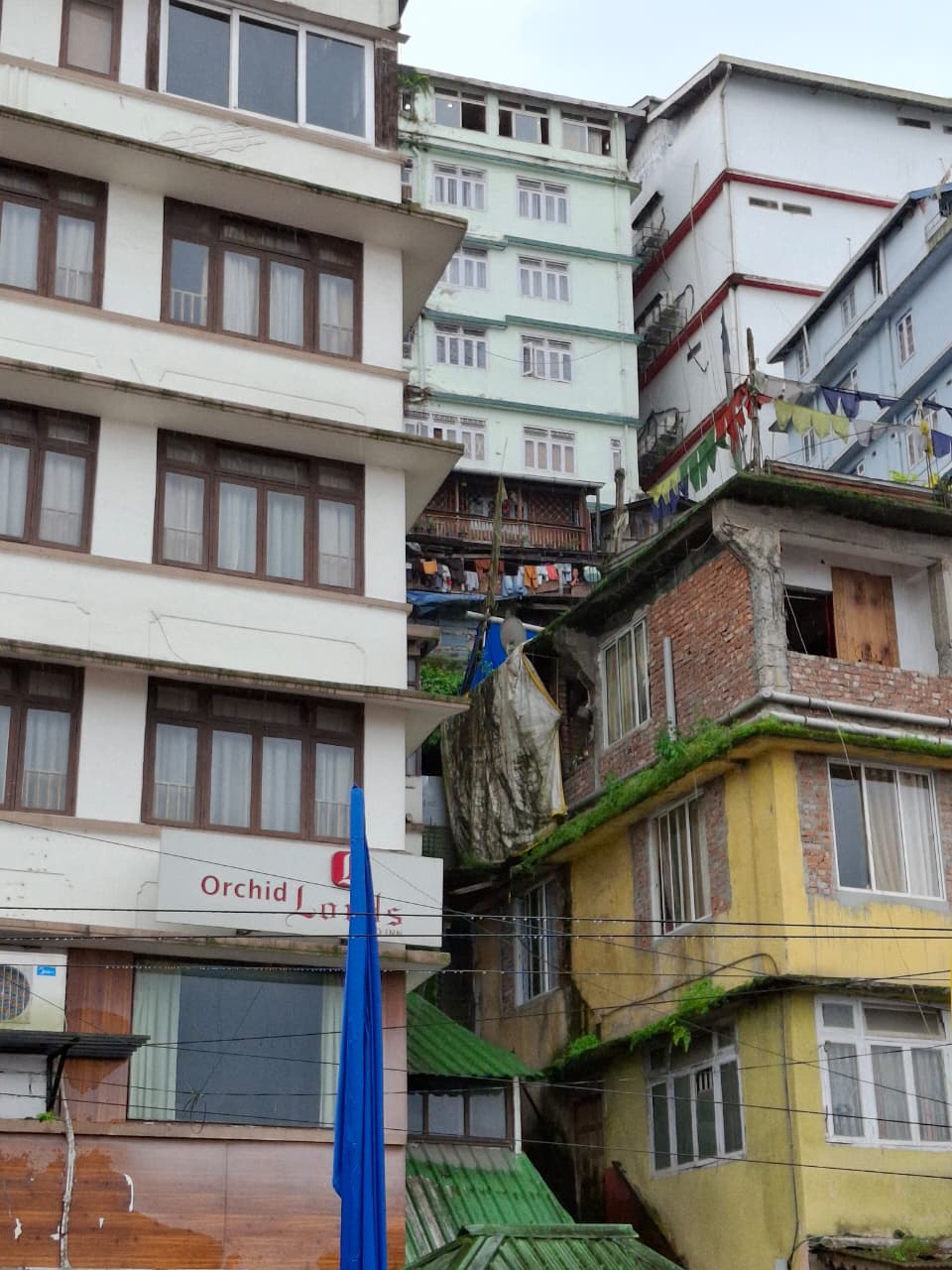
Density as calculation of bodies per unit of area resonates poorly with the human experience of the city. As such we can think about density in more diverse ways. McFarlane proposes four potential measures (2023: 1550):
- numbers of people living in a defined area (usually ward level in Gangtok);
- numbers of people in a room, house or building;
- numbers gathering at sites to shop, eat, play, work;
- numbers of people moving through space such as streets, transport systems, pedestrian infrastructure etc.
Crucially, various social, political, and experiential factors determine when this number, the volume of bodies, is too high. These factors fluctuate depending on which bodies are gathered, where, and when. Thus, density can be relational and relative, rather than formulaic.
To grapple with Gangtok’s density we need to go beyond (but not abandon) calculations of bodies in a certain area and think about experiential factors; how the city feels.
Urban Atmospheres
Urban atmospheres helps us explore experiences of Gangtok’s density. The concept of urban atmospheres has gained popularity across the social sciences and humanities as part of the ‘affective turn’ (Thein, 2005). The affective turn concerns the relationships between space and bodily experience. There are many theoretical complexities, and disagreements, as to what constitutes bodily experience. For our purposes we can simply say that bodies feel in ways we can describe, using the language of emotion (fear, joy, stress for example), and in ways that have no obvious or relatable language, often referred to as the ‘pre-personal’ (Anderson 2016: 44).
Affective atmospheres connect bodies and space as ‘cultural and material constellations that can invoke a spectrum of affective and emotional responses’ (Gandy, 2017: 355). How the city feels varies depending on the space, the subject (the individual, groups of individuals), and other living things and objects. These ‘constellations’ exist in Gangtok at the micro level—the atmosphere inside Orthodox Bar and Restaurant felt by one or two individuals for example, to larger scales—the atmosphere of Paljor Stadium during a football match felt by thousands of people.
Atmospheres are more than just what’s in the air, yet air –interior and exterior—is a good starting point. Air envelopes the body; it enlivens and dampens the senses. Air carries the smells, sounds, gases, particles, and light that shape bodily experiences of urban space. Recall the English phrase, ‘there is something in the air’ to refer to a shared state, a trans-personal response to a certain cultural and material constellation.
Importantly, urban atmospheres are not simply natural occurrences. They can also be created. Think of the manipulation of air, of light, of sound to evoke certain experiences of space.
This article focuses on three atmospheres of Gangtok and the questions they raise: light, moisture and exhaust.
Light
Gangtok’s density is experienced through fluctuations of natural light. Gangtok sits at 1,650 metres altitude, and at the city’s highpoints, rooftops and upper floors, the sky pours light towards bodies, even in cloudy weather. Yet the mountains themselves and the explosion of vertical construction limits light in different spaces, creating ever-shifting atmospheres of bright and gloom.
Limited space between buildings deprives light to lower floors. Building into air space above roads and laneways limits light at the street level. The proliferation of multistorey commercial buildings such as hotels and shopping malls, especially on the top of the ridge to maximise views, block light to surrounding buildings.
Density also makes the duration of time in light, and light of different intensities, unpredictable. With more obstructions, light enters rooms for shorter periods of time than in past years, making rooms colder and damper. At the street level, density blocks light, with seasonal variations, casting shared street space deep in shadow even in daylight.
Less light means more energy. Interior lighting needs to be used for more of the day. Spaces need to be heated in cold weather and ventilated when its hot and wet (see below). Those with access to rooftops can sit in the sun, dry clothes (and chillies), etcetera, but with more buildings being split between more tenants, access to roof space is not guaranteed and may have light blocked by taller buildings in proximity.
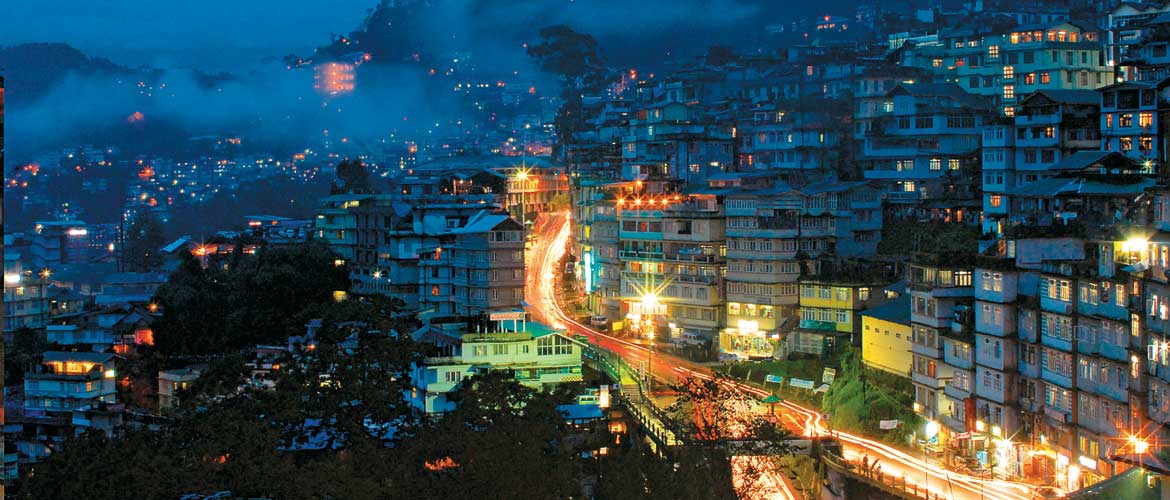
The urban atmospheres of density mean that access to light is uneven and unstable. Thinking about atmospheres of natural light raises the question of who lives in light-filled spaces and who lives in the gloom? How does this change? How fast? Who needs energy to light up space and who can afford it? And crucially, how does this feel? An experience that likely depends on how close to the sky you are standing. Though the movement from light to gloom is not always negative, sometimes the gloom is familiar, comforting, intimate.
In recent decades Gangtok has become brightly illuminated, particularly around MG Marg, West Point Shopping Mall, and the various hotels and casinos scattered along the ridge. Seemingly catering for tourists and residents with disposable incomes, the illuminated night atmosphere of central Gangtok seeks to create a sense of wonder, festival, consumption.
Away from the central area, the atmosphere is dimmer. Moving downwards from the top of town, light shimmers from windows and streetlights. Shops selling liquor or groceries illuminate the night from a naked light bulb, a restaurant sends some dappled light through drawn curtains, and car headlights splice the night with an occasional flare. The mountains facing the city are darker, with smaller settlements and even lone dwellings visible from their illuminated interiors.
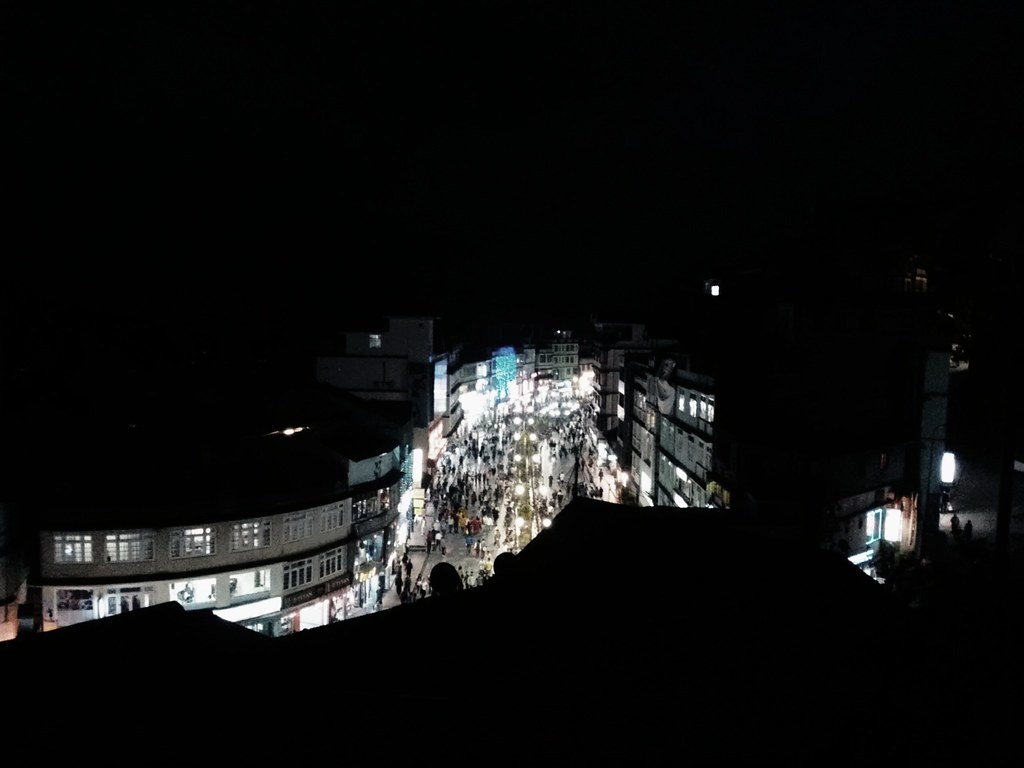
The concentration of illumination around the commercial heart of the city reflects the unevenness of Gangtok’s social and economic geography. The centre is bright, the edges are dark. The centre is for consumption, socialising, tourism and events. The edges are where residents live. While many of the illuminated spaces are exclusive, Gangok’s illumination is very public; it can be experienced by anyone walking through city centre. Illumination is an atmosphere of wonder, yet wonder can wear off with familiarity, and in time the appeal fades for residents while remaining fresh for visitors experiencing the city for the first time.
Moisture
Moisture plays a complex role in the bodily experience of Gangtok. For many residents, and for thousands of tourists, the ‘crisp’ moist air of Gangtok is a reprieve from the plains. This relative affect works both ways, the bodily shock of the plains hits when leaving Gangtok too, even though immersion is gradual along National Highway 10. Moisture in the air signals freshness to the body, a place unpolluted, unruined, until the moisture gains volume and the quaint morning fog becomes an afternoon deluge.
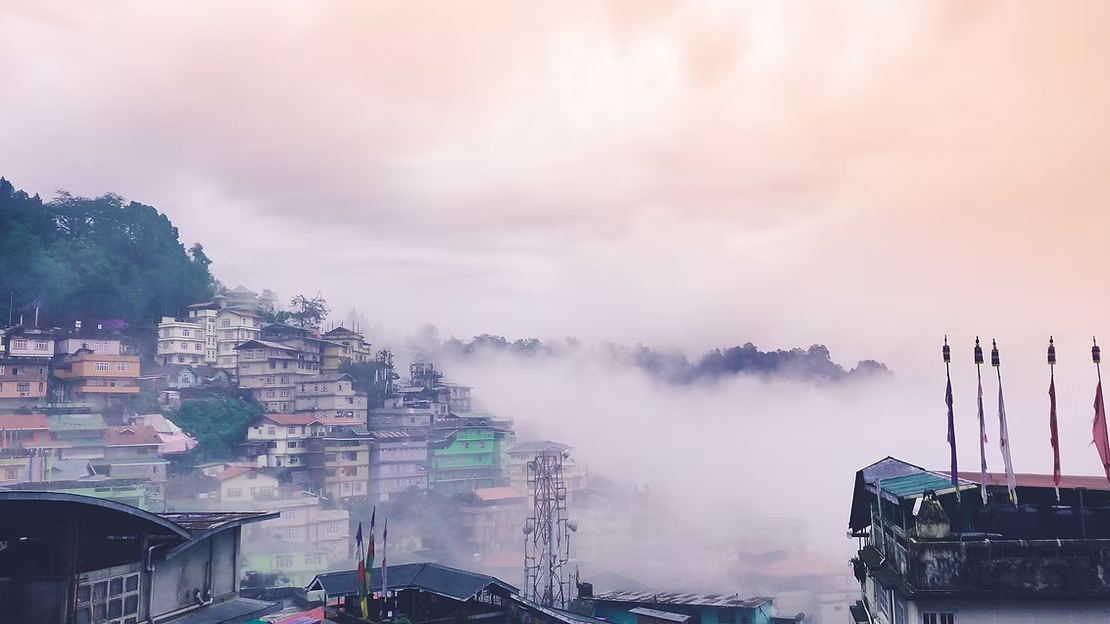
In the monsoon, rain hammers the city’s concrete looking for an escape. Clogged drains flood, roads runs like rivers, concrete starts to sink, hills start to slide. The atmosphere attacks the senses with smells of effluent, garbage and sediment. After the rain, the sweet petrichor lingers, but the densely packed buildings wear the downpour on their battered exteriors. Moisture lingers lower to the ground, seeping through soil and rock into walls and pooling at lower floors.
In the lower reaches of the city, moisture is thicker inside than outside; trapped. Damp and mould creep, settling in walls, on bedding, in human respiratory systems. Clothes don’t dry, dry-cleaners do a roaring trade, and electric fans pulse to dry out interiors. Erratic light exacerbates the moist atmosphere; constellations of damp and gloom.
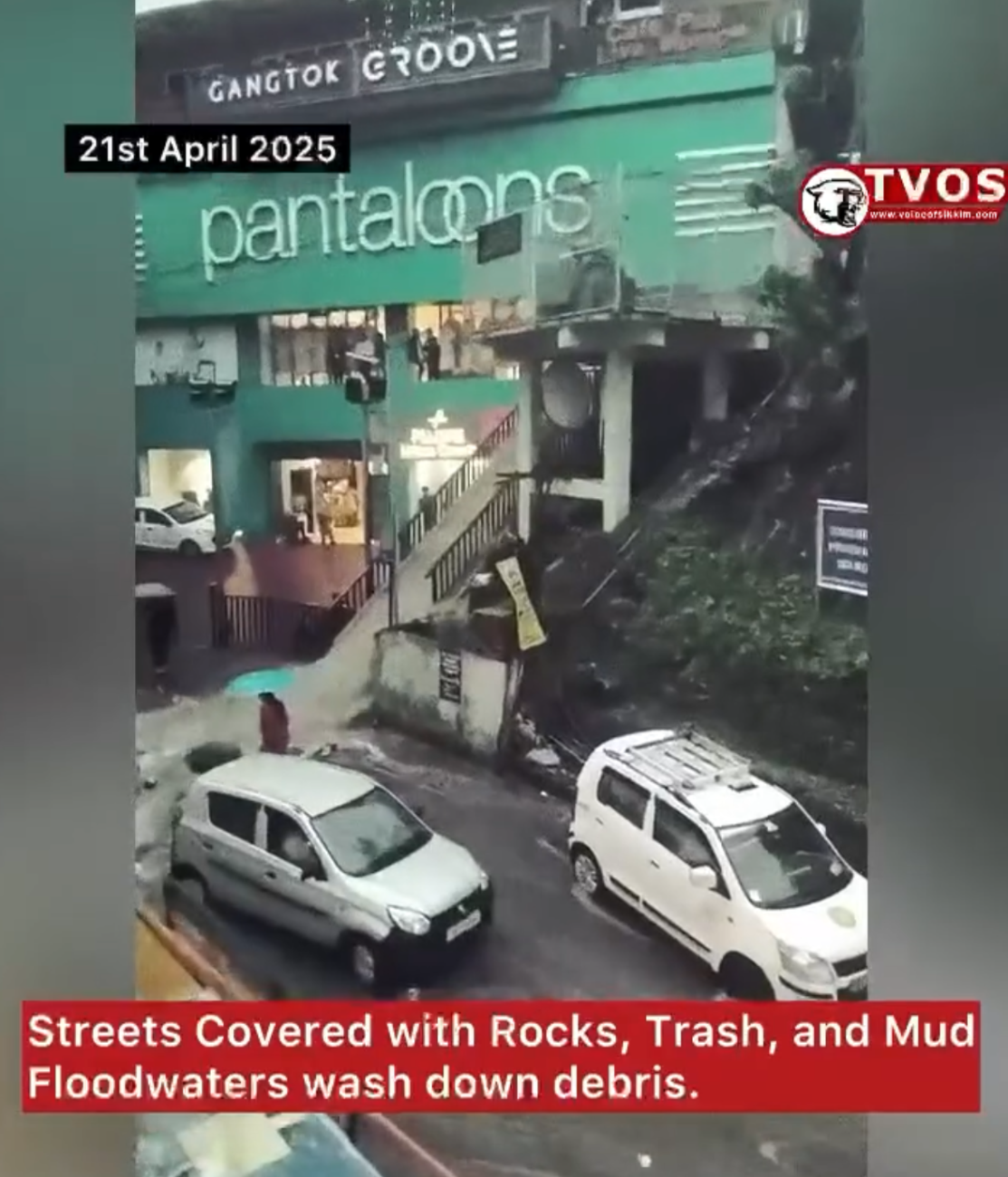
In small doses, moisture fills lungs with fresh air and inspires mobility. In heavy doses, mobility slows down. Roads wash away, landslides block routes, and residents experience prolonged nervousness over the condition of the roads out of town. A small few can afford to fly over the debris in helicopter services while everyone else has to wait or navigate disrupted routes with trepidation; a precarious journey for the old, the sick, and the poor. Immobility is exacerbated by the dysfunction of Pakyong airport outside the city, often attributed to weather-related challenges.
Urban atmospheres of moisture contrast the invigorating atmosphere associated with altitude and encultured through colonial and postcolonial affection for mountain atmospheres (especially when compared to the plains) with the nervous atmosphere of dense concrete on soft hills. Who gets to revel in the moist air and who suffers for it? Uneven experiences of moist atmospheres are arranged vertically in the city, experienced differently on higher and lower ground and on higher and lower floors. Furthermore, everyone in Gangtok, regardless of where they live have to contend with the interrupted mobilities from landslides and washed-out roads.
Exhaust
Exhaust is a constant atmosphere in Gangtok. Exhaust pours out of vehicles, generators, and kitchen fans. Traffic is heavy and exhaust fumes linger; a sensory counterpoint to the imagination of a pristine mountain city with crisp air. Steep topography prioritises cars over walking, taxis are abundant, the consumer finance boom has proliferated car ownership, the tourism-dependent economy keeps vehicles arriving and departing, and construction brings heavy vehicles hauling materials from the plains in a constant flow.
Physical limitations limit the expansion of Gangtok’s roads. More people, more buildings, more cars, and only incrementally more road space. Walls of vertical concrete at the road’s edge trap exhaust fumes, fusing with other particles: LPG gas, construction dust, mustard oil, and—in some localities—wastewater and sewage.
Exhaust permeates ventilation systems and windows of vehicles. It wafts through building windows, especially lower floors. At junctions along main roads clusters of people wait in the fumes for buses and shared taxis. For many residents waiting in the fumes is a daily experience, personal and transpersonal, individual and shared. These gatherings generate encounters among the waiting; classmates, friends, strangers. No doubt leading to conversations about traffic. For others, being stuck in exhaust is part of their livelihood; peddlers selling goods in roadside stalls, guards stationed at gates, traffic police.
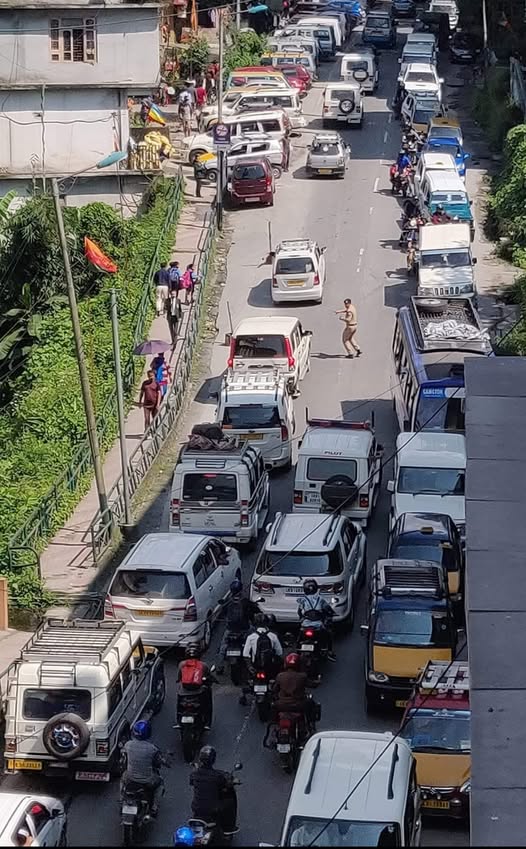
Crucially, roads aren’t just for cars. Historically narrow roads, habitual encroachment of buildings into road space, and (somewhat) limited and damaged footpaths means roads also serve as spaces for walking, hauling, selling, and lurking. Roadways are also spaces for communication; billboards adorn major roads, bringing advertisements and politicians into the constellations of affect. More than visual signals, billboards evoke responses ranging from delight to desire to disgust.
Exhaust is exhausting. The same density that brings vertical construction brings volumes of vehicles into tight spaces. Mountain topography and walls of concrete trap exhaust fumes, fusing them with other particles in constellations gravid with modernity and its debilitations. As with light and moisture the questions of unevenness abound. Who experiences exhaust and who can opt out?
Mind and Body
Light, moisture and exhaust are just some of Gangtok’s urban atmospheres. Attention to atmospheres brings senses, emotions, and sensations—both individual and shared—into our ways of knowing the city and its dense fabric. This approach emphasises the contrast between Gangtok of the mind (policy, statistics, representation) and Gangtok of the body (affect, emotion), and the points of convergence between them. This opens alternative starting points for understanding, critiquing, and improving Gangtok as the city heads towards future growth in limited space.
References
Anderson, Ben. "Affect." In Mark Jayne and Kevin ward (Eds) Urban Theory, pp. 41-51. Routledge, 2016.
Diksha, Amit Kumar. "Analysing urban sprawl and land consumption patterns in major capital cities in the Himalayan region using geoinformatics." Applied Geography 89 (2017): 112-123.
Gandy, Matthew. "Urban atmospheres." Cultural geographies 24, no. 3 (2017): 353-374.
Local Self-Government and Housing Department. Gangtok Integrated Development Plan—2000. Government of Sikkim, 1987
McFarlane, Colin. "Critical Commentary: Repopulating density: COVID-19 and the politics of urban value." Urban Studies 60, no. 9 (2023): 1548-1569.
Thien, Deborah. "After or beyond feeling? A consideration of affect and emotion in geography." Area 37, no. 4 (2005): 450-454.
Urban Development Department. Gangtok 2041: GIS based Master Plan for Gangtok Planning Area. Government of Sikkim, 2023.
Duncan McDuie-Ra is Professor and Head of School of Arts and Social Sciences at Monash University, Kuala Lumpur campus. Duncan researches the interface between humans, technology and urban space, with a focus on Northeast India and the eastern Himalaya. His books include Borderland City in New India (Amsterdam Univ Press, 2016); Debating Race in Contemporary India (Springer, 2015), Northeast Migrants in Delhi (Amsterdam Univ Press, 2012) and Ceasefire City: Militarism, Capitalism and Urbanism in Dimapur (co-authored with D. Kikon, Oxford Univ Press, 2021). Duncan has written over 70 journal articles and essays in Political Geography, Development & Change, Modern Asian Studies, Social & Cultural Geography, and Mobilities among others.



Gangtok has always been a difficult place for me to connect with, as it stands for things I find hard to accept. The city is built on superficiality that feels both intimidating and alienating. Buildings rise rapidly, without a sense of grounding and disregard for the basic elements that make life livable and humane. I struggled to put these feelings into words, but this article helped me immensely. Thank you, Professor Duncan, for this piece.
Terrific article. Rigorous scholarship combined with tremendous human sensitivity and nuance. Thank you for this work.