Selling Shangri-La: Nepal and the Politics of Tourist Desire
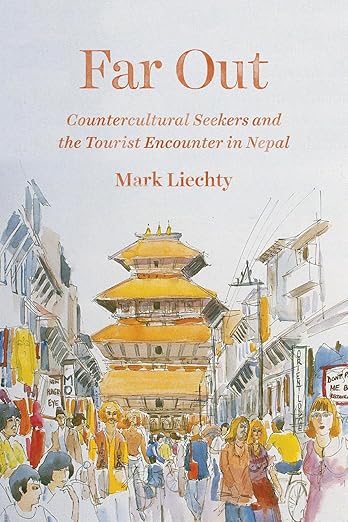
Far Out: Countercultural Seekers and the Tourist Encounter in Nepal by Mark Liechty. University of Chicago Press (2017). ISBN :9780226428949
Nepal was never colonised, yet for decades it sold the West precisely the fantasy the British Empire had planted in their imaginations. Mark Liechty’s Far Out: Countercultural Seekers and the Tourist Encounter in Nepal sets out to explain this paradox. It traces how a resource poor Himalayan kingdom kept reinventing itself: to satisfy desires it had no hand in creating. Crucially, Liechty refuses to cast tourism as something that happened to Nepal. Instead, he seeks to dissect the “cultural and economic encounter between people who shared a larger world stage” (p. xii). This formulation helps us to understand Nepali agency as the centre of the story of tourism, even as Western longing drives the plot. In Far Out, the author traces the shifting Western imaginaries of Nepal and demonstrates how these changing perceptions have shaped the countercultural strategies that Nepalis themselves developed in order to meet and respond to Western desires, longings, and aspirations.
The genesis of Nepal’s tourist boom is especially linked to the Western crisis of meaning. Devastated by the two World Wars, Western travellers looked eastward, projecting onto the Himalayas a longing for ancient wisdom that their own civilisation seemed unable to provide. Books and articles had already helped Kathmandu acquire a romantic appeal long before any Westerner set foot there. China’s invasion of Tibet in 1959 closed that frontier. Consequently, Nepal inherited the full weight of that projection.
The book divides into three neat sections, tracing the evolution of tourism in Nepal across distinct stages. The first section, “The Golden Age,” maps the Western fascination and the early years of Nepal’s tourism sector. Nepalis, long isolated from the outside world, struggled to comprehend why foreigners would desire to visit their rustic villages. Liechty shows how American governmental agencies partnered with the Nepali government to construct the country’s nascent tourism infrastructure, laying the foundation for an industry that would transform the nation.
While governments built infrastructure, the media seduced Western audiences. Journalists descended on Kathmandu to cover King Mahendra Bir Bikram Shah’s lavish royal coronation in 1956, a multi-day spectacle of elephant processions, traditional dances, and foreign dignitaries. The coronation announced Nepal’s opening to the world. Western obsession with the “Abominable Snowman” (Yeti) simultaneously cast Nepal as an exotic and mysterious destination, arriving precisely as the country began welcoming foreigners after the collapse of Rana rule. The first successful Everest expeditions in 1953 amplified Nepal’s global profile further. Climber Eric Shipton’s photographs of Yeti tracks seized press attention worldwide. James Hilton’s novel Lost Horizon, in which a hijacked plane crashes in the Himalayas and survivors discover a hidden utopian valley called “Shangri-La” had already embedded the Himalayas deep in the Western imagination as a place of longevity, and mystery.
The irony was that Nepal, a nation that had never been colonised, found itself catering to the elites who romanticised the lifestyles of the British Raj. Liechty traces the rise and fall of Nepal’s first international hotel, the Royal Hotel, founded by Boris Lissanevitch whom he dubs the “Father of Nepal tourism”. Another foreigner, John Coapman, launched Tiger Tops, the adventure resort that pioneered jungle safaris. Liechty credits him as the “pioneer of hunt adventure tourism” (pp. 94). The Golden Age weaponised Himalayan mythology, channelled Western longings, and inserted Nepal firmly into global tourism circuits.
The book’s middle section, “Hippie Nepal,” is where Liechty’s ethnographic instincts catch fire. Drawing on interviews, diaries, and period doodles, he reconstructs the frenetic energy of Freak Street — the maze of budget lodges, pie shops, bakeries, restaurants, and hashish vendors that entrepreneurial Nepalis built almost overnight. This was to feed the appetites of young Westerners arriving overland from Europe. Through the 1960s, direct buses ran from England to Kathmandu via Iran, ferrying budget travellers in their thousands. The postwar economic boom, rising disposable incomes, and cheap flights made the “Road to Kathmandu” irresistible. Travellers flooded India and pushed on into Nepal. Nepalis converted their homes into lodges to absorb the wave. Liechty charts the rise of iconic establishments— Tibetan Blue, Pie/Pig Alley, Camp Hotel with genuine flair. His account of the emerging tourist district does double duty as urban history, revealing how the influx physically reconfigured the “domestic and commercial space of Kathmandu” (pp.162).
Liechty locates the hippie exodus not merely in wanderlust but in political rupture. The American civil rights movement, the Vietnam War, and the eruption of youth counterculture generated a profound disenchantment that drove young Westerners to abandon not just their countries but their cultures. Liechty dissects the political rage of 1960s youth who rejected both the crass materialism of the postwar consumer boom and what they saw as the moral bankruptcy of their parents’ generation (pp.166). The Far East, and Kathmandu in particular, became the pressure valve for that accumulated frustration. Yet Liechty resists a one-sided account. Nepali youth, themselves unsettled by the disruption of modernisation, encountered these Western arrivals with a complex mixture of curiosity and unease. Both groups, rejecting the conventions of respectable adulthood— education, employment, mortgage, family, briefly converged on Freak Street and forged an unlikely countercultural commons. This arrangement was temporary and fragile. The “conservative backlash” in the early 1970s, accelerated by Nixon-era politics and echoed by crackdowns across Western governments, dismantled the hippie economy. The Nepali state, increasingly embarrassed by the spectacle of foreign vagrants on its streets, moved to clear them. An era closed.
The book’s third section, “Adventure Tourism,” charts what replaced it. The new tourists arrived not to drop out but to push limits. Nepal’s government read the shift, rebranding the country for a global audience now oriented towards health, physical challenges and environmental experience. Nepal rebranded itself as a trekking destination. Thamel replaced Freak Street as the country’s dominant tourist district, built for a clientele looking for tougher physical challenges. Nepal cultivated Dharma tourism with Kopan Monastery, founded on the outskirts, playing a crucial role in attracting spiritual seekers to Tibetan Buddhism. Liechty’s central argument finds its fullest expression here: across every decade, Western desire projected a fantasy onto Nepal—exotic kingdom, counterculture sanctuary, Himalayan wilderness, spiritual refuge, trekking utopia, and Nepal, with remarkable agility, manufactured precisely the product the fantasy demanded. Liechty calls this a co-production, but the term risks making the encounter sound more equal than it was. Westerners had the money, the mobility, and the power to leave.
Far Out’s most significant blind spot is the one Liechty himself identifies but never fully addresses: the Nepali voice in its own right. When conservative Nepalis recoiled at tourists’ drug use, sexuality, and disregard for local dress codes, they were articulating a politics of encounter that deserved far more than a passing acknowledgment that it receives here. The material transformation hinted at in the Freak Street passages, the conversion of domestic space into commercial space, the reshaping of consumption patterns, the transformation of urban spaces are mentioned briefly but never receive suitable analysis. The conclusion arrives abruptly, leaving the reader without a clear sense where Liechty believes this encounter leaves Nepal today.
Overall, the book provides a compelling analysis of how tourism restructured lives, livelihoods and landscapes in Nepal across half a century. More importantly, it establishes a template that scholars of adjacent Himalayan regions— Darjeeling, Ladakh, and Sikkim could adopt. These questions: how tourism reshapes land, labour, urbanisation, transforms land use, and reshapes community space in mountain society remain largely unaddressed. Far Out frames this with rigour and historical depth to make that work in the future possible and necessary.
My own recent encounter in Pokhara offers a small but telling coda. Over dinner, I watched local artists dance to Nepali folk songs in traditional attire, the image of authentic cultural heritage that global tourism demands. Towards the end, the Germans at the next table called out a request for a song. The performers obliged. Within minutes, tourists dressed in hiking boots replaced graceful Nepali footwork, arms were flung wide, legs kicked high, and the room gave over to a German folk song. The moment was warm, spontaneous and joyful, ending with a large tip. It was also, unmistakably, the same co-production that Liechty maps: Western desire naming what it wants, Nepali citizens delivering it and something midwifing in the space between. All of the past iterations of an exotic kingdom, the hippie sanctuary, the trekker’s wilderness have given way to the smoother, more packaged fantasy, but the structure remains identical. Liechty’s great achievement in Far Out is to show that this dynamic is not incidental to Nepal’s tourism story. It is the story. The costumes change. The encounter continues. But whose terms does it endure on?
Dr. Nirvan Pradhan teaches Political Science at Narasinha Dutt College, University of Calcutta. Outside the classroom, he reads in church history and the Old Testament, runs when he can, and contributes to the Lumos initiative, which works on mental health support in Sikkim.