Tika Bhai’s Lyricism: Songs of Self and Struggle
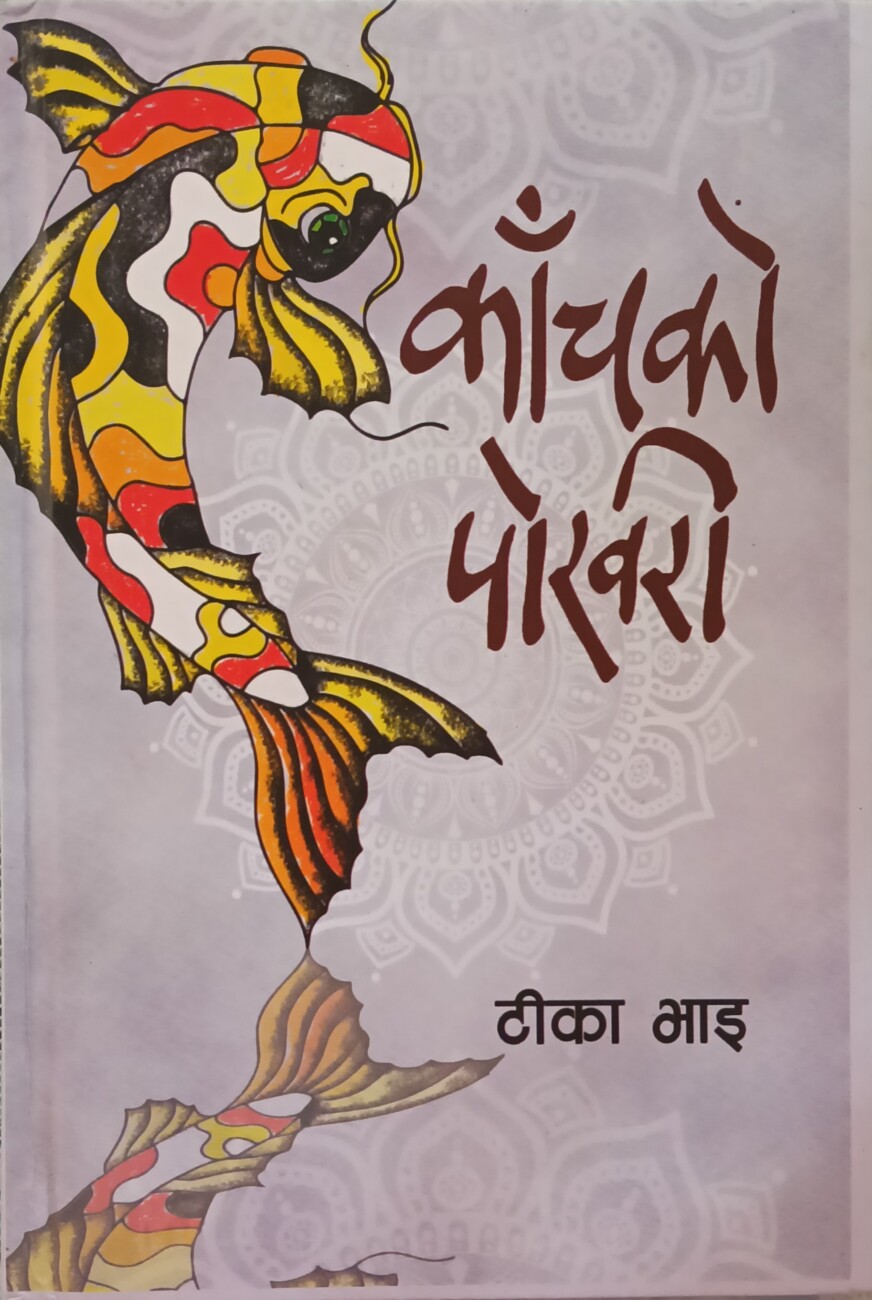
Kaanchko Pokhari by Tika Bhai. Upama Publications, Kalimpong, West Bengal (2024). ISBN: 9789392035906
Very tender
Like a flower I had come,
Steel feet were to
Crush this life,
On a diamond’s edge
Was meant to grind this life. (7)
These lines introduce us to Kaanchko Pokhari’s lyric speaker-brooding, lament-filled, indicting the world for its harshness and, for the memorable cadence that distinguishes this collection from Tika Bhai’s previous work. Tika Bhai is a respected poet from Kalimpong, known for his Nepali verse in the tradition of political commitment. His previous collection Paitalatalatira (Manvi Prakashan, February, 2012) spoke for the oppressed and exploited Gorkha people. That work continues here yet with a twist. The poems suggest the poet is no longer satisfied with poetic intervention alone and that he is reaching now toward something more affective and intimate: the song.
The Song’s Arrival
Jonathan Culler’s Theory of the Lyric (2015) is useful here. Unlike narrative, which moves through time, or drama, which unfolds through character and conflict, lyric resists paraphrase and forward momentum, instead, it asks to be dwelt in, returned to, and heard rather than merely read. Its defining gestures-apostrophe, refrain, repetition, rhyme, direct address are not ornamental but constitutive, the means by which poems produce feeling and stay in memory. Kaanchko Pokhari is deeply aware of this. Memorable cadence is not incidental but consistent throughout Kaanchko Pokhari. Take the lines opening the second poem ‘Duri’ (Distance) for instance:
I am at a distance your eyes can’t reach
Somewhere in the dust where your footsteps fall. (10)
Though it hasn’t come across in the translation, the measured repetition of timra, le, and ma, produces a sonority which solicits the lyric speaker’s mysterious and hyperbolic claims. The structure of these lines also repeats near the end of the poem. The template which stays intact from the previous lines have been italicized below:
I am at a distance your mind can’t reach
Somewhere in the ashes of your ego’s fire. (11)
We could say the repetition of these templates to emphasize the speaker’s central theme of distance between him and his addressee illustrates their resemblance to refrains.
Similarly, the subsequent poem Parewaharu (Pigeons), begins much of its stanzas with the line, ‘Parewaharu Chan’ (There are pigeons). The refrain is followed by curt remarks about the pigeons’ ironical existence, such that they fly but remain directionless. Or that they are waiting to be sacrificed in some ritual. Or that they become mere symbols of peace in front of all the wars. Or that they get treated like refugees in spite of their historical presence in the land. Or that they live like birds that have forgotten their wings. In short, the poem takes several jibes at the pigeons. Eight curt stanzas with three or four measured lines, render its speaker quite caustic in tone. Nevertheless, they have impressive iterations that sit well on the ears:
There are pigeons
Yet without purpose
…Or
There are pigeons
In temples and sacred places
Waiting to be sacrificed for a vow
… Sometimes, startled
They soar up, then land again
Those pigeons. (12-13)
The speaker of the next poem, Chiyabot (The tea bush), addresses plantation workers as one of their own, and repeatedly asks them the riddle-like question, ‘Ke Cha Yo Chiyabotma?’ (What’s in the tea bush?). As in the previous poem, it is structured by a refrain which anchors it to the relationship of plantation workers with the tea bushes. Many answers are suggested to the question but the lyric speaker eventually comes to assert that the workers have blood ties with the tea bushes, whose kinship is yet to be named. Chiyabot:
…
… Ruppe Daju
What’s in the tea bush?
Frightens me like a ghost
Still, I love it
Starves me again and again
Still, I love it
It is my heart, should I uproot it,
It is my face, should I look at it,
What’s in this tea bush?
… What bond binds me to it¸
Baidar Kaka! (14-16)
Even a relatively ‘impersonal’ poem like Chiyabot deftly deploys aural conventions of lyric poetry. It speaks in a colloquial first-person language with harmonies created from rhythm, rhymes and repetitions. This makes Chiyabot’s lines quite unforgettable. Whether personal or impersonal, poems of Kaanchko Pokhari have this musical quality which makes them more song-like than the poems from his previous collection. In Paitalatalatira, lyric conventions operated for other purposes-the cadence there is more declaratory, a voice addressing a gathering from a podium rather than whispering or singing to someone. Where that earlier collection speaks about lives, Kaanchko Pokhari speaks from within.
Within the Lyric Speaker
The lyricist of Kaanchko Pokhari often gets personal. It draws on the poet’s intimate relationships and experiences, memories and feelings, for its addressees and messages. For instance, he is heard ruminating on his experience of being both a parent and a child, which remained relatively less explored in Tika Bhai’s previous collection. This inward turn palpably separates Kaanchko Pokhari from Paitalatalatira. In the earlier collection, the ‘I’ spoke for an oppressed collective- a voice of solidarity rather than interiority, voicing the experiences, dreams and outrage of the downtrodden multitude. In Kaanchko Pokhari, the ‘I’ also expresses the poet’s self, rooted in his emotional and everyday experiences. Take for instance the poem Meri ‘Sanu’ Sita (My Dear Sanu):
My Dear,
I won’t give you the market’s false stories
Instead, for you to withstand the market
I’ll give you the silent dignity buried in my eyes,
You can hold my finger
And look
With your own eyes
The tale of man not in pace
The tale of man out of tune. (22)
Here the father addresses his daughter. It begins with the father acknowledging his repeated failure to bring her stories from the market. He then goes on to justify why he failed. He describes how the market lacks magic and concludes they also don’t have miraculous stories with happy endings. The kind of stories his daughter liked, where princes fought against and won over evil, where success, grace and happiness were possible for her and everyone else. For once, the poem sounds like a forgetful parent making excuses before his kid after not bringing her gifts.
By the time we reach the lines quoted above, he begins rationalising why it was better not to give false stories to his daughter. Indeed, he asserts that he doesn’t wish to ever give her false hopes regarding the market’s power to change her and others’ lives for good. Instead, he dearly hopes to give her the opportunity and ability to look at the market through her own eyes. To realise of her own accord, how the market’s power was inimical to her dreams. Through this memorable poem, Tika Bhai welcomes us into his inner world of anxieties, hopes and desires.
Mato Ra Papako Anuhaar (The Soil and My Father’s Face) is an equally personal and moving poem. Here the lyric speaker remembers his late father every time he looks at the soil he handles, the land he treads upon or the earth he inhabits. Indeed, it’s impossible for the son to not miss his father, with whom as a grown man he finds many similarities, owing to the ubiquitous presence of soil and silence between them. In the poem, the son tenderly attends to the strengths and weaknesses of his father, relates with him for having the same qualities, especially, his failure to live up to societal expectations. It is as if the son of Mato Ra Papako Anuhaar wants to forgive the unsuccessful father of Meri ‘Sanu’ Sita. Both poems also accept with grace the difference between parents and children brought by age, time and relationships. Here are some of its significant lines:
I touch soil
And meet my father.
I meet the face bent over a petition.
It spoke without speaking
It talked without talking
That face.
…We had some quiet conversations
And our conversation ended in silence.
…Between us lies the border of soil
Like a bottle-cap
Forever closed.
Each time I turn to the soil
I see my father’s face. (41-43)
Here, music is integral to both the above poems. In fact, lyric conventions, like first person speaker, apostrophe, intimate tone, colloquial flow, rhymes, repetitions and themes of interiority are neither ornamental nor for mere sentimentality.
For instance, the musical metaphor he deploys in Mero ‘Sanu’ Sita ( The tale of man out of tune). The line indicates how significant music is to Tika Bhai’s poetry and human life in general. Here the tune emphasises the element of sound and the practice of listening. Afterall, both poetry and music require a sound ear to create and receive. Moreover, listening is also a fundamental experience of our being. Lyricism thus is not only a poetic mode but also the poet’s philosophy of engaging with both his private and public life. By attuning us to the many registers of the lyric speaker in Kaanchko Pokhari, Tika Bhai has us thinking about the language we use to express ourselves. Do they really speak only for you?
This inward turn does not abandon the socio-political commentary that defines Bhai’s poetry. Rather, he shifts from being the analyst of the collective to the subject of analysis-and in expressing himself, occupies both roles, turning personal experience into the lens for a continued, now more intimate, political critique. Sanu’s father resists the market’s ideological domination not by commanding or persuading his daughter, but by offering her, as a companion in struggle, the weapon of ‘dignified silence’.
The Lyricist’s Wager
The lyric speaker of Kehi Bhanirakhera Jana Ayeko Chu (I have come to say something before I leave) articulates Tika Bhai’s poetic ambition in Kaanchko Pokhari. His aim is to translate the quiet tunes of the speechless into a portrait of words. This is equally a desire to memorialise the quiet tunes. It reveals how music is salient to Kaanchko Pokhari’s project in more ways than one. For it is the subject (interiority), medium (speech) and form (song) of memorialisation. When Bhai speaks to roads and skies, he animates what cannot speak in order to give voice to those who no longer can. The poems wish to be remembered on the tongues of their people- to circulate orally, to stay in folk memory, the way songs outlast their singers. Consequently, the portrait is not in painting but is heard through the song. Bhai’s declaration of poetic ambition may not interest every reader but the music of his words will surely not leave them untouched. He writes:
Of those who left, quietly, quietly
Of those who fell silent, quietly, quietly
Stringing the tunes of their hearts,
Gathering the imprints of their footsteps,
A portrait I shall draw and keep
Something to the roads I shall say
Something to the skies I shall confide. (80)
The poem Badh (Flood) encapsulates in action all the vows made by the poet above. Its speaker listens to the unsayable ordeals of flood victims and translates them into a poem with memorable flow and a valuable message. I shall only cite its first few lines to highlight how it obeys the maxims enlisted by the above poem:
Sentences crumble
Words come apart
Letters come drowning
And carry away the courtyard’s memories. (27)
Sentences, words and letters are at once literal casualties of the flood and figures for the disintegration of speech, language and communication among its survivors. Traumatic experience resists ordinary language- it returns not as narrative but as rupture, fragment, silence. Bhai’s flood poem enacts precisely this: language doesn’t describe the flood, it disintegrates with it. In memorialising what the flood erases, the poet participates in the survivors’ struggle to recover it.
Tika Bhai knows poetry is made more memorable through music. He wagers on the strength of music to try and inscribe in our memories the experiences of his silenced subjects. These silenced subjects range from flood victims and plantation workers to, at times, the poet himself, whose own failures, griefs and silences are equally part of Kaanchko Pokhari’s memorial project. By taking up room in our memories, his lyric poems desire to change our usual ways of feeling about various issues of private and public life in our region in particular and India and the world in general. Through our feelings, the poems of Kaanchko Pokhari work on us slowly, the way only songs can. This is the oldest wager of lyric poetry, that to move someone emotionally is to move them ethically, and that the poem which stays in memory also quietly reshapes the conscience carrying it.
References
Bhai, Tika. Paitalatalatira. 1st ed., Manvi Prakashan, 2012.
Bhai, Tika. Kaanchko Pokhari. 1st ed., Upama Publications, 2024.
Culler, Jonathan D. Theory of the Lyric. Harvard University Press, 2015.
Abinash Rai is a Research Scholar in Cultural Studies. He likes watching films and series, listening to songs and podcasts, cycling, swimming and basketball.