STORY OF WAR AND PEACE
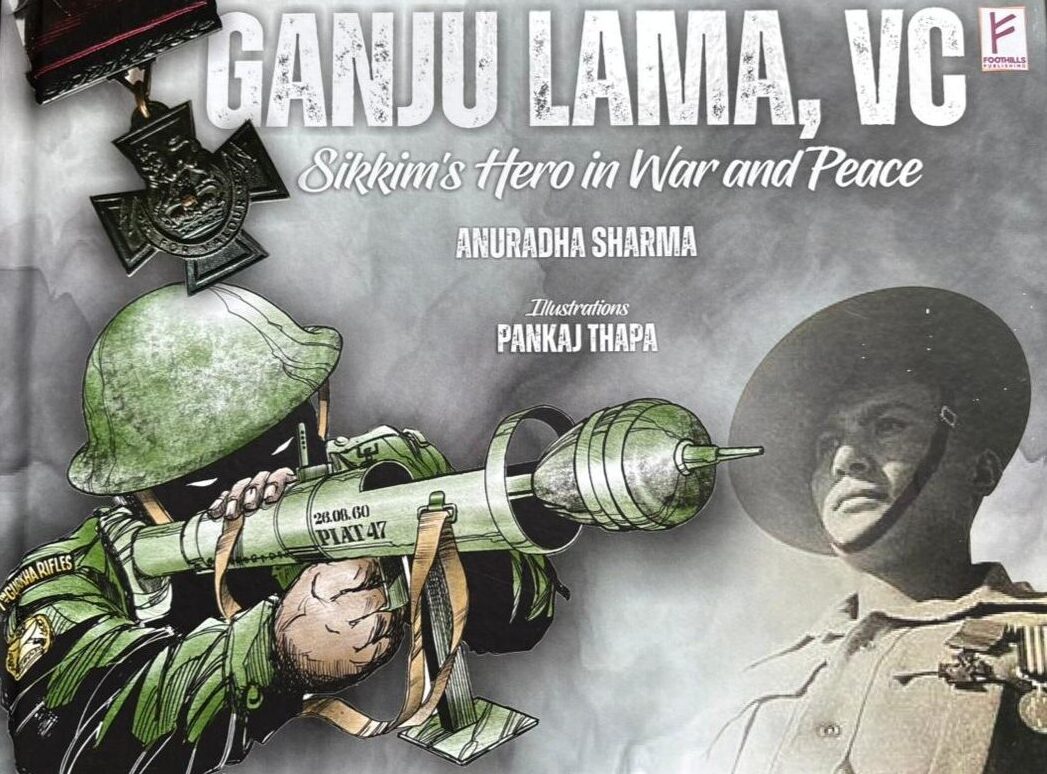
Ganju Lama, VC: Sikkim’s Hero in War and Peace by Anuradha Sharma and illustrated by Pankaj Thapa (2025). Foothills Publishing, Hill Cart Road, Methibari, PO Salbari, West Bengal, India.
When I began to read, the usual authors that my generation of children grew up with were Enid Blyton and other popular writers of the time. We were the lucky ones, having attended private schools with a strong emphasis on the English language and thus had access to a variety of children’s books, fiction, adventure stories specifically for girls like Malory Towers and the Anne of Green Gables series and the Hardy Boys series for the boys.
As I grew older, I began to wonder at the absence of books and stories from our land. Of course, we were compensated for this lack by stories of adventure from our elders, especially those who had returned from the war front. But those stories were narrated to us orally, and we were enthralled by the battlefield actions and long marches in alien lands. Stories of camaraderie and of friendships in unexpected turns of their wartime journey also interested us.
Both the World Wars drew hundreds and thousands of youths to its faraway battlefields from our hills. The empire drew millions of lives from countries under its sway. There were many young men, some barely fully grown, recruited as the machinery of war swallowed them. We would also hear about the trauma they suffered from experiencing indescribable violence and hardships. But there were no written records of these young men who ventured out for adventure and honour from the quiet villages of Sikkim.
Ganju Lama, VC: Sikkim’s Hero in War and Peace by Anuradha Sharma is a timely publication in filling this gap. The book begins with the setting of Sangmo the beautiful, peaceful village in South Sikkim, where our hero was born, named Gyamstso, meaning the infinite ocean.
“Sangmo, in the southern part of the kingdom, was an enchanting village with endless terraced fields hugging its slopes. Lovely homes made of wood and stones dotted the lush green landscapes. The sky stretched like a vast blue canvas, its colours changing with the rising and the setting of the sun, and the comings and goings of clouds and mist. To the east, loomed the stunning mountains of the Chola range, hiding a secret door to the ancient land of Tibet.”
Although Gyamtso’s mother passed away when he was still an infant, his stepmother nurtured him tenderly. From his stern father, he learned discipline and moral values. As he grew into a young man, he yearned for an adventurous life fueled by his soldier uncle, who regaled the youth with colourful adventures and the lure of the lands beyond the hills.
At 20, Gyamtso enlisted in the Indian Gurkha army. At the recruiting centre, his name changed to Ganju Lama. The Gurkha soldiers who were categorized as a martial race were Rais, Limbus, Magars, Thapas, the hill tribes. By the time ,Gyamtso presented himself to join the army, the war was already into its fourth year and the growing need for more soldiers most probably influenced the recruiting officer to accept this sturdy youth from a non-martial tribe.
After his training at Palampur, he was deployed to Imphal in 1943 in the Burma campaign. It is here that Ganju Lama came into his own. The Japanese had captured Burma and were advancing decisively towards Manipur. For the first time, he experienced the hard truth that “…war brings great pain and destruction. It ruins homes, hurts people, and tears families apart. He quickly understood that war should always be the last option, something to be avoided whenever possible”.
Ganju Lama was a brave soldier when it came to defending his country. He fought with grit and intelligence. On May 16, 1944, the Gurkha soldiers launched a surprise attack and defeated the Japanese troop at 33 on Tiddim Road. The action barely ended when the Japanese tanks rolled in. Ganju Lama saw a tank of such monstrous size for the first time, but he was armed with a powerful anti-tank gun, the PIAT. He fought till the last and destroyed the enemy tanks and thus saved his comrades. It was for this brave action that Ganju Lama was honoured with the Victoria Cross, the British army’s highest award in 1944 and with Sikkim’s Pema-Dorji title in 1966.
The story of our hero does not end here. He was a great hero during peacetime as well. After his retirement from the Indian army, he returned to his village, building schools, roads and monasteries. His action as a civilian hero is as much of importance to us as his valour on the battlefield.
For Anuradha Sharma, writing Ganju Lama’s biography, she was beset by the dilemma of writing about valour and courage in the battlefield without glamourising war and violence and balancing with the need to nurture a peaceful outlook on life. Ganju Lama VC: Sikkim’s Hero in War and Peace is a well-chosen title giving equal importance to courage on the battlefield: duty with utmost discipline and bravery, as well as advocating for peace after the war. The biography of our hero in times of war and peace fills the gap in Children’s literature about extraordinary personalities from our region.
The book is illustrated by Pankaj Thapa, one of our best illustrators from Sikkim and the Darjeeling hills. With meticulous research and attention to detail, his illustrations enhance the narrative and capture the excitement of the battlefield.
The book also includes useful information about the war, the participation of Gurkhas and their sacrifice. Anuradha Sharma’s style and treatment of the subject strongly reflect the best practices of her profession as a journalist. She combines a compelling story telling skill with very useful information.
This book opens the way for many others to be written. Congratulations to Foothills Publication on taking this initiative to enrich literature for children.
Prava Rai is the Editor of Sikkim Project and the Founding Director of DG Reading Room Resource and Education Foundation, an education and research-oriented organisation in Dumigaon, South Sikkim.