Constructing Sikkimese Identity: Colonialism, Monarchy, and History in Alex McKay’s ‘The Mandala Kingdom’
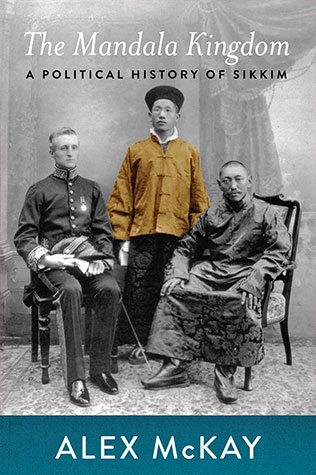
The Mandala Kingdom: A Political History of Sikkim by Alex McKay, Rachna Books, Gangtok. (2021). ISBN 978-81-89602-12-3.
The Mandala Kingdom: A Political History of Sikkim delivers a rich historical account of the British period in Sikkim. Using previously unpublished Royal Family archives, McKay advances fresh insights and presents a comprehensive account from the perspective of the rulers, establishing the book as a significant contribution to Sikkimese history. He illuminates the interplay of Buddhism, Tibetan influence, and the interests of the ruling elite in crafting Sikkim’s historical narrative. The book traces Sikkim's mythic origins under the Namgyal dynasty through the long arc of British colonial engagement. It culminates in the political crisis that led to the merger with India in 1975. McKay offers a nuanced, deeply researched account that challenges many received interpretations of Sikkimese history.
The opening chapter presents the traditional Buddhist view of Sikkim’s history and explains how the Namgyal dynasty emerged as divinely chosen to rule. It reframes the importance of Buddhism, prophecies, and sacred texts in shaping Sikkim’s past. Drawing on Mullard (2011), McKay layers a more critical and historical reading, arguing that many traditional stories about the Namgyal dynasty arose from religion and politics rather than being purely factual. The strength of the approach lies in its ability to question traditional accounts using modern research while still acknowledging their cultural significance for local identity. McKay encourages readers to examine Sikkim’s history critically without dismissing the weight these narratives carry. The chapter highlights the challenges of the 18th century, especially the Gorkha invasions and territorial losses. McKay foregrounds the importance of class and power alongside ethnic and religious factors in shaping early Sikkimese society.
McKay details the tempestuous relationship between Sikkim and the British. He argues that Sikkim lost Darjeeling because of cultural misunderstandings. While scholars have written about the Anglo-Sikkimese conflict in the mid-19th century, many accounts display biased perspectives. McKay handles this issue with the delicacy it deserves. He demonstrates how British officials such as Dr. Campbell’s arrogance and lack of diplomatic skill worsened relations. British officials often misread Sikkim’s political system and blamed Dewan Namgyal for many problems. By challenging the traditional British narrative that “pagla” (mad) Dewan Namgyal was a villain, McKay recovers the strength and fortitude of the Dewan who defended Sikkim’s interests against the colonial overlords. Personal rivalries, cultural misunderstandings, and British imperial ambitions altered Sikkim’s history and expanded British influence over the kingdom. McKay’s empathetic yet critical re-examination of Dewan Namgyal enriches our understanding of this pivotal conflict.
In the chapter, ‘Sikkim 1861-1888’, McKay demonstrates that Sikkim’s loss of autonomy was a gradual process. Sikkim’s history during this period emerged from the struggle between British imperial expansion, Tibetan influence and internal political divisions. After the 1861 Treaty, the British viewed Sikkim no longer as an independent kingdom, but primarily as a route to Tibet. Its position as a buffer state was secured. The Chogyals and Sikkimese elites struggled to balance relations with British and Tibetan powers to protect their kingdom. Around this time, Nepalese immigration transformed Sikkimese society, economy, and politics, creating divisions among the ruling elite. The chapter reveals that British support for Nepalese immigration served partly political aims by reducing Tibetan influence in Sikkim. By 1888, after the British military expedition and the defeat of Tibetan forces, the Chogyal retained the throne but real power had largely shifted to the British. One limitation of this chapter stems from its heavy reliance on British colonial records. Consequently, the voices of ordinary Sikkimese people, especially Lepchas and Nepalese settlers, remain less visible.
Sikkim transformed considerably under British rule, especially during the time of J. C. White. The British administration introduced roads, schools, hospitals, courts, and postal services, creating an organized government and modernising Sikkim. However, the chapter exposes the negative side of British rule. The British eroded Sikkim’s independence and often made important decisions without the consent of the Chogyal, such as choosing Sidkeong Tulku as heir. Nepalese settlers faced unfair treatment, higher taxation and discrimination, while many aristocrats fell into debt. During the Francis Young Husband Mission to Tibet, many Sikkimese were forced to work as porters under difficult conditions. Overall, the book provides a nuanced account of how Sikkim moved from a traditional kingdom to a more modern state under British influence. It reveals that modernization brought progress, but also colonial control, social tensions, and unequal benefits.
One of the book's most compelling chapters explores Sidkeong Tulku, whom McKay portrays as a visionary leader who sought to modernize Sikkim while preserving Buddhism. His education in Oxford, religious reforms, support for education, forestry conservation, and efforts to connect Sikkim with the wider Buddhist world stand out clearly. However, the chapter is at times too sympathetic towards him and idealizes him as a tragic hero whose early death prevented a bright future for Sikkim. The resistance his reforms faced from ordinary people, monks, and aristocrats is sidestepped. His criticism of local customs as “superstition” is noted, but not sufficiently interrogated. While most people in Sikkim at the time practised Hinduism, Sidkeong’s vision focused heavily on Buddhism and Buddhist identity. This is a tension that the book could have explored more. McKay shows how deeply Sidkeong absorbed British education and colonial ideas of modernisation, portraying him as a complex figure who tried to balance Buddhism, tradition, and modernity; but the analysis is unable to fully explore the complexities.
The British policy in Sikkim shifted after C. A. Bell assumed the role of political officer in 1908. Unlike White’s authoritarian approach, Bell adopted a more diplomatic and cooperative style and sought an alliance with the Sikkimese ruling elite. Bell’s policies stabilised Sikkim, strengthened the Namgyal monarchy, and prepared the state for a gradual return of internal administration to local control. Bell introduced measures such as the ‘Sikkim Debt Law of 1910’ to curb exploitative money-lending practices and restricted further Nepalese immigration through land and forest policies. These actions reflected his attempt to balance British strategic interests with the concerns of Sikkim’s traditional elites.
The discussion of identity formation during this period offers one of the most interesting sections. McKay reveals how a shared Bhutia-Lepcha Buddhist identity was promoted, while Nepalese communities remained politically underrepresented despite their growing demographic and economic importance. The chapter effectively demonstrates that ideas of “Sikkimese identity” were not fixed but were shaped by both colonial policies and local responses. The argument runs through the entire book and constitutes one of its most important contributions.
The chapter on the return to autonomy unpacks the rise of Tashi Namgyal following the death of Sidkeong Tulku and the restoration of Sikkim’s internal autonomy in 1918. Unlike his predecessor, Tashi Namgyal avoided bold reforms, but advocated combining modern ideas with Sikkimese traditions. The tensions between the Bhutia-Lepcha ruling groups and the growing Nepalese population reveal that Sikkimese identity was derived largely by religion and ethnicity rather than civic nationalism, which prevented the growth of a united independence movement.
The last chapter, ‘Endings’ covers the period from 1918 to 1948, described by the author as the “calm before the storm” (pg. 268). It examines the deeper causes of the fall of the Namgyal dynasty. McKay argues that Sikkim failed to develop a strong national identity that included all ethnic communities, especially the Nepalese majority. He links political instability to demographic and social change rather than blaming individual leaders alone. Tashi Namgyal is presented as a wise, modern, and deeply religious ruler who successfully balanced Western modernity with traditional Buddhist kingship. His efforts in education, healthcare, and administration, alongside his commitment to monastic institutions are demonstrated. The chapter demonstrates how British influence shaped Sikkim’s elite society without completely replacing local traditions, and how educated Sikkimese became intermediaries between British India and Tibet. The chapter has some weaknesses: at times McKay appears overly sympathetic to the monarchy, placing too much responsibility for Sikkim’s collapse on British policies and Indian intervention rather than examining the monarchy’s own failures. The discussion of L. D. Kazi, for instance, sometimes portrays him more negatively than other political figures, suggesting a bias that the author does not fully acknowledge. The monarchy’s structural incapacity to manage demographic changes, its failure to build institutions that could incorporate the Nepalese majority receives far less attention than the contingent factors of British withdrawal and Indian intervention.
The book concludes with a summary of Sikkim’s political, social, and cultural history from the establishment of the Namgyal kingdom to its merger with India. One of its greatest strengths lies in its analysis of Sikkim’s identity. The author argues that Sikkimese identity was shaped by Buddhism, the Namgyal monarchy, and a shared Bhutia-Lepcha framework. The discussion of ethnic relations, especially the colonial construction of this divide, challenges many traditional interpretations and encourages readers to reconsider accepted historical narratives. Rather than portraying the British as either entirely oppressive or entirely beneficial, McKay presents a nuanced view that acknowledges interference and exploitation, while recognising contributions to education, healthcare, and administrative modernization. The argument about Nepalese migration and its long-term impact on Sikkim’s political and demographic structure is convincingly made. The growth of the Nepalese population transformed the social balance of the kingdom and eventually reconfigured the basis of political power. The experiences and perspectives of ordinary Nepalese people receive relatively little attention, a weakness that the author himself admits at the outset. The conclusion focuses heavily on elites, rulers, British officials, and political structures, while the voices of common people remain largely absent.
The Mandala Kingdom stands out as a strong and well-researched work that reassesses Sikkim’s history, identity, colonial experience, and political transformation with authority and clarity. Its greatest contribution lies in showing that Sikkimese history cannot be reduced to simple narratives of colonial oppression or royal decline, but must be understood as a layered process in which Buddhism, ethnicity, and geopolitics constantly intersected. Despite its tendency to privilege elite perspectives and occasionally show sympathy for the monarchy, the book succeeds in presenting Sikkim’s modern history in lucid and accessible prose. This book remains essential reading for anyone interested in the political history of the Himalayan borderlands.
References
Mullard, Saul. (2011). Opening the Hidden Land: State Formation and the Construction of Sikkimese History. Rachna Books.
Dr. Lavomit Lepcha teaches History at SRM University, Gangtok, Sikkim. She holds a PhD in History, with research interests focused on British intervention in the Eastern Himalayas, particularly in Sikkim and Bhutan. Her doctoral dissertation, British Residency in Sikkim: A Study of the Colonial Control System, 1889–1947, explored the nature and functioning of colonial administration in Sikkim during the British period. In her free time, she enjoys reading history, meeting new people, and learning about their lives, experiences, and stories; believing that every individual has a unique history worth understanding.