Looking for Mauli
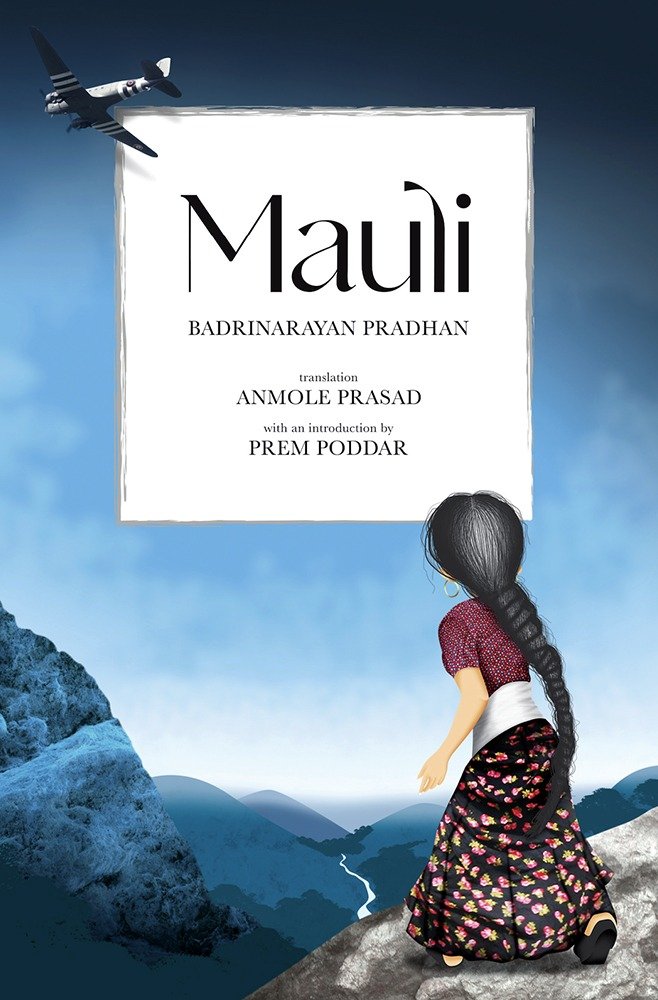
Mauli by Badrinarayan Pradhan, translated by Anmole Prasad. Rachna Books & Publications, Gangtok, Sikkim (2023) ISBN: 978- 81-89602-18-5
Badrinarayan Pradhan’s Mauli, originally published in Nepali in 1993 and translated into English by Anmole Prasad in 2023, follows Malati Ghimiray, known as Mauli, from her colonial education at Loreto Convent in Darjeeling to her return to Nepal. Written largely during the intense political ferment of the Gorkhaland agitation in the late 1980s, the novel captures a deep-seated regional consciousness. Moving between places, languages, and social expectations, Mauli’s life unfolds against a period of considerable political change. The novel spans the mid-1940s to the early 1960s—an era marked by the end of British rule in India, the collapse of the Rana regime in Nepal, and the geopolitical shifts surrounding the 1962 Sino-Indian War.
The novel’s geographical and historical setting immediately raises questions about migration, identity, and the relationship between Nepal and Darjeeling. In his foreword, Pradhan recalls visiting Ilam and wondering why his ancestors had left such a beautiful place to settle elsewhere. In his introduction, Prem Poddar frames Mauli as a ‘translated woman’ (p. xv), drawing attention to the borders that shape her life and the boundaries she continually crosses. These perspectives offer useful ways into the novel. However, I sometimes found the relationship between its larger political events and Mauli’s personal story difficult to follow. The historical context is important, but the shifts between family histories, social relationships, and political developments do not always come together in a way that makes the narrative easy to navigate.
Nowhere is this tension between historical change and personal reality clearer than within the domestic sphere. Much of the novel centres on Mauli’s return to Nepal, where she must negotiate rigid family expectations, caste hierarchies, and the patriarchal structures governing society, marriage and property. The stark differences between the lives available to men and women emerge across the story. Mauli’s father is a wealthy landlord with extensive estates and multiple wives, while the women in his household must negotiate their positions in relation to one another. The term sauta, used for a co-wife, is a constant reminder of how women's relationships are shaped by men's marital arrangements. Bishwambar represents a more violent expression of this unequal order. He violates Mauli before and after marriage, exploits Dhankumari, a domestic worker in Mauli’s father’s household, and unlawfully appropriates land. His treatment of women and his dealings with property suggest a broader sense of entitlement, in which both women's lives and other people's resources become subject to his will.
Yet Mauli’s circumstances are more complicated than those of a woman with no resources or support. She has a wealthy and supportive father, the love and care of Elder-Mother despite being the daughter of her sauta, and an education that gives her opportunities unavailable to many women around her. Her father even builds her a house beside his own so that she can remain close to him after marriage, and she retains the choice to continue her studies. These details made me wonder what possibilities were actually available to Mauli, what prevented her from pursuing them, and how she understood her own choices. Because the novel does not always give us enough insight into her thoughts, these questions are left hanging.
It would be too easy to judge her by contemporary expectations of agency without considering the constraints placed on women in the mid-twentieth century. Her endurance and her efforts to help other women helping Dhankumari navigate the consequences of Bishwambar’s exploitation or supporting Sangita’s pursuit of new opportunities can be understood as ways of exercising agency within those constraints. Yet the women surrounding Mauli often feel more vivid and emotionally grounded because their struggles make their choices legible in ways Mauli’s frequently are not. Ultimately, I wanted the novel to help me understand not only what Mauli endured, but also what she wanted.
Part of this disconnect also comes from the challenge of translating a novel so deeply rooted in language and place. The English translation is generally readable, though there are moments when the original linguistic context seems difficult to carry across. A central tension in Mauli's life is her movement between English and Nepali, where her father sends her to Darjeeling to ‘rattle away in English’ (p. 4), only for her to later return to the Nepali linguistic and cultural world. In the English version, both languages inevitably appear in English on the page, so moments when Mauli switches languages, becomes self-conscious, or repeats herself for someone else can be difficult to distinguish without relying on context. As someone from Darjeeling, I found myself filling in some of those gaps instinctively, but I wonder how easily an outside reader would recognise the social meaning of those shifts. The translation also moves between translating certain Nepali terms into English ("Elder-Mother," for instance) and retaining others such as sauta and hajur. This gives the text some of the texture of the original language, but the choices are not always predictable, and some terms are left for the reader to understand through context.
As someone born and raised in Darjeeling with family roots in Nepal, I was also struck by how difficult it is to pin down what Darjeeling or Nepal actually mean to Mauli. Her attachment to Nepal becomes clearer as the story progresses; she values its cultural world and actively works to rediscover and reclaim it. Darjeeling, however, remains harder to read emotionally. Beyond its association with her English education, it is difficult to determine what the place means to her. Towards the end, Mauli returns to Darjeeling in search of her son, Pritikumar, who has joined the Indian army and struggles to comprehend that Nepal and India are separate nations. This moment brings the political border into the intimate space of family life, showing how national boundaries can shape relationships even when cultural and familial ties extend across them.
Ultimately, Mauli is a complex, sometimes contradictory read. It raises vital questions about language, gender, migration and the Nepal-India border. Yet evaluating a book as an important historical and cultural text is not quite the same as experiencing it as a compelling novel. At times the historical events feel crowded together, while Mauli as a protagonist remains elusive-a figure moving through constraints whose personal voice is often swallowed by the heavy themes built around her.
Nomika is from Darjeeling and has a background in History. She has worked in communications with non-profits and is interested in food, memory, everyday life, and the stories of the Eastern Himalaya. As an illustrator, she frequently documents the meals, places, and creatures around her. When she’s not working, she’s usually in bed scrolling on her phone or out on a long walk, stopping to admire a tree (or a cat).