When the Darjeeling hills under British India were gaining fame for the plush Darjeeling tea, another plantation was blooming underneath its shadows, one cinchona tree at a time.
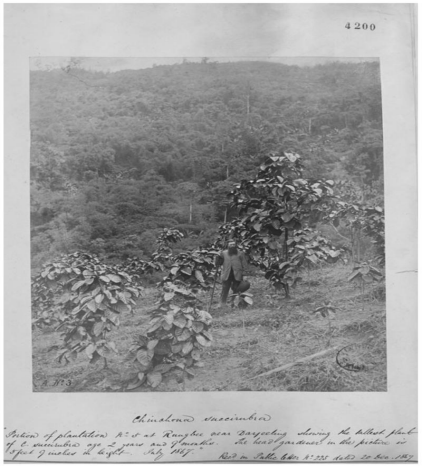
Photo: Sir Benjamin Simpson; July 1867. (India Office Select Materials, British Library. Shelfmark: 1000/40 (4200). Source and copyright: British Library Board.
The Peruvian native tree was smuggled across malaria-plagued British colonies in search of suitable location for the production of quinine. In the Eastern Himalayan foothills of Mungpoo, it took its deepest root.
In 1862, under the direction of Dr. Thomas Anderson, a Scottish botanist and Superintendent of the Royal Botanic Garden Calcutta, cinchona flourished. The subtropical climate and sub-alpine hilly altitude (1200-6170 ft asl) of Mungpoo provided ideal conditions for the quinine-yielding Cinchona trees that were native to the Andes, South America. The success encompassed the hills of Munsong-1901, Rongo-1938 and Latpanchar-1943. The plantation provided British colonies with an economically vital steady supply of the anti-malarial drug.
The land that hosted the plantation was a land plowed by geopolitical drills. It shaped the demography and ecological footprints of the landscape even before the colonial expansion could sow the seeds.
The land that hosted the plantation was a land plowed by geopolitical drills. It shaped the demography and ecological footprints of the landscape even before the colonial expansion could sow the seeds. The land that would later become plantations was once within the jurisdiction of the Chogyal who ruled the Kingdom of Sikkim. In 1718, the east of Teesta River including Munsong and Rongo was annexed by the Kingdom of Bhutan. Decades later, Mungpoo and Latpanchar too changed hands in 1780, the western stretches of Teesta River fell into the expanding Gorkha Kingdom of Nepal.
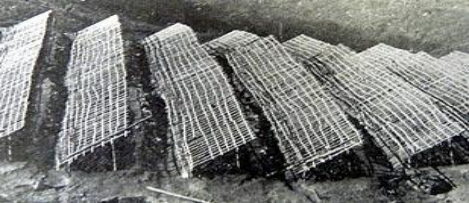
Photo: Empire Forestry Journal v.8,no.1
It was only after the Anglo-Gorkha War (1814-1816) and the subsequent Treaty of Sugauli (March 4, 1816), the Darjeeling hills were ceded to British India, paving the way for the establishment of plantation. Furthermore, its expansion was further encouraged by the Treaty of Sinchula (November 11, 1865) following the Anglo-Bhutan War (1864-1865).
The colonial enterprise needed hundreds of hands to extract the bitter quinine. Soon, labourers were brought from the Kingdom of Nepal and the Kingdom of Sikkim under the Sardari system.
The colonial enterprise needed hundreds of hands to extract the bitter quinine. Soon, labourers were brought from the Kingdom of Nepal and the Kingdom of Sikkim under the Sardari system. The trusted workers, given the title of Sardars, were sent back home to fetch family and convince community members to work in the plantations. As the result of this, the communities are still predominantly engaged in the plantation. The Sardars earned a monthly commission of one anna for every hand that laboured the land.
Like the cinchonas, the people who worked the land too were uprooted and planted.
The nature of their work was cyclic, the rhythm of “Badla”. An acre of land in exchange for a lineage of continuous toil. With time both the cinchona and the people adapted, leading to a seamless naturalization in the region. This influx of migratory kin not only carved the plantation with their toil but also created a tight-knit community still seen in Mungpoo today.
They perished as nameless, numbered labourers but imprints of their footprints remained on the roads, factories, and settlements of Mungpoo. Their individual histories often remain quieter than the ruins they left behind.
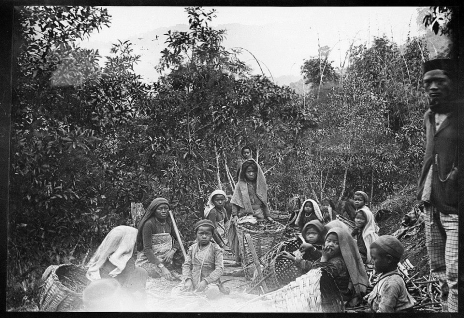
Photo: Welcome Collection.
Mungpoo today lies in West Bengal, India. It is administered by The Directorate of Cinchona and other Medicinal Plants under the Department of Food Processing Industries and Horticulture, Gorkhaland Territorial Administration. But it was not always so. Mungpoo was originally under the Department of Commerce and Industries until 2006.
1934 onwards, German synthetic alternatives like chloroquine and hydroxychoroquine entered the market. Hence the demand plummeted for the labour-derived, labour-intensive organic quinine. The World Wars also aided in the demise of the colossal colonial endeavour. Factories slowed and many structures were left to decay beneath the moss and monsoon rain.
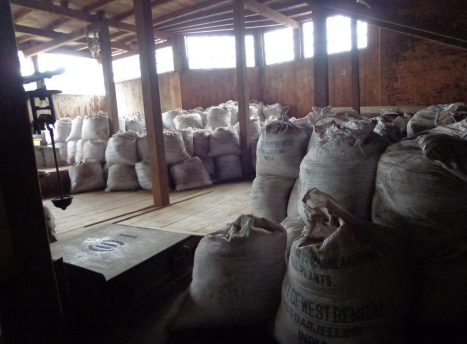
Photo: Townsend Middleton.
This departmental shift marked the end of the era. The era of the grand colonial pharmaceutical history. A prudent pivot, a stark pivot, towards survival. Survival through diversification.
Rubber. Cardamom. Kiwi.
Lemongrass. Strawberry.
This departmental shift also washed away the bleak traces of those nameless, numbered pioneers who woke up at 4 am, reached Ganti Ghar at 6 am and toiled on the land till 4 pm. Reminders of community, livelihood, and belonging erased - year by year.
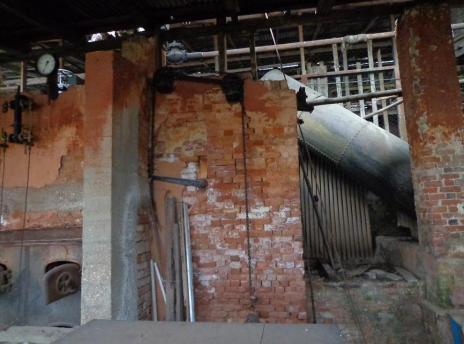
Photo: Townsend Middleton
Today, these crumbling monuments of industrial decay serve as landmarks. Like landmarks that anchor memory and magnetic fields for the migratory birds returning innately.
Season after season.
The hills too have migrations.
A syndicate seat. A train ticket.
A flight overseas.
Migrating- in search of Mughlan
An oasis.
Fleeing economically parched hills.
Stunted academic seeds.
Healthcare, crumbling
But like birds they return innately.
Season after season-
For festivals.
For funerals.
For home.
For returning residents, Chamra Godam A lady-
Elegant. Poised.
Wrapped rust-red.
Where cinchona bark was laid to weather for quinine. Stood as a landmark in our emotional map.
A glimpse from the car meant: “I am home.”
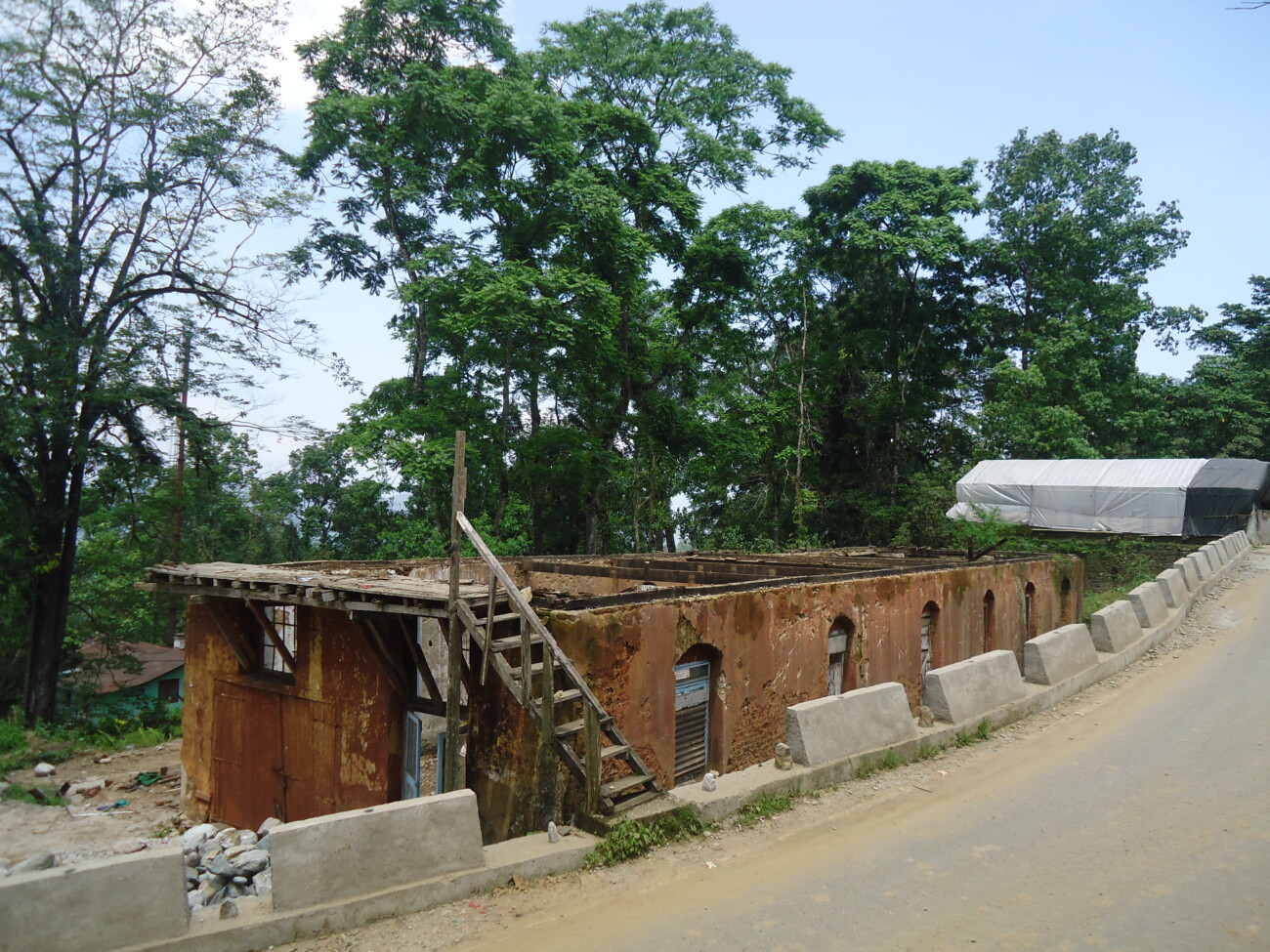
Photo: Ida Anandi Mukhiya
The Godam was like the Cinchona plantation-
weathering, but still standing.
Like a mother awaiting her returning kin.
The Godam was unlike the Indian monuments of tourism.
But she was ours.
Our history.
Our heritage.
Our sense of belonging.
Today, on the 11th of May 2026, the Chamra Godam is being dismantled piece by piece.
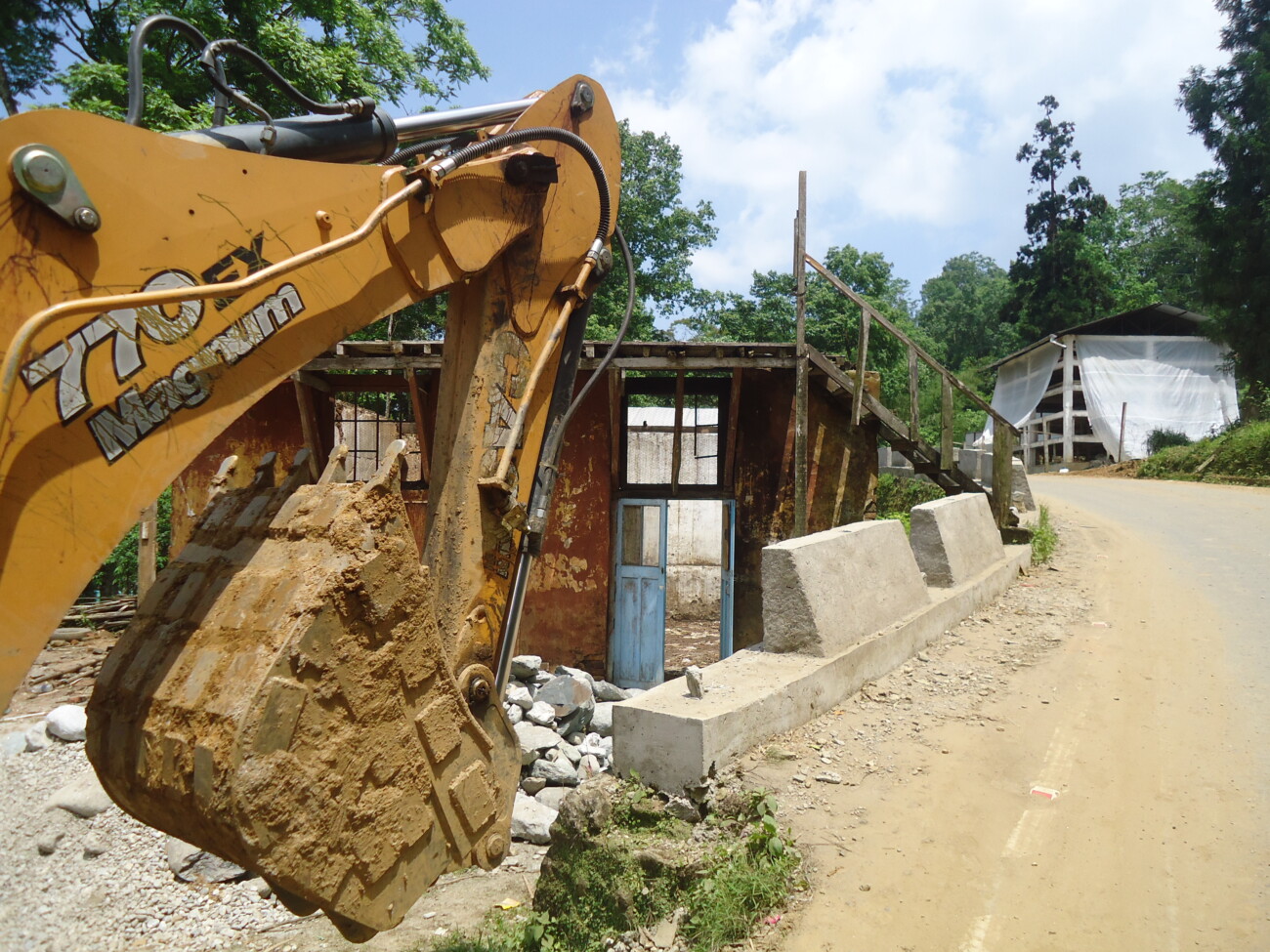
Photo: Ida Anandi Mukhiya
Today, do these crumbling monuments of industrial decay matter? It matters profoundly-to the local plantation workers and their descendants. To them, these ruins represent not just a lost era of global significance, but also their generational heritage and cultural identity. A tangible proof against the recurring identity scrutiny.
This history forms the foundation of their ongoing quest for World Heritage recognition, supported by Kalimpong Krishak Kalyan Sangstha, which notes that the plantation actually precedes the iconic Darjeeling Toy Train (1881). Our antique factory machineries could be turned into a museum.
Alas!
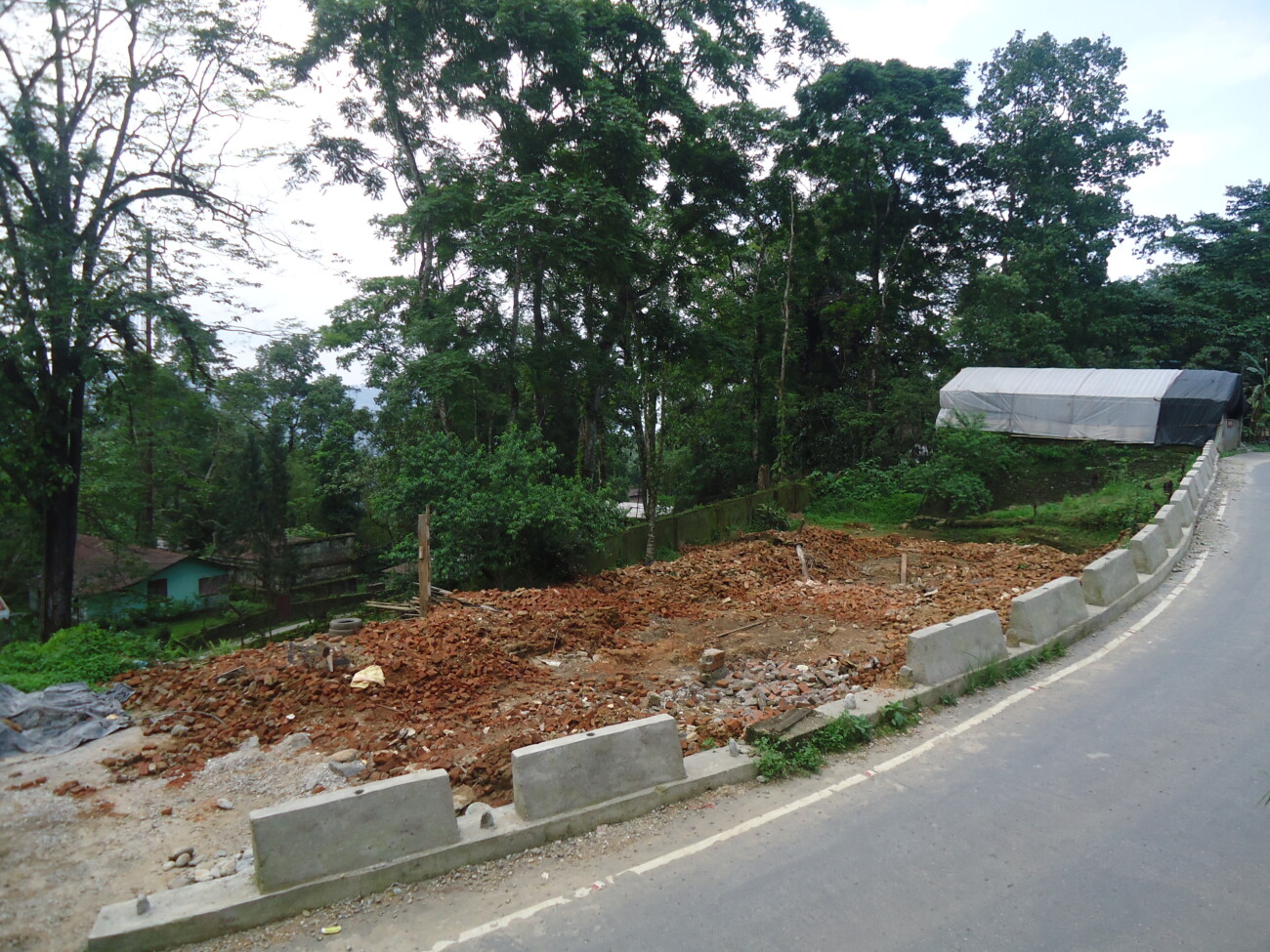
Photo: Ida Anandi Mukhiya
From earth she came. To earth she departed.
Among her ruins, I sat-
in silence-
Stillness.
Structures without spectacles are rarely deemed worth preserving.
What remains now is the plein air painting from the sunny morning of 16th September, 2024.
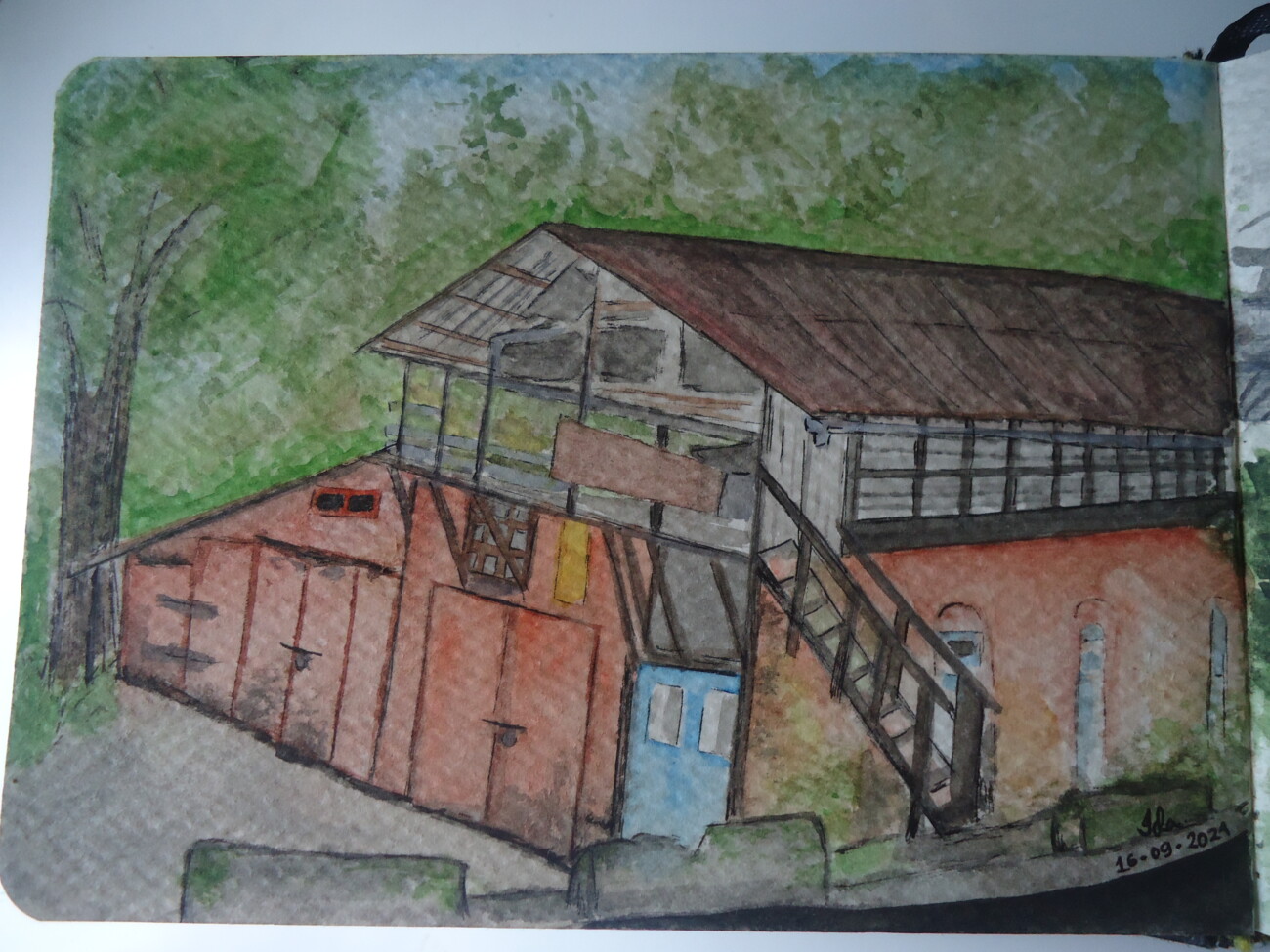
Artwork: Ida Anandi Mukhiya
REFERENCES:
1. Antique machines of Mungpoo Cinchona Plantation. (2018, April 2). Get Bengal. 2. Chowdhury, K. D. (2022). Cinchona in Darjeeling: A Colonial Overview. Innovation The Research Concept, 7(1).
3. Middleton, T. (2021). Becoming-After: The lives and politics of quinine’s remains. Cultural Anthropology, 36(2), 282-311. https://doi.org/10.14506.2.05
4. Middleton, T. (2024). Quinine’s remains: Empire’s Medicine and the life thereafter. University of California Press. https://doi.org/10.155/liminos.187
5. Pradhan, U.M. (2020, October 8). Hydroxychloroquine and our cinchona. The Darjeeling Chronicle.
6. Rai, G. (2024). The changing narratives of Indian Gorkhas. Education India Journal: A Quarterly Refereed Journal of Dialogues on Education, 10(2), 574-586.
7. Safarkhani, M. (2025). Space to place, housing to home: A systematic review of sense of place in housing studies. Sustainability, 17(15), Article 6842. https://doi.org/10.3390/su17156842 8. Sarkar, D. (2013, November 7). Cinchona plantation in Darjeeling is in shambles. The Economic Times (7 November).
Ida Anandi Mukhiya holds a B.Sc and an M.Sc in Zoology from the University of Calcutta, specializing in entomology. Her interests intersect art, science and storytelling. Through her photo essay Zugunruhe, she merges biological concepts with visual storytelling to document and archive the vanishing architectural heritage and cultural memory of her hometown in the Eastern Himalayas.



A sad but true tale of the developing world, not only Mungpoo/pu but Darjeeling and most presumably the world at large.
In the days of jaundiced eyes sentimentalists are not fools but idiots clinging on to eye sores that have no comercial value and we form the losing minority.
Wow I love this word, Zugunruhe!Always learn something new after reading your articles.