Understanding Sacred Mountains Through the Ordinary
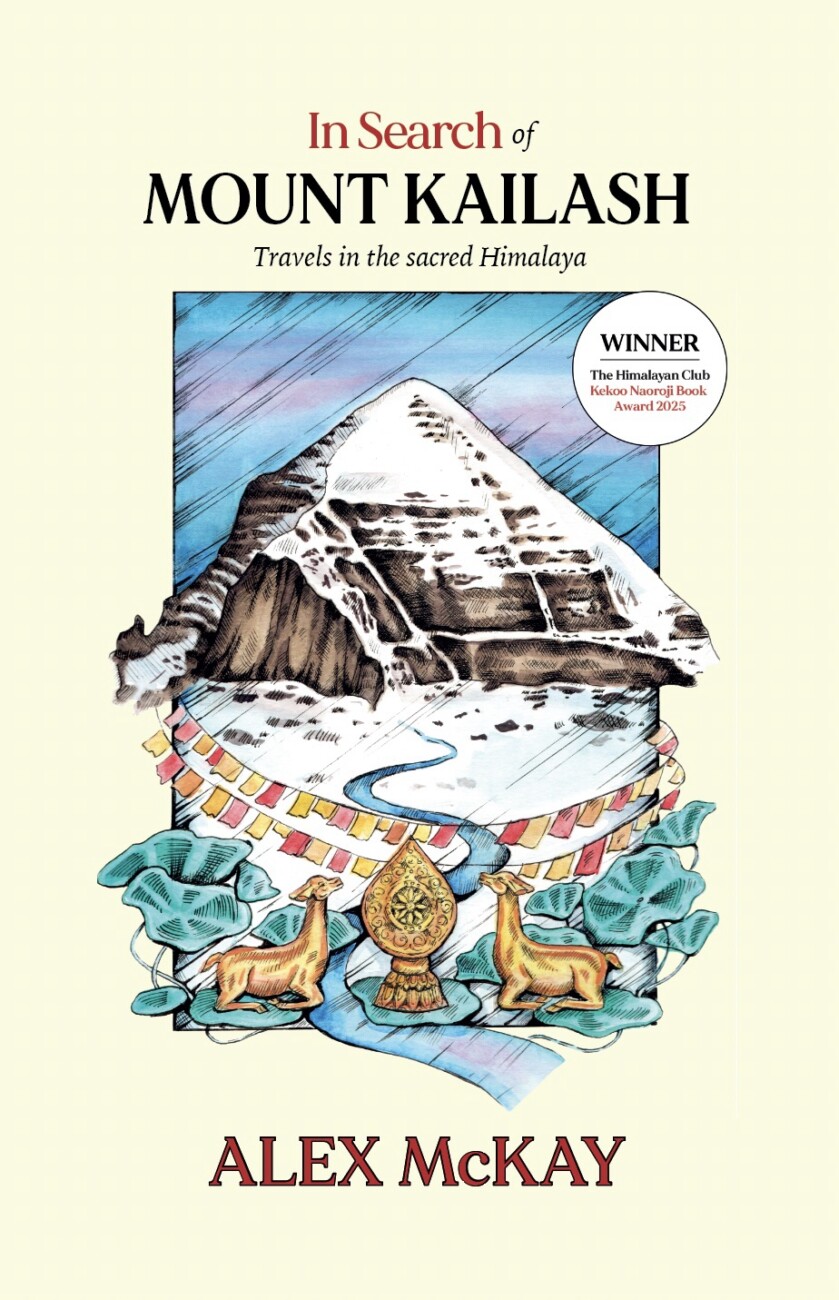
In Search of Mount Kailash: Travels in the Sacred Himalayas by Alex McKay. Rachna Books Gangtok, 2026. ISBN: 978-81-89602-239
Mountains have long been understood as extensions of human belief systems. In their vastness lies a spiritual significance that human societies continually seek to interpret and embody. Across the Himalayas, mountains are revered not merely as physical landscapes but as a way of life and religious entities. Among the Rong (Lepcha) people of Sikkim, for instance, a narrated mythology mentions the creation of the first Rong from the snow of Mountain Kachendzonga (Tamsang, 2000). Another example, is the pilgrimage to Kedarnath temple in the Garhwal Himalayas of Uttarkhand, dedicated to Shiva, remains one of the most prominent examples of the relationship between landscape and devotion in India. Despite the risks posed by difficult terrain, extreme weather, and even disasters such as the 2013 floods, devotees continue to undertake the journey in large numbers. It is within this broader Himalayan sacred geography that Alex McKay’s In Search of Mount Kailash: Travels in the Sacred Himalayas situates itself.
The book is both a travel narrative and an intellectual journey spanning nearly three decades. The author does not approach Mount Kailash merely as a destination; rather, he seeks to understand the religious, cultural, and historical worlds that surround it. Unlike many travellers drawn to the Himalayas by romanticized ideas of serenity and spiritual enlightenment, the author’s primary interest lies in understanding the beliefs, histories, and lived experiences of the people inhabiting the landscapes. What initially attracts him is not simply the mountain itself but the possibility of seeing what remains unseen through the lens of a student of history. This perspective becomes one of the book's strengths, as readers witness not only the author's travels but also his gradual intellectual transformation.
A particular reflection appears in the ninth chapter “Leiden,” where the author writes:
“Like learning how to play a musical instrument, understanding is not a matter of steady evolution but rather consists of a series of sudden leaps followed by long periods of consolidation. Those leaps often come from a moment of insight when you move from knowing something to understanding it in its widest context, for there is a big difference between the two” (p. 199).
The travels are not presented as a constant collection of knowledge but as a series of reflections, and insights that gradually shape the understanding of the Himalayas and their sacred landscapes.
The book is divided into two parts. The first chapter that introduces part one of the book called “Meeting the Mountains,” explores the myths and sacred narratives associated with Mount Kailash. The chapter discusses Tibetan stories of Milarepa, the hermit who flew to the mountain peak, alongside Hindu traditions that identify Kailash as the abode of Shiva and Kubera, and Jain beliefs that associate it with Rishabha.These narratives reveal how a single mountain can simultaneously occupy multiple religious worlds. More importantly, attention is given to indigenous traditions in which mountains are not merely symbols but active participants in social life. Mountains become what is described in the book as “eco-cultural units” where landscape, memory, ritual, and identity intersect.
The discussion of the Bon religion and its relationship with Tibetan Buddhism recurs in many chapters of the book. Rather than presenting religious traditions as isolated systems, the book demonstrates how beliefs change through interaction, incorporation, and adaptation.This theme is also evident in the ninth chapter “Leiden” of Part Two that offers an interesting analogy to describe the gradual absorption of local traditions into larger religious systems. The author compares the process to a village store selling locally produced goods that is gradually replaced by supermarkets stocked with national and foreign products. This analogy provides a useful way of understanding religious transformation in the Himalayas. The observations also resonate with Robert Redfield's distinction between the Great Tradition and the Little Tradition, where local beliefs and practices exist in continuous dialogue with institutionalized religious systems. Similarly, they can be read through Antonio Gramsci's notion of cultural hegemony, whereby dominant traditions establish legitimacy not simply through replacement but through the incorporation and reinterpretation of local beliefs.
The sacredness of Mount Kailash is inseparable from the lakes Manasarovar and Rakshastal, whose contrasting symbolic meanings create a sacred-profane duality central to many religious imaginations of the region. The author’s exploration reveals how sacred landscapes transcend political borders, attracting pilgrims, traders, and travellers from diverse cultural backgrounds. His own journey, beginning during the era of the Himalayan hippy trail, became an effort to move beyond inherited Western representations of the region and to understand it through direct experience. Particularly evocative is the description of the fishtail peak of the Annapurna range in Pokhara sacred to the Gurungs in the second chapter of the book “An Indian Initiation”. As a reader, researcher, and traveller, I found this section especially resonant. Machhapuchhre, or Fishtail Mountain, has inspired generations of trekkers and mountain enthusiasts, and it was also among the first mountain images that inspired my own fascination with trekking and Himalayan landscapes. This personal resonance mirrors one of the book's central themes that journeys often begin in wonder, but meaningful understanding emerges only through sustained engagement.
In the same chapter “Indian Initiation,” the author describes hill people as calm, quiet, and dignified, reflecting his admiration for the communities he encounters. Yet he avoids reducing them to idealized figures and instead situates their lives within broader historical and social contexts. He is equally critical of the ways in which mountain landscapes are marketed and represented. He critiques forms of tourism and state promotion that commodify the Himalayas for economic gain while often overlooking the people’s histories that give meaning to these landscapes.
One of the book’s central contributions is its portrayal of the Himalayas as a “cultural frontier.” This theme becomes particularly visible in the third chapter “Tibet: A Dream in Exile,” where the enduring fascination with Tibet as a mysterious and spiritual land is examined. Further the chapter demonstrates how Tibet’s historical isolation contributed to its representation as a “Forbidden Land,” while simultaneously challenging romanticized depictions of Tibetan society. His experiences in Dharamshala and McLeod Ganj, including encounters with His Holiness the Dalai Lama, provide insight into exile, identity, and the complexities of Tibetan Buddhism. His reflections on the Tibetan massifs and sacred landscapes are accompanied by deeper questions about politics, identity, and peace. At one point, he wonders whether Tibet would be perceived as a zone of peace if existing political circumstances were reversed and Tibetans possessed greater political autonomy. Such reflections reveal his willingness to question dominant narratives rather than accept them uncritically.
The theme of borders and frontier spaces continues in subsequent chapters of part one such as “Lhasa: 1984” as the author tries to enter the closely sealed borders of Tibet, from Honkong. and the two “Kailash: A Tibetan Journey”where he tries to enter Kailash via Pakistan. Here, Tibet emerges not only as a sacred landscape but also as a politically regulated territory shaped by state power, and mobility restrictions. The contrast between the experiences of local Tibetans and foreign travellers reveals how access to space is mediated by unequal political realities.
The author’s travel account also highlights the resilience of Tibetan culture. The second chapter “An Indian Initiation" mentions the presence of Buddhas carved in the cliff face even after destruction of the bamiyan by the Mongols. The presence of the Buddha statue demonstrates how material culture can function as a form of cultural resistance.
The travel account also offers valuable anthropological observations. The descriptions of rituals such as sky burials, pilgrimage practices, and monastic traditions reflect a sustained engagement with local cultures. At the same time, the book frequently balances rational inquiry with an appreciation of faith and spiritual experience. This dual perspective allows the author to approach religious practices with both scholarly curiosity and personal openness.
The second part of the book traces the author’s transition into formal academic study. His return to Dharamshala, where he lived among local families and participated in everyday life, resembles what anthropologists would later describe as participant observation. These experiences enriches the author’s understanding of social life and religious practice beyond formal institutions.
An important theme throughout the book is the relationship between local traditions and what are often called “world religions.” The book repeatedly demonstrates that Himalayan religious cultures cannot be understood through rigid categories. Hinduism, Buddhism, Tantric traditions, territorial deities, local spirits, and indigenous cosmologies coexist and interact in complex ways.These observations have broader relevance across the Himalayan region. Similar processes of religious assimilation, reinterpretation, and revival can be observed among various indigenous communities, including Kirati groups in Nepal. The author does not explicitly frame these processes through theoretical language. However, his observations provide valuable insight into how religious transformations occur. Such processes are not unique to Tibet.
The book is equally attentive to social hierarchies. In the eighth chapter “University of Gangnani,” the author explores the differing status accorded to various ascetic traditions, including the marginal position of certain groups such as the Aghoris. More broadly, drawing attention to the social inequalities and hierarchies that continue to shape everyday life in South Asia. In this context, the observations reveal how sacred spaces are not isolated from wider social structures but are deeply embedded within systems of caste, class, and privilege. As the author notes in the twelfth chapter “Shifting Centre,” “For every pilgrim focussed on their spiritual goal or physical welfare, there was a labourer shovelling gravel and a clerk bent over his account book.” Such moments ground the sacred within the everyday and reveal the often invisible labour upon which pilgrimage depends
Conflict and contested identities emerge as another significant theme. The travels through Tibet and Kashmir reveal frontier regions shaped by competing political claims, cultural negotiations, and historical tensions. The reflections on Tibetan exile and Kashmiri identity move beyond simplistic narratives, illustrating the diverse ways in which people understand belonging, nationhood, and place. This demonstrates that borderlands are not merely geographical margins but lived spaces where identities are continuously negotiated and reimagined. Tibet appears not only as a sacred landscape but also as a site of displacement, memory, and resistance.
Food and everyday practices receive equal attention. As a vegetarian traveller, the author frequently reflects on the challenges and possibilities of adapting to local food cultures, particularly through staples such as tsampa and butter tea. These observations underscore a broader anthropological insight i.e. food is deeply connected to environment, culture, and personal identity. Even as researchers attempt to bridge emic and etic perspectives, dietary practices often reveal the limits and possibilities of fully immersing.
The book’s greatest strength lies in its refusal to romanticize the Himalayas. The author repeatedly challenges colonial and popular representations that portray Tibet and the Himalayan region as timeless, mystical spaces detached from history. He critiques earlier travel accounts, reflects on his own assumptions, and attempts to understand the region in its everyday realities. While traces of romantic fascination occasionally remain, the overall narrative is marked by a strong commitment to reflexivity and critical observation.
Thus, In Search of Mount Kailash is much more than a travelogue. It is an intellectual and personal exploration of sacred landscapes, religious transformations, borderlands, and cultural encounters. The book demonstrates that the significance of Mount Kailash lies not only in the mountain itself but also in the journeys, communities, histories, and beliefs encountered along the way. The result is a nuanced and engaging account that encourages readers to understand the Himalayas not as an abstract spiritual ideal but as a lived and dynamic world shaped by everyday realities. Returning to the ninth chapter “Leiden,” the book ultimately focuses on the movement from knowing something to understanding it in its widest context.
References
Tamsang, L. (2000). Lepcha Folkore and Folk Songs. Sahitya Academi.
Ayushi is a PhD scholar in Anthropology at Sikkim University, researching urbanisation in Gangtok through ethnographic lenses. She holds dual M.A. degrees in Anthropology and in Advertising & PR. Her interests include food, migration, urban and visual anthropology. She has collaborated on projects with the University of Lapland, and received the Zubaan-Sasakawa Peace Foundation Grant for research on women health workers during COVID-19. She has presented her work at national and international forums, including a recent paper on the Teesta floods at the Inter Polar Conference in Kathmandu. She is currently undertaking doctoral research on urban transition in Gangtok, while concurrently examining the city’s evolving urban landscape through the lens of street art and visual media.