A Fragile Equilibrium
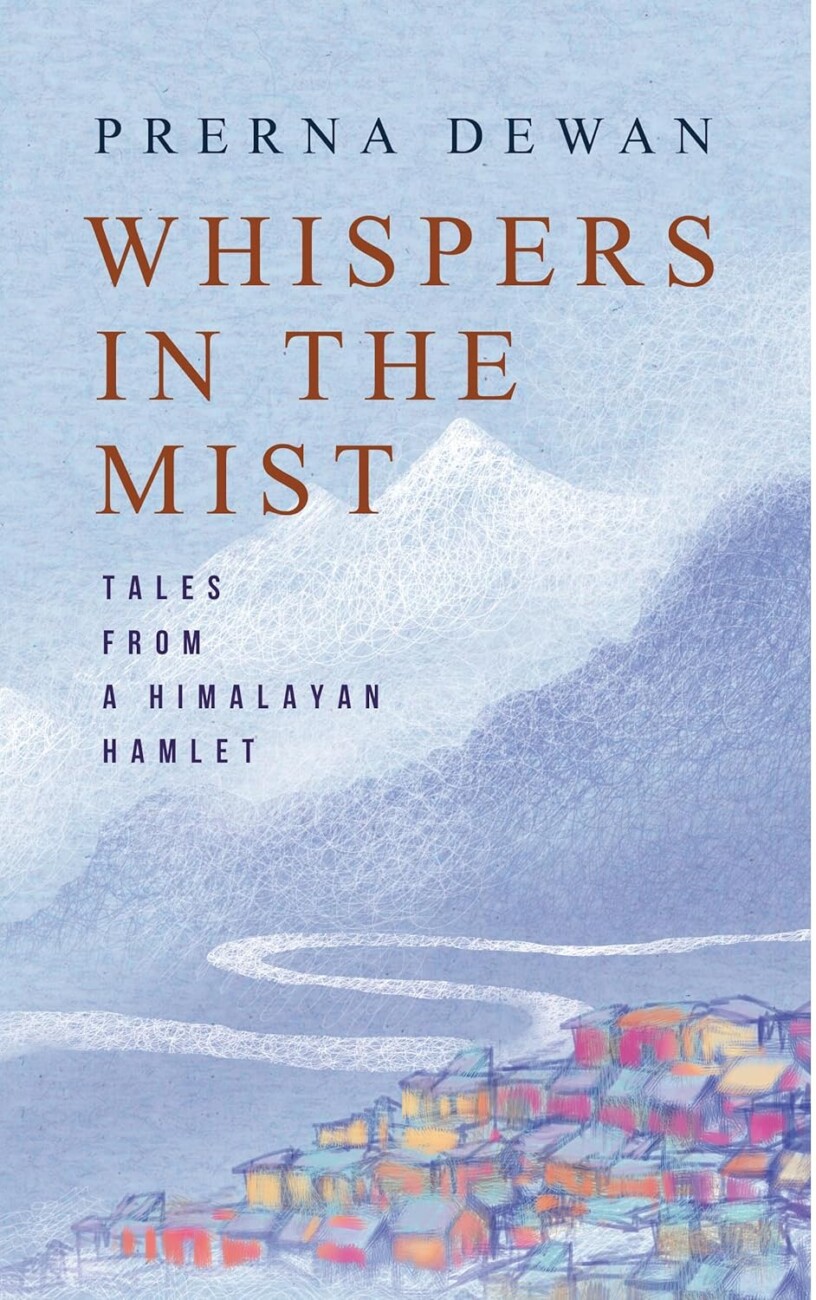
Whispers in the Mist: Tales from a Himalayan Hamlet by Prerna Dewan Rai. Readomania (2025). ISBN: 978-81-981203-6-6.
Prerna Dewan’s Whispers in the Mist: Tales from a Himalayan Hamlet is a collection of ten interconnected stories bound together by the spectral presence of a woman named Gayatri. The author builds a world that is set between the living and the dead. Dewan captures the rhythm of village life in the mist-laden hills, where every whisper becomes a fragment of a larger story about survival, community spirit and fellow feeling.
The narrative begins with the death of Gayatri, whose soul lingers, unable to rest. “Gayatri’s spirit was on the loose” (Dewan, 158). From this spectral perspective, Dewan threads together the lives of all the other characters whose joys, destinies and sufferings intermingle in ways both visible and invisible. Each tale, though distinct, reverberates with echoes from the others, creating an intricate mosaic of interconnected human experiences. The ghost of Gayatri is not simply a supernatural element; she is the moral and emotional axis of the book. Through her, the reader is drawn into the invisible world that binds the living to the dead. The ghost becomes a metaphor for unresolved pain and for the persistence of memory that haunts every human life. The figure of the ghostly Gayatri can also be read as a collective conscience, a silent witness to the sins, guilt and tenderness that define the village’s moral landscape.
Set in a Himalayan hamlet of the Darjeeling hills, the stories transport readers into a world far removed from the urban imagination. Dewan’s village is not the romanticised hill station of tourist brochures but a lived space of everyday struggle and domestic problems. Life here is marked by fundamental concerns- water scarcity, poor schooling, social stigma and the oppressive weight of tradition. The rhythm of existence moves with the cycles of nature; the changing light, the arrival of monsoon, and the biting cold of winter. Yet amid this rural reality, Dewan unearths something deeply human, the capacity to hope, to endure and to love even in the face of despair.
One of the most fascinating aspects of Whispers in the Mist is its use of folklore to reveal the cultural psyche of the Himalayan village. Dewan beautifully weaves folk beliefs into the tapestry of everyday life- ancestral curses about wandering spirits, omens and the moral consequences of human actions. They are not presented as fanciful events but as the living grammar of a community that negotiates the unknown through story and faith. In this world created by Dewan, the dead do not simply depart; they remain as whispers in the mist, shaping decisions and guiding dreams. The porous boundary between the spiritual and the earthly reflects a worldview where belief is both a comfort and a burden.
The stories confront everyday realities, social ostracism, sexual violence, generational trauma and political unrest, filtered through a lens of myth and mysticism that softens without erasing their severity. For instance, the rape of a young woman during the Gorkhaland movement and the subsequent silence of the village are not merely social commentaries; they are also explorations of how shame and social life in the village intertwine. “Your father was a criminal who raped young girls. He raped me, too. Then he took away all of your grandparents’ money and the silver cup that was our ancestral token …Savita had not had a good night’s sleep since the year 1986. The hills witnessed a historic demand for a separate state called Gorkhaland in West Bengal that year” (170).
The villagers’ belief in spirits, omens and unseen forces stems from an understanding of the world shaped by landscape and history. The mist that surrounds the hamlet is more than atmospheric; it becomes a metaphor for uncertainty, the haze between life and death, between truth and illusion. It allows Dewan to explore the ineffable- the grief that cannot be spoken, the guilt that cannot be confessed and the hope that refuses to die.
Dewan’s portrayal of the rural Himalayan setting highlights the stark difference between this world and the mainstream urban one. City life is defined by speed, anonymity and noise; whereas the village exists in slowness, intimacy and silence. The problems faced by Dewan’s characters- scarcity of resources, lack of education, and rigid social hierarchies, are not framed as exotic peculiarities but as universal struggles refracted through a specific geography. What distinguishes the Himalayan hamlet is not its poverty but its moral texture- the entanglement of communal responsibility, folklore, and memory. In this insular world, every tragedy is shared, every secret is half-known, and every act, whether kind or cruel, reverberates through generations.
Dewan’s prose often leans toward the poetic, mirroring the rhythm of oral storytelling. The language is slightly verbose yet lyrical, capable of evoking both the sensory richness of the hills and the emotional complexity of its inhabitants. Through recurring imagery- the mist, the sound of rain, the spectral presence of Gayatri, and the gaze of a cat; Dewan builds a sensory world that feels both intimate and otherworldly. The cat, Baini (younger sister in Nepali), who appears as a recurring motif and later becomes a symbolic thread in the epilogue, functions almost as an intermediary between worlds, observing with silent detachment yet embodying the persistence of life. The final image of the cat wandering through the hamlet suggests that stories, like spirits, never truly end. They merely change form, waiting to be retold.
Whispers in the Mist challenges the reader’s assumptions about closure and resolution. Many of the stories end not with clear conclusions but with lingering silences, unresolved emotions, and spectral presences. This narrative openness mirrors the cyclical temporality of rural life, where the past is never fully gone, and the future remains uncertain. Yet, this very ambiguity can be both a strength and a limitation. While it imbues the text with depth and mystery, it also risks leaving some arcs feeling incomplete. Readers accustomed to linear storytelling may find the fragmented structure disorienting, though others may see in it the truth of life itself, where closure is a luxury few can afford.
What makes the book deeply affecting is its moral and emotional honesty. Dewan does not romanticise her setting; nor does she condemn it from a distance. She writes as someone who knows the pulse of the place, its contradictions, and its quiet dignity. The mist that envelops her hamlet is not merely physical; it is existential, symbolic of the ambiguity that defines all human life. The spirits, the myths, the gossip, the rituals, are all part of a fragile equilibrium that keeps the community alive even as it holds them captive.
Whispers in the Mist stands as a remarkable work of Himalayan fiction- introspective, melancholic and steeped in the rhythms of oral tradition. Its blend of folklore and social realism invites readers to confront the uneasy coexistence of faith and doubt, life and afterlife, progress and tradition. Prerna Dewan’s prose whispers rather than declares, but its echoes linger long after the last page, much like the mist that never quite lifts from her hamlet. The result is a book that captures not just the external beauty of the mountains but also the inner landscape of the people who inhabit them- their fears, their faith, their memories and above all, their quiet, enduring strength. This book is worth a read, being an organic reiteration of stories from the Himalayan region.
Francis Ekka is currently a research scholar in the English department at Sikkim University. He has published research papers in journals indexed by the Web of Science and UGC CARE. Alongside his academic work, he holds a strong passion for poetry and creative writing. His poems have been featured in Rhythm of the River: An Anthology of Tribal Poetry.