Songs of the Bloody Revolution: Collectively Grieving 1986
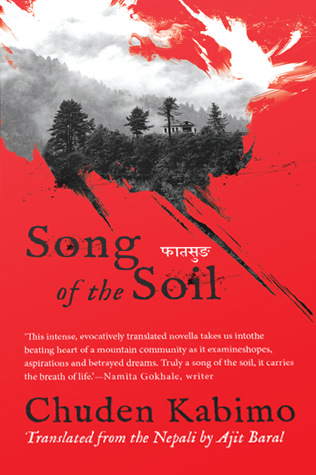
The Song Of The Soil (Faatsung, 2019) by Chuden Kabimoo, translated by Ajit Baral. Rachna Books (2021). ISBN: 988-81-89602-15-4
When, the legendary Nepali Rock Band 1974 AD sang the song ‘Chyangba and the Bloody Revolution’, which goes:
"There is a rumour in the villages
The Chyangba from the other house has disappeared
Has he joined the army, where has he gone?
It's been a couple of months
Here father and mother are dying with worry, oh dear !"
It soon became an anthem among the Dajus on the Indian side of the border, loitering freely in Darjeeling town, whom I quite intimidated looked up to. And what perhaps hit the right chord was that it was not far from their reality. In fact, it was deeply ingrained in the traumas of our brothers who lost their youth to the bloody year of 1986.
The YouTube Blurb of the song reads: Chyangba and the Bloody Revolution was written during the Maoist war/revolution that took the lives of 13000 or more Nepali people. The song depicts a story of Chyangba (a boy from the mountains) who goes missing and no one knows his whereabouts. He could have joined the army or the Maoists. Is he dead or alive? The question lingers among his loved ones.
Ripden and his friends, the main characters in the story Faatsung by Chuden Kabimo were a band of young changybas, who succumbed to one such bloody revolution. Song of the Soil translated by Ajit Baral is the English translation of Faatsung written by Chuden Kabimo. The book preserves the humorous voice of hope and despair and the succinct story-telling style of the original, thus making for a gripping and tragic read.
The Gorkhaland agitation of 1986 is one of the most important movements of Sub-National self-determination which transpired in the Darjeeling and Kalimpong Hills. A mass movement to form a separate state under the Indian Union under the leadership of Subash Ghisingh’s Gorkha National Liberation Front (GNLF) faced suppression by the then government of the Communist Party of India (Marxist) when Chief Minister Jyoti Basu was in power in the state of West Bengal. The movement ultimately led to the creation of the Darjeeling Gorkha Hill Council, a semi-autonomous administrative body on 22 August 1988.
In Faatsung, the events of 1986 unfold as a memory of bygone days. The story follows Ripden and the narrator on a journey to find Ripden's long-lost father, who vanished after 1986. The duo then encounters an old survivor of the time, who recounts the happenings of the 1986 Andolan revolution).
Through the search, the author reconstructs the agitation via a series of staggered recollections - which are fragmented and deeply subjective.
As the narrator travels to his native village in Malbung to document the passing of his childhood friend, Ripden, in a tragic landslide, he evokes his memories of school days, his village, and his friends. Using a simple and humorous voice, typical of Darjeeling's lexicon, the author points out subtle socio-political dynamics of the present day.
The landslide itself becomes a cruel metaphor of the situation that Ripden, symbolizing the unsteady youth that grew up after the agitation
'"Sainla Baje dies because of drink. So, I don't like the villagers getting drunk. Nor do I like them selling their land to get drunk."
"Three months after he disappeared, a shakha branch, of the Rastriya Swayamsewak Sangh was set up on the school playground."
The Gorkhaland movement of 1986 witnessed mass participation from the youth, organized into the Gorkha Volunteer Cell (GVC). In Kalimpong, Chattrey Subba was at the forefront of one faction of GVC.
As the novella progresses, we are allowed into the space of the youth of 1986, particularly from the GVC Faction of Chandra Singh Subba. Young boys who had probably just wanted to skip math tuition suddenly find themselves manufacturing crude bombs to fight state forces. Even as these characters grow up through the thrill of a revolution, they succumb to personal losses and resentment.
Anecdotes from 1986 live on in almost every family and village in Darjeeling and they are seldom untouched by violence and grief. The morbid realities that unfolded during those years are well-captured in the books, causing an uneasy discomfort in someone like me, who had the privilege of growing up in times of peace. My neighbours talk about bloody heads hanging on the nearby trees and houses being looted in broad daylight, as if they were talking about the weather. The gravity of their experiences catching on to them, as their eyes turn worried, like an after-thought.
The essence of Faatsung is in its insider lens, a forgiving one that discusses the hopes and dreams of young boys as they navigated the violence of a revolution they barely chose.
But it is not to say that there was no free will in this young foot soldier's participation in the movement. It is also the nature of things that when citizens are left to cope with socio-political neglect, resentment is bound to boil over. The 1986 agitation was hardly an abrupt overnight adventure. The demand for the right to self-determination for the people of Darjeeling hills is a long-standing one documented as early as 1909 when the Hillmen's Association appealed for a separate administrative setup for Darjeeling to the Morley Minto Reforms. So what fueled violence in an otherwise diplomatic political movement, and what led it astray?
Soon after the agitation, the streets of Darjeeling were flooded with brown sugar, easily and cheaply accessible for a common man. It slowly engulfed the unemployed Gorkha youths who would often indulge in this rare fantasy to ease the scars left behind by the agitation. As the Government authorities turned a blind eye towards the epidemic, an entire generation was lost and not even accounted for. (Chasing the Dragons in the Hills,14 Nov 2016 - Darjeeling Chronicle).
What followed the years after the agitation was hardly a resolution, but a slow erosion. It echoes in global histories that when violence subsides, addiction to cheap narcotics is often what breaks the back of the motivated youth. The pattern is not unique, like the spread of heroin through urban Black communities in the United States following the civil rights movements. In Darjeeling too, free-will succumbed to chemical frenzy, and quietly neutralized the hopeful dreams for self-determination.
What is also quite thoughtfully captured in Faatsung, is the complex experience of being a youth in the 80's. The imaginings of Darjeeling's youth were imprinted with the Pop-rock music and the action films from the Global Media. The jingoistic cowboy-rockstar hero was in wide circulation through cassettes and cinema halls, offering a masculine fantasy of revolution. Kabimo captures the internationalization ironically:
“Every night in his dreams he would run like the hero of Rambo, carrying a gun.”
The fantasy, however, proves tragically hollow. The spectacle of resistance eclipses its ethics, leaving young men emotionally unarmed for the aftermath of defeat.
"We won’t pick a fight with other boys from now on. We will fight against the CPI(M)."
Even as the fighting escalates between the GNLF and CPIM cadets, revolutionaries, and the CRPF to culminate in infighting between the two factions of the GNLF, we get glimpses of lesser-known narratives of loss and tragedy.
What I found most remarkable about Chuden Kabimo's observations is his attention to the inconsequential moments within the revolution. Such fleeting moments of human vulnerability add layers of emotion against the violent unfolding of events. The author articulates the characters' nostalgic longing for Home, their encounters with love, and hopes and dreams of family. From homes being lost to landslides or set on fire amidst the revolution, the author questions identity and belonging by emphasizing the symbolism of Home and dreams.
"When a house burns down, it does not merely mean that some pieces of wood have been set on fire, or that stones and mud have been left to smolder. It means that an entire world has gone up in flames. Faith itself has gone up in flame. Belief has gone up in flames. Possibilities have gone up in flames. One’s self has gone up in flames."
The Covid-19 Pandemic taught me a term called 'collective grieving'. When violence crashes into our lives, it leaves behind after waves of grief that get carried on for generations. Via the subplots of Shahid Ram Prasad, Budhathoki’s daughter, Neptay, and the narrator himself, Faatsung consolidates the personal griefs of the surviving characters of 1986. In holistically covering narratives, the author points at the larger impact on the masses of conflict and deceit orchestrated by a powerful few.
Song of the Soil resists grand narratives of revolution and instead chronicles its residues: memory, longing, and unresolved mourning. Its longlisting for the JCB Prize for Literature in 2022 marks an important recognition as the first Nepali translation to achieve this. However, its true significance lies elsewhere. Kabimo reminds us that revolutions may end, but their afterlives of grief, addiction, and longing for home continue to shape those who survive them.
Simran Sharma is a freelance writer from Darjeeling. Her writings have previously been featured on The Pomelo, The Darjeeling Chronicle, Brown History. She runs कथाkokatha an independent blog that explores and document written narratives of the Eastern Himalayan region, particularly Darjeeling and Kalimpong.