The Politics of Everyday Life in Darjeeling: Fragments of Change and Society on Edge
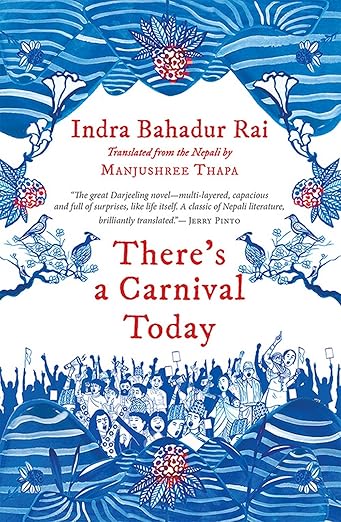
There’s a Carnival Today (Aaja Ramita Cha, 1964) by Indra Bahadur Rai, translated by Manjushree Thapa. Speaking Tiger (2017). ISBN: 9789386702319
There’s a Carnival Today, originally written by Indra Bahadur Rai as Aaja Ramita Cha, grabs attention with the word Ramita in its title, a term that feels very familiar and deeply rooted in Nepali culture. The word ramita in the Nepali language often denotes a public performance, festivity, or spectacle. In common Nepali usage, the term ramita seems light-hearted, informal, and even amusing, yet it frequently carries an undertone of irony. Common phrases like Ramita hernu aako? (Come to see the spectacle?) Or Ke ramita heri baseko? (What’s with the staring?) are frequently used to mock and dismiss serious situations as insignificant. Rai’s use of the word ramita in the title is deeply ironic: what appears to be entertainment or festivity is actually a metaphor for the everyday struggles, societal turmoil, marginalization, and hardships faced by tea plantation workers and the people of Darjeeling. The title thus serves as a significant political and cultural metaphor, making it more than just a light-hearted reference to celebration.
Set in the fascinating Darjeeling hills, the novel is a clear and panoramic work that provides a comprehensive, multi-layered portrayal of the region’s politics and culture, accurately portraying many facets of its social and economic life. In addition to offering a unique, honest, and frequently unpleasant vision of Darjeeling during the post-colonial era, the novel provides a thorough perspective on the political and social developments that affected the local population there during the 1950s. Indra Bahadur Rai’s fictional work illuminates the political turmoil, cultural identity concerns, and diaspora issues that still affect the region. The novel does more than just tell a story: it also highlights the reasons why Darjeeling has historically been a region marked by frequent disruption, instability, and unrest.
Rai presents the novel in a non-linear, layered perspective that moves beyond a single storyline. It delves into the everyday lives of diverse characters caught in the tensions of personal ambitions, the struggles of identity and belonging, political moments, and the collective concerns of the tea garden community. The novel’s non-linear structure features several short scenes, voices, and events that seamlessly guide the reader through conversations ranging from bazaars to tea shops, gatherings, festivities, and arguments.
The novel centers on Janakman Yonzon (Janak), an Indian Nepali, as the main protagonist, and his wife Sita, who is from Dhankuta, Nepal, and who comes to Darjeeling to study and later marries Janak. Rai delves into the inner lives of a wide range of characters while examining the central theme of identity, especially as it arises from the tense, often hostile coexistence of various ethnic groups in the region. These groups struggle with economic insecurities, racial and caste hierarchies, and the pressures of cultural assimilation. The novel depicts the tensions of a society seeking to modernize, yet remaining bound by entrenched social systems. Rai’s depiction of caste identity remains central to the novel’s exploration of social hierarchy and belonging in Darjeeling.
The characters ultimately adapt, sometimes reluctantly or strategically, to the new dominant regional identity, a process made visible by the arrival of later characters in the narrative. One clear example is Janak’s neighbour, Ajoy Das, who is of Bengali descent. In the novel, Janak and Ajoy trade crude, ethnically charged insults in the most casual, informal tone: “You go and eat fish bone sauce. What do you know, you Bengali who sleeps in a skirt?” “You go and eat stale rice. What do you know, you hill man who sleeps in a sack?”(p. 27). The exchange lays bare a sense of racial superiority and the deep anxiety over identity that lies at the heart of the story.
Many characters, including Janak and Namgyal, are locked in an ongoing, often unspoken struggle to define who they are- within a nation-state that refuses to fully acknowledge or include them. This exclusion does not announce itself in dramatic events but seeps into everyday conversations, where the impact is subtle and reflected in interpersonal conflicts and a persistent sense of displacement. “We must make Nepalis buy at Nepali shops” (p. 23), revealing both solidarity and desperation. Later, that same frustration erupts more bitterly: “It’s become laughable, as it is, for us to claim to do business. The best businesses are in the hands of those of other castes and kinds. The petrol pumps, the lumber trade, rice and dal, clothes, these all were snatched up a long time ago by others. What’s in our hands, other than vegetables and oranges? To claim that we do business…” (p. 125). These lines lay bare the economic marginalisation that compounds a deeper sense of identity-related insecurity: an insecurity that stems from living in a place you call home, yet knowing that the nation does not fully return the claim.
Globalization and transnational mobility have reshaped diasporic perspectives on nationhood. The ease of crossing borders has produced fluid, volatile identities in which people adopt new affiliations and drift away from the supposed “purity” of their original roots, giving rise to inevitable hybridity (Bhattarai, 2025). This tension is poignantly captured in Janak’s proud yet conflicted declaration, “We, the Nepalis of Darjeeling, are trusted by both India and Nepal, and so both India and Nepal try to win our love and affection; but Darjeeling is ours, and we are Darjeeling’s” (p. 170). This statement reveals a heart pulled in two directions. Though Janak’s family migrated long ago from Dhankuta to Darjeeling, and though he has built his life on Indian soil, his emotional anchor remains tethered to Nepal and Nepali culture. He claims belonging to Darjeeling with fierce local pride, yet he cannot (and does not want to) erase the Nepali part of himself. In that single breath, he embodies the hybrid, in-between identity of the hill diaspora: neither fully Indian nor fully Nepali, but irrevocably both, and therefore fully neither.
Through the distinct political activities, interests, and goals of Janak and Bhudev, Rai portrays the constantly evolving socio-political environment of Darjeeling. The novel addresses significant concerns such as employment, trade, and the demand for land resources. In addition, Rai addresses concerns about the region’s growing population, pointing out that “there was also a proposal on the matter of Nepalis who, year after year, migrated over to settle in Darjeeling and Assam” (p. 67). This demonstrates how issues of migration, belonging, and political legitimacy are linked to the economic crisis in the area.
The novel highlights the simmering grievances of the tea plantation workers. Janak’s son, Ravi, works as a school teacher and is portrayed as a committed supporter of the cause of the tea plantation workers. Through his active involvement, Rai illustrates that the political unrest in Darjeeling goes beyond mere occupational issues; it is not merely about labour rights. It reflects a broader desire felt by the majority of the population to overhaul existing power structures and achieve genuine social justice.
Rai’s depiction of domestic spaces and interpersonal relationships forms one of the strongest thematic strands in the novel. Through Janak’s lens, the novel vividly portrays the chaotic yet revealing nature of domestic life in Darjeeling. Janak’s marriage to Sita, a woman who embodies the customary expectations of married women in Darjeeling society, highlights the patriarchal structure that defines and often disregards women in domestic life there. Sita’s identity is primarily shaped by her responsibilities as a wife and carer, reflecting the traditional constraints placed on women.
In contrast, Janak’s infidelity with Yamuna introduces a modernist female figure who is assertive and self-reliant, underscoring tensions between tradition and emerging gender roles. At the same time, Janak’s strained connections with his children reveal generational clashes and conflicting aspirations, further complicating the domestic landscape. Together, these relationships- Janak’s ties with his neighbours, his marriage to Sita, his affair with Yamuna, and his bond with his children- illustrate the layered and changing dynamics of family, gender, and social change in Darjeeling society.
There's a Carnival Today is a captivating novel because it is both a story about the past and a reflection of the present. Many of the issues Rai outlines still exist in Darjeeling today, including youth unemployment, political unrest and regular protests, anger with politicians, inequalities among tea plantation labourers, identity issues for Gorkha/Nepali-speaking Indians, and a sense of neglect by the state. Rai captures why Darjeeling continues to experience periods of turmoil. He demonstrates that the crisis has deep roots in history and ordinary life, not just in political movements. The title serves as a powerful thematic lens and metaphor. Indra Bahadur Rai’s usage of the carnival metaphor emphasises that the political upheavals in Darjeeling are neither fixed nor permanent, but rather everyday events in which identities are constantly contested, challenged, and redefined. Thus, the carnival symbolizes both an indication of and a potentially unsettling reminder that meaningful change, while essential, involves chaos, disruption, and instability before any resolution emerges.
Reference
Bhattarai, P. P. (2025) “Diasporic Identity: A Transnational Consciousness”- in Rai’s There is a Carnival Today, Adhayana Journal.
Lhaden Ongmu Bhutia is an Assistant Professor of Political Science at Sreegopal Banerjee College, University of Burdwan, West Bengal. In her free time, she enjoys watching series and documentaries and is passionate about travelling.