TINY LIVES NOTICED IN VERSE
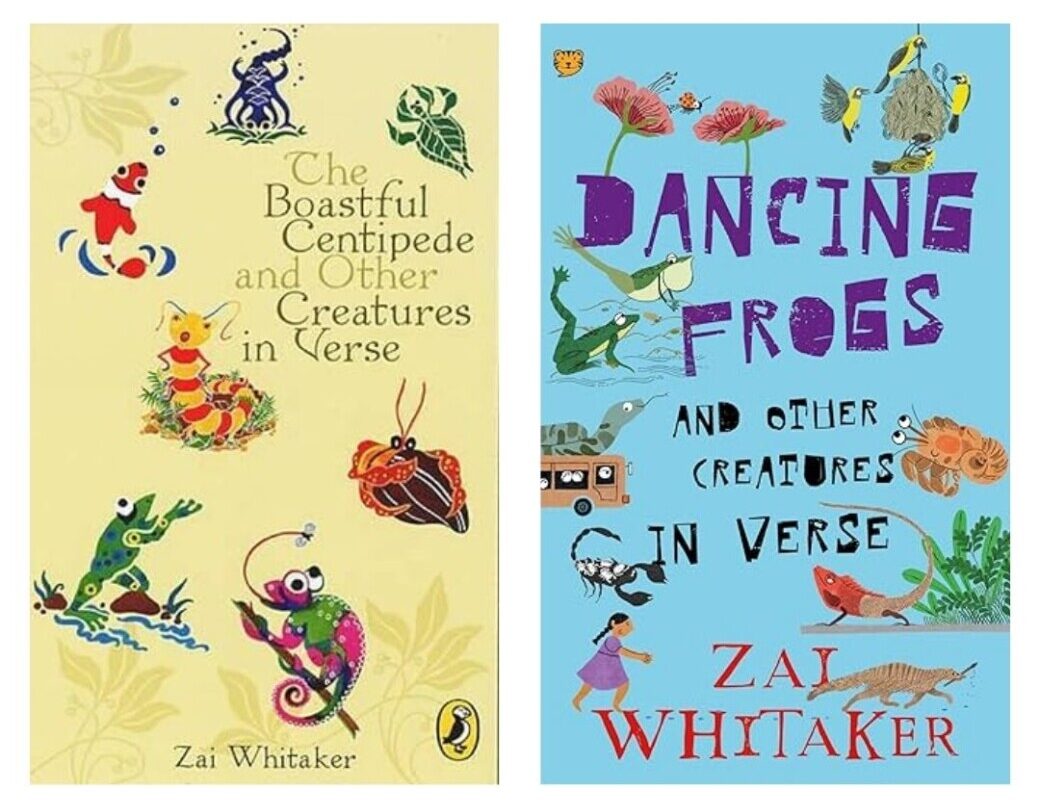
The Boastful Centipede and Other Creatures. Zai Whitaker. Puffin Books. Penguin Books India. ISBN: 9780143335344. (2006).
Dancing Frogs and Other Creatures in Verse. Zai Whitaker. Talking Cub.Speaking Tiger Books. (2025)ISBN: 9789363369931
These two beautiful poetry collections by Zai Whitaker offer a warm and whimsical collection of poems from the world of tiny creatures that we often seem to care less about or be fearful of. They form a delightful read for children (8+ ) and young adults who enjoy reading about animals and their habits, in verse. The Boastful Centipede and Other Creatures in Verse was first published in 2006 by Penguin Books India. Then came The Dancing Frog and Other Creatures in Verse, which is the revised and extended version published in 2025 by Speaking Tiger. This new edition has ten more poems, covering creatures such as the Dancing Frog, who discovers a cool way to attract their females, the plight of the bumblebees amidst the crisis of climate change, the orb spider with its camouflage trick and beetles who deserve everything but our berating, and the list goes on.
When I first read The Boastful Centipede and Other Creatures in Verse, I was quite drawn to its use of humour with each entry on habits and quirky personalities of tiny creatures. This somehow reminded me of Ogden Nash’s animal poems. In particular, Nash’s ‘The Centipede’ is very similar to Whitaker’s ‘The Boastful Centipede,’ because of their playful and comical approach to the subject. In both these poems, the centipedes contend with humans, while Nash rebukes, and Whitaker exposes.
The Centipede
I objurgate the centipede,
A bug we do not really need.
At sleepy-time he beats a path
Straight to the bedroom or the bath.
You always wallop where he's not,
Or, if he is, he makes a spot.
Ogden Nash:1931
The Boastful Centipede
………………………….
Oh foo! The centipede angrily said,
‘Have you no sense in your human head?
Who ever heard of a centipede fall?
With sixty legs, no danger at all!
It’s my own private train, the centi Express,
And my travel plans never cause me stress.
I also have sixty super knees,
Complete with knee caps, if you please.’
…………………………………………………
Zai Whitaker:2006
However, the tone differs vastly despite both being playful. Whitaker’s stand is amusement and mildly cautionary, while Nash’s is dismissive, which is typical of his style. Additionally, the irregular meters in both poems somehow reflect the cheeky and unpredictable nature of the subject. What makes both appealing is the use of rhyme scheme and rhythm, which amplifies the comic effect. This playful combination runs throughout the collections under review, highlighting Whitaker’s skilful use of verse infused with rhythm and humour.
As children’s poetry, the collections’ strength lies in providing a sensorial experience through rhythm and structure. These elements allow them to speak directly to the hearts of the young readers, as they did to me. The poems have a steady rhythmic beat and structure, often featuring four-line stanzas with simple meter, such as ABCB or AABB rhyme schemes. Furthermore, the anticipation of sound, along with countless visual imagery, as shown in two examples, expands children’s imagination.
Now I see him, now I don’t,
He simply isn’t there-
He’s done his disappearing act,
Vanished into air.
Oh there he is, bold magician,
Who likes to come and go-
By changing costumes rapidly,
So that he doesn’t show
.……………….
The Chameleon’s Magic
The robber crab’s the size of a plate,
Which really doesn’t help its gait.
Its walk is noisy, clackety-clack,
And makes a rather curvy track.
Now it's halfway up the coconut tree-
The robber crab is on a spree!
From left to right it staggers free,
It's seen a smaller crab for tea.
……………………
The Robber Crab and the Coconut
These poems beautifully capture the cognitive approach to children's poetry, as outlined by critic Karen Coats (2013). She asserts that children’s poetry is what it does and how it makes you feel rather than what it is. According to her, it keeps the body alive in language through rhythm, movement, and imagery rooted in the senses. And in doing this, it supports emotional connection and nurtures empathy in children and others who engage with children’s poetry.
To give a very personal account, the creepy crawlies or, in polite terms, the ‘tiny creatures’, unnerve me despite having lived amidst nature for as long as I can remember. Their uninvited adventures, including spiders, hammerhead worms, bugs and caterpillars in my room, are a mandate which is either met with fright or disgust. I guess it is unfair to treat them this way, after all, we have taken their homes and complicated their lives with our presence. As Whitaker writes, ‘it’s unfair. We hardly ever think about the small animals around us.’ Here is where the collections work best, bringing their readers closer to nature and wildlife, big and small. It nudges you to begin your journey appreciating the tiny beings a bit more, even in your discomfort. In fact, after reading about the stick insects, I began to question my childhood superstition, which associated them with death.
I wish that I could learn this trick
Of simply looking like a stick
A good escape from people who
You’re not so very keen to view!
However, I’ve come to realize their clever antics, which mean no harm and ask nothing more than to be left unseen or unjudged. Now, one might wonder why a seemingly trivial shift over something so small warrants mention. Yet it only reveals how we easily dismiss the presence of such creatures and how deeply entrenched our discomfort and superstitions are with such beings. They may not all the time fit our ideas of beauty, comfort, and usefulness, but we cannot ignore the ecological value they hold. This is one of the many charms of the collections, seeking to hold space for young minds to build compassion for non-human entities.
Furthermore, the intention behind the collections is sincere and genuine. Zai is a well-known naturalist with a keen interest in animals, especially those that the rest of us overlook or misunderstand. In the first edition, she writes, they do plenty that is very fascinating, which tells us why the books came into being. We see her commitment to share the secret lives of her tiny friends such as the scorpions, skinks, bullfrogs, hermit crabs and expose their contributions, just in case we have forgotten about them. Thereby, the thematic intention is purely ecocritical as it breaks away from anthropocentric views on ecological realities. It wonderfully foregrounds the complex, absurd, beautiful, and vulnerable lives of creatures from the natural world.
As literature for children, it is apparent to the discerning readers that these poems reaffirm the instinctive and emotional bond between children and the natural world. This echoes You’s (2021) discussion on creatureliness, a post-human ethics widely explored in children’s literature that fundamentally binds children and animals with shared vulnerability and physicality. Zai’s poetry, hence, effectively showcases the notion of creatureliness in its own right by illuminating the resilient interconnectedness found in nature, and in doing so, it invites children to engage in the meaning-making process.
The other aspect that truly resonates with me is the thoughtful arrangement of the collections, which clearly follows a pedagogical scaffold that considers the reader’s imagination and their capacities to engage. Whitaker pauses after each poetic entry, offering a brief note to guide the readers for the next creature in line before concluding with a graceful verse. This reflects the consideration of an educator who advocates not only for the tiny creatures but also for the readers as well. Adding to this is the use of minimal illustrations in shades of black, grey and white, which creates a subdued monochromatic visual appeal. The first collection relies on one or two small vignette-style images serving primarily as reference points for the readers. In contrast, the new edition brings a sense of movement, action, and emotion, which in many parts serves as a story of its own accord. For example, the bumblebees crying under the sun, clownfish’s quick manoeuvre to trick predators into the sea anemone’s mouth, or even a mischievous mongoose running away with a paintbrush while its weary owner chases after it.
These visual elements work together in the storytelling process, which invites engagement and facilitates meaning-making, which is essential in children’s literature. However, when it comes to children’s poetry specifically, the overpowering play of illustrations is one obvious reason which may translate into passive engagement from children. Nonetheless, a balance is needed, which I see here in both the collections, providing a smooth synergy along with the verse.
To conclude, Zai’s poetry is more than just what meets the eye. Whether it is the employment of verse with wit and charm, the intention or the pedagogical stance, it organically proposes young children and readers alike to acquaint themselves with the natural world through rhythm and curiosity. A tool vital for nurturing ecological awareness in young children.
References
Coats, K. (2013). The meaning of children's poetry: A cognitive approach. International Research in Children's Literature, 6(2), 127-142.
You, C. (2021). The necessity of an anthropomorphic approach to children’s literature. Children's Literature in Education, 52(2), 183-199.
Kursongkit Lepcha is an educator and scholar from Sikkim. She currently serves as Editorial and Research Support for the Sikkim Project, along with coordinating DGRRREF’s multiple operations. When time allows, she enjoys reading, writing, and dreaming.